

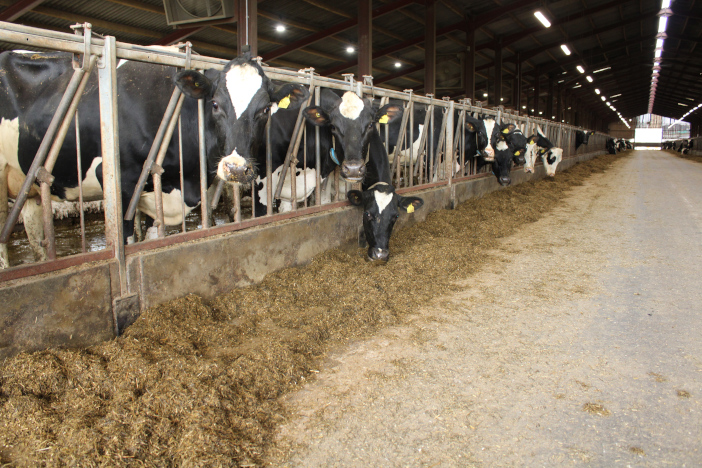
Established in 1940, farmers and contractors, Metcalfe Farms has developed a system that makes full use of the slurry generated by its 1,300 head of Holstein milkers. With over 1,400ha, an on-site, slurry fed, anaerobic digester, two Vogelsang separators and a fleet of 19 New Holland tractors, the farm is at the cutting edge of slurry management.
Richard Metcalfe explains that slurry was not always handled in this way and that, through growth, the farm was keen to make more of its slurry.
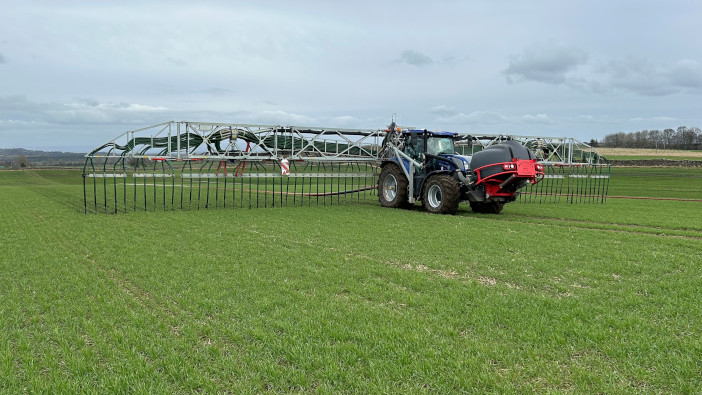
“We had contractors for years but, as the herd increased and we acquired more land, it was tricky to find a reliable service, so we took it on ourselves by investing in three Vogelsang 24m BackPac applicators and a selection of three smaller 12m dribble bars,” he says.
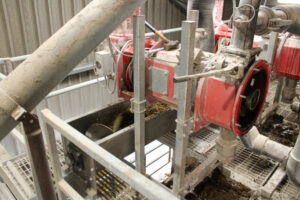
Installing two Vogelsang XSplit separators has led to the farm developing a green bedding system which has provided a cost saving. With the solid faction being used for bedding, it reduces the amount of slurry being fed to the digester. However, there is still more than enough to provide the farm with a nutrient rich digestate.
“Our rotary parlour requires a lot of water, so managing our slurry and waste water had become more of a challenge. Since installing the separators, the slurry is channelled underground to a reception pit and pumped up into the AD plant. Some gets separated at source for green bedding, with the liquid faction fed back into the digester,” he explains.
Demand for the liquid faction is high and 70,000cu m of digestate is applied every year. Both the farm and the contracting arm of the business make good use of the nitrogen rich, liquid digestate.
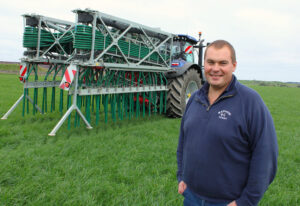
“We have a five cut silage system, so we are applying digestate roughly every five to six weeks. We also apply it to our own crops, including wheat, barley and oilseed rape (OSR).” he says.
The application season starts in February on grassland. In early spring, slurry is applied to the farm’s arable crops before moving back to grass application after first cut.
“We apply digestate to OSR in August, straight after we have drilled, to help it get away. It also helps with cabbage stem flea beetle,” he says.
The typical rate of application is between 20 and 30cu m/ha and this is dependent on the nutrient value of the digestate and what the soil needs.
“We soil test regularly, together with our digestate analysis to calculate the optimum application rate. Using flow meters, and the auto shut off on the Vogelsang dribble bars, enables us to be as accurate with slurry and digestate as we would be with fertiliser,” he says.
The Vogelsang BackPac applicators feature auto shut off to reduce the spreading width to 18m, which enables tractors to run in between 36m tramlines. The booms can be further reduced to operate at 15m, although with purpose built 12m applicators in the fleet, it is rare that this is needed.
“We bought our first Vogelsang 24m in 2017 after we had moved away from using a contractor in 2016. We also bought a 12m applicator and this was sufficient for our farm, but, as word got around, we started offering slurry application as a service and bought two more Vogelsang BackPac’s in 2022 and 2023,” he says.
Vogelsang’s BackPac design is centrally mounted on the tractor to reduce movement and improve accuracy. The arms fold quickly and neatly behind the tractor to make access to tighter spaces easier for operators.
The BackPac has 300mm drop pipes which allow the slurry to travel 150mm each way, so there is no crop striping or banding. Some applicators have a 500mm spacing so there is a gap in the middle that doesn’t get the benefit of the slurry.
“The accuracy is good and the parts have been hardwearing. We use dribble bars rather than a trailing shoe because we operate on a wide variety of soil types and gradients of land. Vogelsang has a UK parts department that can get us what we need off the shelf, rather than having to wait for imports. This is a big help, because if we need to apply slurry we don’t want to be waiting for weeks,” he says.
The majority of applications are carried out using an umbilical system with a mixture of five and six inch pipe, Slurryquip and Wox reelers, and Wox hose humpers to spread on arable tramlines.
“We run a fleet of New Holland tractors and are lucky to have dealer Russells based here on our site. The BackPac sits well on the T7. 270 and is very stable during application and transport. We have four teams now, so during the green harvest we can have more than eight tractors dedicated to slurry and digestate application,” he says.
To spread in remote areas or when there is a higher than average demand, a SlurryKat mobile steel tank is used as a nurse tank. This, and six SlurryKat tankers, has led to contracting in a radius of 50 miles from the business’s base in North Yorkshire.
 The scale of the operation is unlike most contracting businesses. The site is still expanding, and near to the digester, which was installed in 2014, there is also a carboniferous Limestone Quarry which supplies aggregates across the North East and Yorkshire.
The dairy herd and stubble to stubble contracting business remains at the heart of the operation, with the business using its Washford Farm home base as a showcase for its services.
“We like to think that by operating a modern, productive farm with the latest technology that we can demonstrate to our customers, that we share their passion for farming well. With ever increasing costs and tight margins it is important to make the most of what you have, and we like to think that our slurry system is testament to this,” he concludes.