


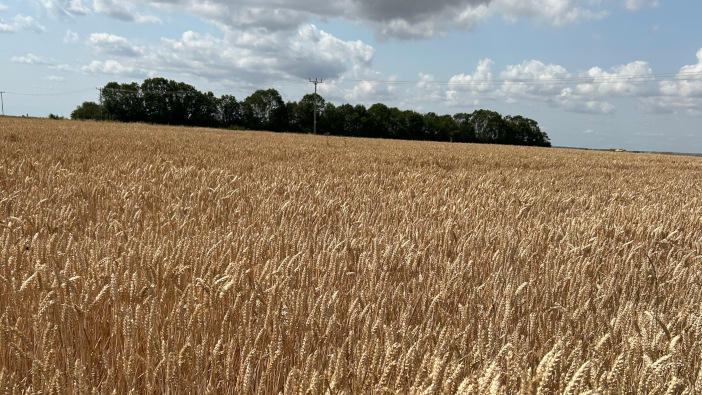
Sparkler, a new Group 4 soft wheat with a very high UK treated yield of 106%, has joined the 2026/27 Recommended List (RL) as the highest yielding UK soft feed variety, confirms Kurtis Scarboro, crop manager for Elsoms Seeds.
He says: “With a powerful genetic background combining Graham and LG Skyscraper in its parentage, Sparkler offers growers the benefits of both a very high treated and untreated yield. Historically, Graham performed very strongly in the West, whilst Skyscraper dominated the North of England and Scotland for many years, so we’re very excited to see Sparkler continue that impressive lineage in both those key regions and throughout the rest of the UK.”
The variety scored 7.2 for septoria resistance, giving it the second highest score on the RL behind another Elsoms variety, Mayflower. A 7 for yellow rust was also impressive in a year when high disease pressure led to many varieties being downgraded.
“Sparkler’s wide marketability, based on both its suitability for UK distilling and recent approval for UKS export, gives it a key advantage over other Group 4 soft wheats,” Kurtis adds.
After three years of testing, it has been rated as high for its distilling quality, outperforming the mean of controls and showing good early vigour for a good specific weight of 76.7kg/hl. Its high tillering capacity enables it to produce a lot of straw.
“With distributor support for the variety building nicely and high expectations ahead we are confident that Sparkler will attract the attention of wheat growers to continue the process already begun by another Elsoms variety, Bamford, in re-addressing the balance of Hard and Soft wheat currently being grown in the UK” concludes Kurtis.
The farmer’s view
Supporting the AHDB’s recommendation on Sparkler, Lincolnshire based arable farmer Vic Barker, who farms 222ha on soils ranging from heavy loam to light silt loam, got an early opportunity to evaluate the new Group 4 and was impressed with its performance during a very challenging season noted for prolonged dry conditions.
He says: “We drilled 6ha of Sparkler at a seed rate of 175kg/ha in early December into two fields, following crops of cabbages and parsnips respectively. Establishing well, the crop showed tremendous early vigour, wintered well, then kicked on again in early spring following its first split of nitrogen applied at a rate of 80kg/ha on March 3rd.”
He explains that they utilised a belt and braces approach for the new variety with both T1 and T2 sprays built around a strong tank mix that included both Revystar (mefentrifluconazole + fluxapyroxad) and Stabilan (chlormequat chloride) – a PGR used to prevent lodging and strengthen plant stems.
Vic says that the variety was straightforward to manage, fitting nicely into the normal spray pattern and all went smoothly through spring and early summer. However, by June 14th at T3 applications, the absence of any significant rainfall had become a serious concern.
“Harvesting in the second week of August, Sparkler was our highest yielding winter wheat from 5 varieties grown in 2025, recording an average yield of 9.76t/ha – a great result given the near drought conditions,” he says. “In terms of my initial observations, its ability to get away quickly could potentially make Sparkler a good variety for late drilling. It tillered well, producing a lot of straw and coped better with the dry conditions than some of our other varieties.
“For 2026 we’ve gone with an earlier drilling date and increased our drilled area to 10ha. Assuming different weather challenges next year I’m sure we’ll know a lot more about Sparkler by next harvest. It’s early days, but I certainly like what I’ve seen so far and its inclusion on the new RL looks fully justified” he concludes.
A future in distilling
With very high importance linked to Sparkler’s future distilling potential, Nick Pitts, supply chain sustainability manager at the Scottish Whisky Research Institute (SWRI) has been testing the new Group 4 soft wheat in recent months.
He says: “The SWRI is the industry’s research and technology organisation, conducting forward-looking studies to support our members, who represent the majority of the industry. We run a comprehensive testing programme covering all stages of whisky production; from raw materials like wheat and barley to bottling, ensuring long-term sustainability.
“Distillers prefer soft wheats of at least ‘Medium’ quality, so the addition of Sparkler to the RL as a ‘High’ distilling variety – alongside other varieties such as Solitaire – is welcome. Sparkler has consistently delivered high alcohol yields during testing, offering farmers and distillers a strong option for grain distilling,” he concludes.