

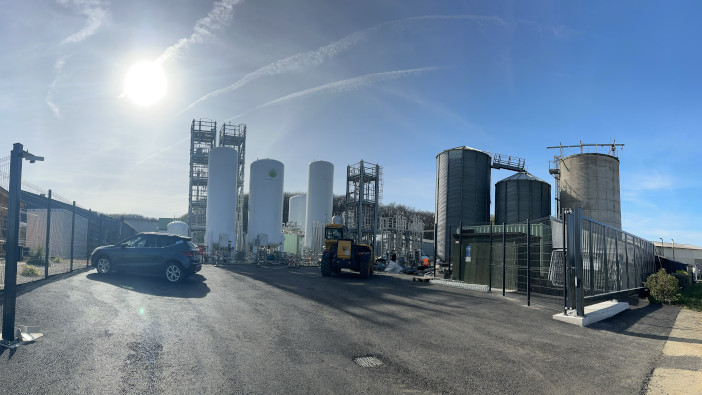
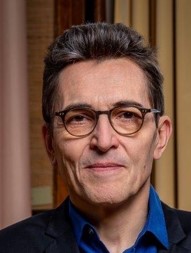
French agritech company Sublime Energie is developing on-farm technologies to accelerate local supply chains of liquid natural gas and carbon dioxide. It recently revealed its Charlie project in Plélo, Côtes-d’Armor, Brittany, a combination of both on-farm liquification and a central processing hub.
Working with growers already producing biomethane from digesters, the business produces systems to liquefy the gas on farm, before collecting it and transporting it to a local hub where the bioCO2 and the biomethane are separated, upgraded to commercial specifications and utilised within the local area.
The on-farm technology includes pre-treatment. Connected directly to the outbound fittings of the digester, the gases are collected and treated to remove impurities before being compressed, cooled, and combined with the company’s patented carrier agent. The compression and refrigeration process reportedly increases the energy density of the biomethane by up to 200 times.
According to Bruno Adhémar, founder and CEO, the agent is fully recyclable and is removed from the final product when the CO2 and methane are separated, meaning that it can be delivered back to the farm to be used again.
Digestate is also removed at the farm, meaning that this remains available to be further separated into liquid and solid fractions and used as a high-nitrogen organic fertiliser.
A circular system
To minimise potential emissions within the system – although trucks will hopefully be run on the liquid biomethane produced – the supplier farms will be within a 50km radius of the central hub. Once delivered and separated, the biomethane is put through a cryogenic distillation system that reduces the temperature further to -160°C, producing commercial-grade liquid biomethane that can be used for heavy transport on-site and on surrounding farms to fuel machinery.
“The separated bioCO2 can also be used in the agrifood sector, whether it’s in beverages, or in greenhouse horticultural production,” Bruno explains.
Sublime Energie states that the combined use cases for the system can go some way to significantly reducing the greenhouse gas emissions in rural areas and across other industries. The use of liquid biomethane as a fuel source for heavy equipment could reduce vehicle emissions by up to 85%, especially important for sectors where electrification is challenging due to the size and required autonomy. It also provides a sustainable source of bioCO2 for the food and beverage industry, offsetting the use of fossil fuel derived CO2.
It also retains the use of digestate as an organic fertiliser, helping growers to cut back on synthetic products, which not only increase Scope 3 emissions for farming businesses, but have also seen various price shocks due to the global events in recent years.
Another benefit is the reduction of livestock emissions. Bruno says that the preferred feedstock for the system is slurry, with small amounts of crop to meet the desired energy output. By utilising slurry, growers can significantly reduce the methane emissions on their farm as it is kept undercover.
The current setup is designed around farms producing 50cu m/hr of biomethane, possible for farms with around 150-200 cows, with collections estimated to take place twice a week. With ten farms producing at this rate, it’s estimated that each central hub could produce 3,000t of liquid biomethane and around 5,500t of liquid bioCO2 each year. According to Bruno, the process of integrating the system on farm is relatively simple, even with those already running digesters.
“These units can last more than 40 years in some cases, so we have to ensure that any addition can integrate seamlessly,” he explains.
 Road to commercialisation
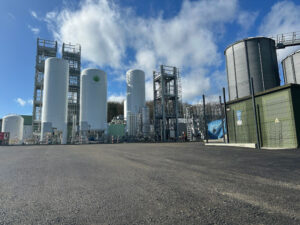
Installed on the Gazéa farm, the Charlie demonstrator was unveiled earlier in April and has an annual capacity of 180t of liquid biomethane and 300t of liquid bioCO2. Production is due to begin this year, following a period of testing.
It followed a period of four years of development, following the installation of the Bravo demonstrator, which proved that on-farm liquification could be done. Now, Sublime Energie is beginning work on the Delta project, which will put into practice the central hub idea. Around a dozen farms will be involved, feeding liquid biomethane and bioCO2 into a central hub.
Sublime Energie is therefore entering a new round of fundraising, with the aim of raising €20m. Work will take place throughout 2027, with Delta expected to be working before the end of 2028. Broader commercialisation is the end goal, however, and Bruno says that he sees great potential, not only on mainland Europe, but in the UK.