


Farm Contractor & Large Scale Farmer
    Twitter LinkedIn
    • FREE Email Newsletters
    • About Us
    • Advertise
    • Subscribe
    • Contact Us
    Twitter LinkedIn
    Podcast
    Farm Contractor & Large Scale Farmer
    • News
      • Arable & Agronomy
      • Dealership News
      • Environmental Land Management Scheme/Policy
      • Event News
      • Health & Safety
      • Machinery
      • People
      • World News
    • Farm Machinery
      • Amenity & Maintenance
      • Cultivations
      • Drilling
      • Grassland Equipment
      • Harvesting
      • Muck & Slurry
      • Sprayers
      • Telehandlers
      • Tractors
      • Tractor of the Year
      • Tyres & Tracks
      • Whatever happened to?
    • Precision Farming
    • Markets & Policy
    • Profiles
      • National Arable and Grassland Awards
      • Company Profiles
      • Reader Profiles
    • Livestock
      • Beef
      • Dairy
      • Sheep
    • Magazines
      1. September 2026
      2. August 2026
      3. 2026 Drills and Seeds supplement
      4. July 2026
      5. June 2026
      6. May 2026
      7. April 2026
      8. March 2026
      9. 2026 Tyre Developments supplement
      10. February 2026
      11. January 2026
      12. December 2025
      13. November 2025
      14. 2025 Agritechnica preview
      15. October 2025 issue
      16. September 2025 issue
      17. August 2025 issue
      18. 2025 Drills and Seeds supplement
      19. July 2025 issue
      20. June 2025 issue
      21. Cereals event guide 2025
      22. May 2025 issue
      23. April 2025 issue
      24. March 2025 issue
      25. 2025 Tyre Developments supplement
      26. February 2025 issue
      27. National Arable and Grassland Awards supplement
      28. January 2025 issue
      29. December 2024 issue
      30. November 2024 issue
      31. October 2024 issue
      32. September 2024 issue
      33. August 2024 Issue
      34. 2024 Drills and Seeds supplement
      35. July 2024 Issue
      36. Cereals Supplement
      37. June 2024 Issue
      38. May 2024 Issue
      39. April 2024 Issue
      40. Tyres and Tracks Supplement
      41. March 2024 Issue
      42. National Arable & Grassland Award – Meet the Finalists
      43. February 2024 Issue
      44. January 2024 Issue
      45. December 2023
      46. Agritechnica Preview Supplement
      47. November 2023
      48. October 2023
      Featured

      September 2026 issue available now

      By Matthew TiltSeptember 1, 2026
      Recent

      September 2026 issue available now

      September 1, 2026

      August 2026 issue available now

      August 2, 2026

      2026 Drills and Seeds supplement available now

      August 1, 2026
    • Events
    • Podcast
    Farm Contractor & Large Scale Farmer
    Arable & Agronomy

    Miscanthus could be a viable cropping option for flood-prone land

    Matthew TiltBy Matthew TiltDecember 7, 20233 Mins Read
    Facebook Twitter LinkedIn Email

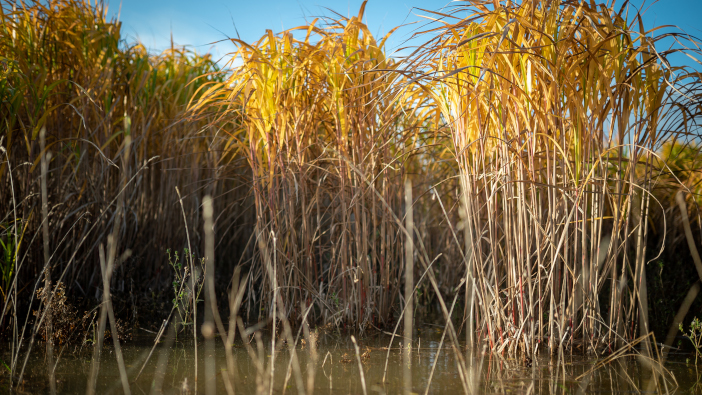
    A new study from the Institute of Biological Environmental and Rural Sciences (IBERS) at Aberystwyth University has found that the perennial crop miscanthus can thrive on waterlogged fields; providing soil stability and strong yields despite excess water.

    Lead author Dr Jason Kam explained that crop quality is not compromised by flooding. “There is no significant difference in yield and other physiological development. Observed height and tiller number have no differences between winter flooded and non-flooded ground.

    “Because of miscanthus’ perennial nature, annual planting is not needed. This therefore reduces soil disturbance to a minimum. The structure of miscanthus rhizome and root helps to stabilise soils, making it more resilient against flood-caused soil erosion.”

    Rob Meadley, who farms in East Yorkshire, grows twelve hectares of miscanthus on varying, flood-prone land that previously struggled to produce viable arable crops. He originally planted in March 2012, which was followed by the wettest April on record, and further bad weather in June.

    He explained that the 2014 harvest was also impacted by the legacy of flooding and a lack of weed control. “Arable crops would never have survived the conditions that the miscanthus was exposed to, and we didn’t lose any money on inputs. The annual yield quickly recovered, and in 2017 and 2020, we had bumper harvests of over 13t/ha.”

    201420152016201720182019202020212022
    Tonnage9.78100.66143.64157.54139.94153.41159.36134.61154.25
    Yield (tonnes/ha)0.818.3611.9313.0811.6212.7413.2411.1812.81

    The area has also enabled Mr Meadley to square off an arable field next to it, and the minimal maintenance required has been ideal due to the field’s location two miles from the farm.

    “The crop has also helped to naturally control blackgrass in that area,” he explained.

    He added that when he established the miscanthus, there were no other options for the patch of ground that would have been as profitable. “Back in 2012 when we decided to plant Miscanthus, the principle was looking at the whole farm net margin and identifying the risk in this area.

    “It wasn’t performing as well as other parts of the farm and Miscanthus was 100% the right decision for it. The only other option for that land would have been environmental grass, but Miscanthus beats this hands down from a net margin point of view.”

    Terravesta chairman, William Cracroft-Eley, established the crop in 2015 on flood-prone ground, having previously grown in on other areas of the farm. At the first harvest, the crop was four feet underwater due to flooding. As a result, he left it until the next year.

    “It was a win-win situation because no damage was done to the land, no money was spent on contractors, it wasn’t a loss, because we harvested the crop the following year with the new growth and we hadn’t spent any money on inputs because no fertiliser was applied,” he said

    “Miscanthus does well on all types of land, and like any crop, it does better on more favourable land. But, it also thrives where other crops fail, and this could be for numerous reasons, and in this case, it’s become an ideal solution to water-logged land which would otherwise be unprofitable.”

    Farmers can now also benefit from new Sustainable Farming Incentive payments, with up to £2,645 per year on a ten-hectare crop available. According to Terravesta, this now brings forward the breakeven point to two years earlier, with a net return on a ten-hectare plot being £930 per hectare.

    For more information go to www.terravesta.com

    Tweet
    Share
    Share
    Pin
    Share. Facebook Twitter LinkedIn Email
    Previous ArticleAgritechnica sees new tyre ranges from Trelleborg
    Next Article South West AgriTech Showcase returns
    Matthew Tilt
    • Twitter
    • LinkedIn

    Machinery editor for Farm Contractor & Large Scale Farmer. Matt has worked as an agricultural machinery journalist for five years, following time spent in his family’s Worcestershire contracting business. When he’s not driving or writing about the latest farm equipment, he can be found in his local cinema, or with his headphones in, reading a good book.

    Read Similar Stories

    De Sangosse and ADAS launch new phosphate stewardship hub

    September 1, 2026

    Second Harvest Report shows yield and quality variation

    August 20, 2026

    Hybrid oilseed rape impresses in North Yorkshire

    August 13, 2026
    Most Read Stories

    Vogelsang joins forces with BeTec

    September 2, 2026

    Michelin adds tracks to its portfolio and sells off Camso brand

    September 2, 2026

    Agrifac introduces new electric driveline platform

    September 2, 2026
    Farm Contractor & Large Scale Farmer

    The UK's leading agricultural machinery journal

    Twitter LinkedIn
    © 2024 MA Agriculture Ltd, a Mark Allen Group company

    Privacy Policy | Cookies Policy | Terms & Conditions

    • Farmers Weekly
    • AA Farmer
    • Poultry News
    • Pig World

    Type above and press Enter to search. Press Esc to cancel.