


Farm Contractor & Large Scale Farmer
    Twitter LinkedIn
    • FREE Email Newsletters
    • About Us
    • Advertise
    • Subscribe
    • Contact Us
    Twitter LinkedIn
    Podcast
    Farm Contractor & Large Scale Farmer
    • News
      • Arable & Agronomy
      • Dealership News
      • Environmental Land Management Scheme/Policy
      • Event News
      • Health & Safety
      • Machinery
      • People
      • World News
    • Farm Machinery
      • Amenity & Maintenance
      • Cultivations
      • Drilling
      • Grassland Equipment
      • Harvesting
      • Muck & Slurry
      • Sprayers
      • Telehandlers
      • Tractors
      • Tractor of the Year
      • Tyres & Tracks
      • Whatever happened to?
    • Precision Farming
    • Markets & Policy
    • Profiles
      • National Arable and Grassland Awards
      • Company Profiles
      • Reader Profiles
    • Livestock
      • Beef
      • Dairy
      • Sheep
    • Magazines
      1. May 2026
      2. April 2026
      3. March 2026
      4. 2026 Tyre Developments supplement
      5. February 2026
      6. January 2026
      7. December 2025
      8. November 2025
      9. 2025 Agritechnica preview
      10. October 2025 issue
      11. September 2025 issue
      12. August 2025 issue
      13. 2025 Drills and Seeds supplement
      14. July 2025 issue
      15. June 2025 issue
      16. Cereals event guide 2025
      17. May 2025 issue
      18. April 2025 issue
      19. March 2025 issue
      20. 2025 Tyre Developments supplement
      21. February 2025 issue
      22. National Arable and Grassland Awards supplement
      23. January 2025 issue
      24. December 2024 issue
      25. November 2024 issue
      26. October 2024 issue
      27. September 2024 issue
      28. August 2024 Issue
      29. 2024 Drills and Seeds supplement
      30. July 2024 Issue
      31. Cereals Supplement
      32. June 2024 Issue
      33. May 2024 Issue
      34. April 2024 Issue
      35. Tyres and Tracks Supplement
      36. March 2024 Issue
      37. National Arable & Grassland Award – Meet the Finalists
      38. February 2024 Issue
      39. January 2024 Issue
      40. December 2023
      41. Agritechnica Preview Supplement
      42. November 2023
      43. October 2023
      Featured

      May 2026 issue available now

      By Matthew TiltMay 1, 2026
      Recent

      May 2026 issue available now

      May 1, 2026

      April 2026 issue available now

      April 1, 2026

      March 2026 issue available now

      March 2, 2026
    • Events
    • Podcast
    Farm Contractor & Large Scale Farmer
    Arable & Agronomy

    New NIAB research demonstrates efficacy of mechanical weeding

    Matthew TiltBy Matthew TiltOctober 24, 20233 Mins Read
    Facebook Twitter LinkedIn Email

    According to new research conducted by NIAB, a combined approach to weed control can help to reduce reliance on chemical inputs. Non-chemical approaches, including mechanical hoes, have the potential to offset herbicide resistance and reduce reliance on chemical plant protection in conventional cropping.

    The results are part of an EU-funded Horizon integrated weed management project, with research undertaken by NIAB research agronomist Will Smith, alongside weed biology and management specialist John Cussans. The project looked at different methods of weed control, specifically control of blackgrass in winter wheat.

    Their ultimate aim was to look at ways to reduce herbicide usage in line with impending controls on the use of pre-emergence products and chemical applications, balanced with the EU-wide policy to reduce usage by 50% by 2030. While these do not directly impact the UK, similar targets are anticipated in this country, as continued usage could impact trade with member states.

    “Development in the weed control sector is going to be led by non-chemical solutions,” said Mr Smith. “This means consideration of cultural, non-chemical and biological pathways. We also need to look at continued herbicide development, particularly the potential to offset resistance.”

    Cultural factors include crop rotation, crop choice and drilling dates, while biological solutions include biocides and biostimulants, as well as non-synthetic herbicides such as organic acids. Particularly interesting to the project was inter-row hoeing, enabling more aggressive cultivation which can remove more established weeds.

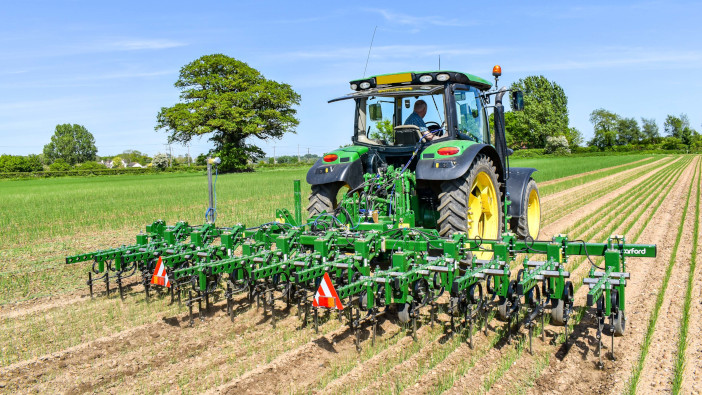
    Using a Garford Farm Machinery Robocrop hoeing unit, the project found that there was an additional 15% control of blackgrass heads when mechanical weeding was added to a herbicide programme when working in narrow rows. The efficacy was doubled on wider rows.

    “Inter-row cultivation adds an appreciable level of control of between 15-25% when combined with herbicides,” explained Mr Smith. “The sweet spot of course is to use IRC in combination with reduced chemical inputs to meet the reduction targets.”

    Looking at the margins, the research found that a combination of inter-row hoeing and herbicides is comparable to just using chemical controls, while in low pressure areas, the use of just an inter-row hoe may be preferential. Mr Smith added that the key is changing mindsets, as many conventional growers do not consider mechanical weeding as a viable option.

    “What our research indicates is that growers can achieve at least the same or marginally better margins over weed control than currently used methods, with the scope to deliver effective weed control while reducing reliance on chemical solutions,” he said.

    Crucially, even if new equipment is purchased to handle mechanical weeding, the additional costings have been calculated at £15 per hectare, based on two passes. Larger scale operations may even see this drop to below £10.

    “The research demonstrates the benefits of integrating our range of precision-guided hoes in broadacre arable crops, for both conventional and organic systems,” said Allan Knight, Garford Farm Machinery technical sales and marketing manager.

    As agrochemicals are withdrawn from the market, more and more conventional farmers are beginning to appreciate hoes as a more appropriate solution, in combination with other weed controls.

    “While previously non-chemical approaches have been seen as an expensive add-on to conventional herbicide programmes, the addition of mechanical weed control products as part of an integrated weed management system offers a cost-effective and sustainable solution to growers,” he concluded.

    For more information go to www.garford.com

    Tweet
    Share
    Share
    Pin
    Share. Facebook Twitter LinkedIn Email
    Previous ArticleDoncaster dealer awarded expanded Merlo territory
    Next Article Severn Trent trials show 50-tonne maize yields, alongside water quality benefits
    Matthew Tilt
    • Twitter
    • LinkedIn

    Machinery editor for Farm Contractor & Large Scale Farmer. Matt has worked as an agricultural machinery journalist for five years, following time spent in his family’s Worcestershire contracting business. When he’s not driving or writing about the latest farm equipment, he can be found in his local cinema, or with his headphones in, reading a good book.

    Read Similar Stories

    Cheffins to host two auctions on behalf of Velcourt

    May 6, 2026

    New NAAC contracting prices highlights impact of fuel costs

    May 6, 2026

    More than £2m grossed as Cheffins vintage auctions get underway

    April 30, 2026
    Most Read Stories

    Kubota appoints Hughes Agri Oswestry to its dealer network

    May 7, 2026

    Winners announced at National Women in Agriculture Awards 2026

    May 7, 2026

    Cheffins to host two auctions on behalf of Velcourt

    May 6, 2026
    Farm Contractor & Large Scale Farmer

    The UK's leading agricultural machinery journal

    Twitter LinkedIn
    © 2024 MA Agriculture Ltd, a Mark Allen Group company

    Privacy Policy | Cookies Policy | Terms & Conditions

    • Farmers Weekly
    • AA Farmer
    • Poultry News
    • Pig World

    Type above and press Enter to search. Press Esc to cancel.