


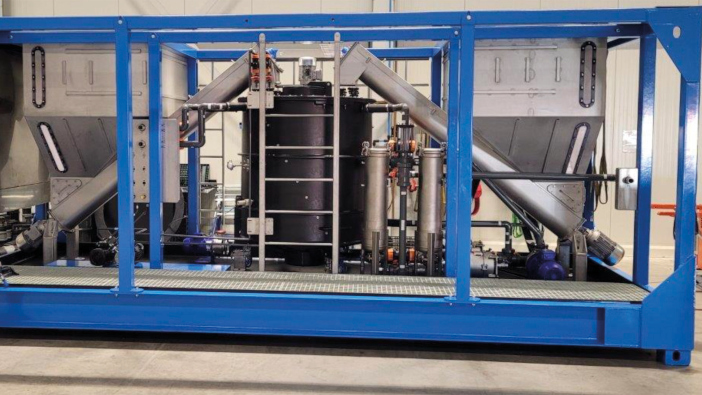
Part of the Agro-Vital offering, Triplex is designed to be a bespoke, sustainable foliar solution
Andrew Sincock, managing director of Agro-Vital UK, kickstarted the Triplex launch event – held on his own farm near Chepstow – by explaining that the company aimed to treat nutrition differently. “Sustainability is the ability to continue indefinitely. A lot of talk is about regeneration, but we can’t do this forever; eventually, we will hit a ceiling and will need to sustain that.”
The Triplex system is a continuation of the company’s liquid portfolio, which was developed in response to the changing legislation in the Netherlands, which forbids granular applications within 10m of watercourses; liquid and foliar nutrition, however, can be applied within 1m.
“There’s a recognition that one-size-fits-all farming is no longer fit for purpose,” he says. “We want to offer made-to-order, complex, small-batch liquid and foliar solutions.”
Soil or sap analysis is fed into the system to produce a bespoke nutrition formulation, with additional details about soil types and crop rotation to help build a complete picture of what the soil has in stock, and what it requires. This will incorporate both macro nutrients and trace elements, which are produced in batches to be used as a starter liquid fertiliser or as a top-up foliar solution.
The company currently has two machines in the Netherlands, with a single unit in the UK, with aims to offer Triplex as a service initially, before offering the machine to contractors across the country.
“We can’t meet the demand of all farmers in the UK,” says Andrew. “But we can build interest, and a contractor would be covering a large enough area to justify the expense of the machine. It could be an interesting area of diversification.”

The long-term goal is to have local hubs with strong, actionable knowledge about local farms and soil types. Agrii has reportedly already expressed interest in the system as another solution for its customers, along with Hutchinsons, Cobb Agri and Pearce Seeds.
Rapid formulations
The machine can produce a 2,000kg batch in around 20min. Andrew notes that there are multiple formulations ready to go, and deliveries of these can reach UK farms in two to three days. Unknown formulations take longer, as the sample results are sent to the Netherlands for testing – ensuring that there are no safety or nutrient lock-up issues with the formulation.
“New formulations will take around a week, maybe 10 days,” says Andrew. “However, every time a new mix comes through the system, this will be available to growers going forward, so we will quickly build up a varied portfolio to suit most growers’ needs.”
The formulations are delivered at the correct dilution, meaning they can be applied neat at a lower rate than some other nutrient options. The dilution also mitigates concerns around machinery wear and corrosion.
Can it be scaled?
Those in attendance were impressed with the system; there were concerns about the scale of the system. One grower pointed out that small batches would mean a significant amount of IBCs arriving on the farm, which would then need to be disposed of at a cost to the grower.
Andrew noted that the company could produce large batches if required, and there would be options for other delivery solutions as long as growers had suitable storage on-site. Since the visit, the company has also invested in storage tanks of their own, which can be filled in around half a day.
“We’re still trialling this and learning about where it fits within the UK market,” notes Andrew. We wondered whether a direct injection system, as seen on sprayers from Amazone and Knight Farm Machinery, could be a solution; dropping small amounts of neat product into the sprayline to be applied based on precision maps.
“It could be used like this,” explains Andrew. “However, the application rates are typically around 150-300 litres/ha, so it’s unlikely that this would be the most efficient method.”
According to Carl Gibbard, technical accounts manager, Triplex is not designed to replace full-scale applications; instead, it’s another tool to help growers treat fields, or even part fields in a bespoke manner. “We used to put hedgerows in to separate soil type, then as the scale of machinery increased, we ripped those out. We’re now seeing more variations in crop quality and nutrient uptake.”
Adding to this, Andrew notes that the formulations can be adjusted to account for any additional applications growers might make. Using phosphorus as an example, he says that granular phosphorus is typically much cheaper than liquid formulations, so he would expect growers to apply it separately.
He added that growers needed to rethink their nitrogen use efficiency figures, as this only considers the nitrogen applied to the crop. “Growers will see a 70-80% NUE figure and be happy with that, but when you also take into account the nitrogen present in the soil, the NUE is normally around 28% lower – a significant drop that shows we’re not handling nutrient applications effectively.”