


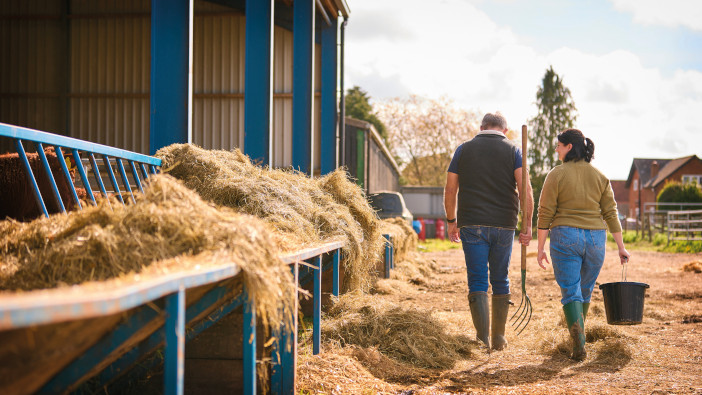
A new white paper from staff development service, Real Success, is calling for an industry-wide and on-farm reset in how farming treats, develops and leads staff
Paul Harris, founder and managing director of Real Success, started the launch of the paper by saying that people are a company’s most important asset. “The industry is facing its biggest crisis currently: how to find and retain labour,” he explained. “However, it is not a people gap. We believe it is a mindset gap, and some brave decisions and changes will be needed to address this.”
While farming has invested in technology, crop and animal genetics, and systems for sustainability, Paul believes that the same cannot be said for staff, and all the good work done on farms for animal welfare and sustainability will be irrelevant if there is no working on farm. He added that while work needed to be done to make farming more attractive to school leavers and job seekers, the industry also needed to marry this with better treatment on farms.
“We cannot criticise the next generation of workers for not wanting to work 100hrs/week or 10 or 12 days without a break,” he said. “Tired, frustrated workers are a risk to themselves, to machinery and to livestock, and with an ageing workforce, we cannot afford not to pull in and retain staff.”
In the white paper, it’s stated that the next generation of workers is looking for something meaningful, where they can see that they have made a difference. There is potential to make farming hugely appealing in this regard, as it remains one of the few industries where you can see the results of your work every day.
However, more farms need to understand the concept of a work/life balance, as well as providing clear roles and expectations, with opportunities for progression. While there will no doubt be concerns about the potential cost of this, Paul highlighted that on average it costs a year’s salary to replace a worker, meaning that businesses with a high staff turnover are unwittingly making margins even tighter for themselves.
Industry wide solutions
The paper calls for an industry-wide programme focused on people management. This would start with training made available for farm managers around the fundamentals of working with people, training them to communicate effectively, delegate work and manage conflicts, as well as conduct regular reviews to address areas of improvement and motivate staff.
It also notes that pathways need to be in place to enable farm staff to progress to leadership positions, with training in management skills that complement technical ability.
Addressing one of the wider problems within the industry, Real Success also hopes for sector participants to recognise that produce requires a fair price, which will create additional margin and support investment in staff.
Standards for working conditions need to be brought into place, creating a basic expectation for bathroom facilities and common areas on the farm, as well as standardised working hours, breaks and rest periods. We asked Paul how this could be implemented on large arable farms and contracting units, where weather windows sometimes necessitated long working hours in the peak seasons. He acknowledged that there was no silver bullet in this regard, but that this should be considered within a holistic view of farming.
“There might be some questions to ask about why you can’t get onto the field at certain points of the year, and if technology or new methods might solve this,” he said. “It could be a case of needing more people on staff, which might be more achievable if margins increase. Other options include a more balanced pay structure that evens pay out across both peak periods and the quieter months, so that time off or reduced hours can be negotiated over winter.”
Alongside the industry-wide suggestions, Real Success also calls for a national accreditation to assess farms on their employability status, enabling colleges to place staff securely and support apprentice schemes. This would work alongside inclusion in supply chain assurance, with Real Success already developing programmes with Marks & Spencer and Muller.
Support for the industry

Paul notes that these initiatives are not designed to penalise farms not currently meeting the standards suggested, but to support them and celebrate those businesses meeting the expectations.
Alongside the industry-wide solutions, Real Success would launch a national Careers in Farming campaign to encourage school leavers to consider agriculture and also called for funded regional leadership hubs which would provide practical advice, support and opportunities to visit accredited businesses.
Solutions on farm
Paul concluded by saying that the work would start at home and showcased a farmer action plan; 10 points that he believed all farms could integrate into their businesses to improve staff relations. “For many farms, they simply need a nudge in the right direction because they are doing the majority of this.”
- Protect working hours and rest – exhausted workers make mistakes and lose motivation, so rest days should be protected, work schedules should be planned in advance, and responsibilities shared across the team.
- Improve staff facilities – ensure that break rooms are warm, toilets are clean, and wash facilities are up to standard. Good facilities attract good people.
- Clearly document roles and expectations – clear job descriptions, written expectations and protocols to remove ambiguity and increase accountability.
- Hold better conversations and regular reviews – good communication and regular reviews allow issues to be addressed before they become problems, as well as create clarity, build trust and reveal concerns.
- Recruit for values – instead of hiring bodies, hire for the values the applicant has, such as reliability, a positive attitude, respect for animals or machines, and a willingness to learn. Skills and knowledge can be taught.
- Induct new team members properly – new starters reportedly choose within the first 48hrs whether they feel welcome and confident in the team and within their role.
- Invest in training beyond the technical – many issues on farms come from conflict management. People training can help team members recognise personality styles and encourage team growth.
- Lead safely by example – the UK farming industry has an awful health and safety record. Leaders need to follow procedures and refuse unsafe shortcuts to ensure that the team follows suit.
- Build cultures intentionally – cultures are shaped by how people treat each other, what is praised and what is tolerated. Strong team culture keeps people together when under pressure.
- Think long-term – succession is about building resilience. Documenting systems, training backups and preparing future team leaders can enable farms to be passed down prepared for future uncertainties.
Paul concluded by saying it was vital to get growers and the wider industry on-board, and that we could no longer afford to recruit from within as the labour pool both in UK agriculture, and from abroad continued to shrink.
“This is a burning bridge for the industry, and we cannot continue to move across it without addressing the underlying issues,” he said.