

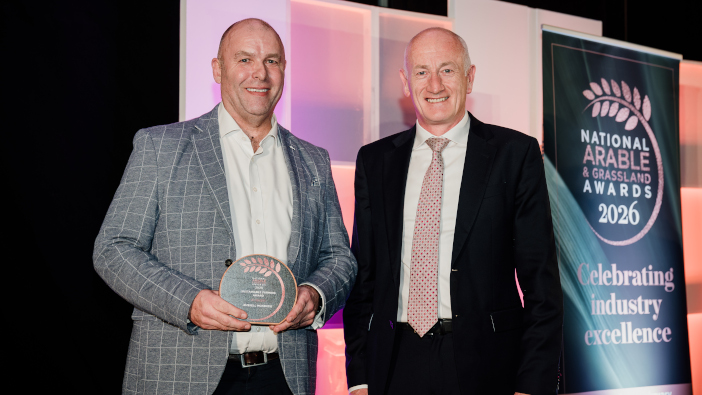
At the fifth National Arable and Grassland Awards, Farm Contractor & Large Scale Farmer and Agronomist & Arable Farmer celebrate the brightest and best within the agricultural industry.
Following his Nuffield Scholarship in 2014, Russell became a quick adopter of no-till practices.
Looking after soils had always been a key focus, but it was his ‘Success with No-till under any conditions’ scholarship that really opened his eyes to what was possible. He realised that he had been building soil organic matter levels and making his soils more resilient in difficult seasons for years.
Since he has become an ambassador for sustainable farming, speaking at the prestigious Rank Symposium on net zero and also being invited to speak on his approach to regenerative agriculture at Bureau Veritas in Paris.
Rightly, this impressed the judges, but more so did his approach in building a system that significantly benefits the environment and biodiversity.
With limited information sources, Russell took matters into his own hands and undertook numerous trials on his own farm, which is still ongoing today.
As well as evaluating variety performance under differing establishment methods, he has tested wheat blends, various input regimes (including nutrient strategies with soil conditioners and biostimulants) and cropping strategies.
By improving soils and keeping its biology fed, Russell has reduced wheat nitrogen application from 220 kgs/ha to 180 kgs/ha.
Straw is chopped to return residues, helping SOM levels rise to between 6.7- 7%. The diversity of cover and catch crops roots keep soil biology functioning, cover crops capturing nitrogen that may have otherwise been lost to the environment.
A good example was a crop of Siskin group 2 wheat, planted after spring beans that achieved 13% protein from an application of 185 kgs N/ha and a yield of 11.5 tonnes/ha. Through carrying out soil mineral nitrogen tests after cover crops, he has regularly found that 34-38 kgs/Nitrogen per ha is being captured that otherwise would have been lost.
When the opportunity arises, he also integrates sheep into the rotation to graze cover crops to start a natural recycling process, maintaining a circular nature to his cropping strategy
Part of his trials programme has allowed him to get more out of phosphate fertilisers. Over the past four years, he has been comparing the use of DAP to biologicals Luxor plus or minus Calfite.
The former is a mix of humic and fulvic acid with pidolic acid and L-PGA, which helps scavenge and deliver phosphorus during the spring growing season, the latter is a calcium phosphite product.
Russell is on P indices of minus two to one, and it has been well documented that a significant amount of phosphate in the form of TSP can be locked up after application and not be available to the plant. What he has discovered is that he can still produce high-yielding crops despite a soil index of one.
In his trials, he has regularly seen an uplift in winter wheat of 0.9-1.15 tonnes/ha from the Luxor/Calfite application at GS30. This can be above the responses from DAP, and where equal, it is at a fraction of the cost.
Of equal importance is a reduction in carbon footprint. Russell has partnered with the University of Nottingham’s soil department, comparing his methods to farms employing intensive cultivation practices. It revealed soil organic matter levels were 3% higher, a 20% improvement in water retention and crucially, capturing 30% more carbon with 34% less CO2 emissions from his soils.
That Russell is dedicated to farming in harmony with the environment is beyond doubt. Liquid fertilisers and glyphosate sprays are applied with a molasses-based carbon source to balance the carbon associated with such products.
He is also proud of it. For the last two seasons, he has been growing milling wheat for Wildfarmed, a distinctive, recognisable brand on the supermarket shelf.
The protocols include a restricted nitrogen level, reducing or omitting synthetic inputs, whilst also either growing a companion crop or planting in-field flower strips. All are features that enhance and benefit the environment, and help highlight the work farmers do to put sustainable food on the table.
The National Arable and Grassland Awards are organised by Farm Contractor & Large Scale Farmer and Agronomist & Arable Farmer, in association with BASIS, the National Association of Agricultural Contractors and the Voluntary Initiative.
Our thanks to our sponsors AHDB, QLF and principal sponsors Barclays and Propel Finance.