


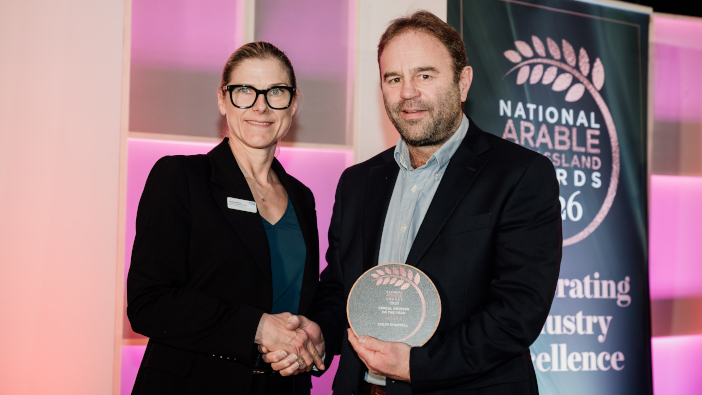
At the fifth National Arable and Grassland Awards, Farm Contractor & Large Scale Farmer and Agronomist & Arable Farmer celebrate the brightest and best within the agricultural industry.
Fourth generation farmer Colin not only runs a highly successful arable enterprise but also a carbon negative one.
For the last 12 years, Crusoe has been the milling wheat of choice, averaging 10.5t/ha with less than 200kgCO2e/t footprint. One reason perhaps why the farm is part of the ADAS Carbon Farm Demo network.
Crusoe might be too risky to grow in the future. Last season it averaged 11t/ha, but he had to use nearer 240kgsN/ha. He has switched part of his wheat area to Loxton for Warburtons.
It is that level of detail that impressed the judges. Colin does just about everything, including the crop walking, supported by two members of staff plus an apprentice.
Taking charge of matters for himself has seen a switch in management approach, the focus now on NUE (nitrogen use efficiency). Keeping roots in the ground over cultivation, with organic composts, has helped him reduce nitrogen use by a third in five years. Wrapping liquid UAN in carbon (using Nurture N and carbon N balancer) alone has boosted NUE efficiency by 10%, he believes.
The result is a considerable saving in input costs. The 24/25 season saw some fields receive just a single fungicide application to combat yellow rust.
A nutritional approach to crop health helped one crop of Bamford achieve 8.5t/ha using just 165kgN/ha with no PGR or insecticide and a £10/ha fungicide spend. Variable rate drilling also helped crop evenness and trim seed costs.
Weeds have been a problem in the past but Colin has amended his rotation to reduce seedbank return. He discarded the recommended maize growing protocol due to its heavy soil movement and use of mined nutrients, opting for roots instead.
Reducing soil-applied nitrogen has also helped Colin reduce herbicide inputs. The previously mentioned crop of Bamford had just one peri-emergence spray.
Considerable thought has been given to the rotation. Wide and diverse, it has helped improve soil structure. VESS scoring has shown topsoils at 1-2 and subsoils 3-4, Colin describes these as a “sponge” that absorbs vast amounts of water in the winter, which can then be released later into the spring when the inevitable drought kicks in.
The rotation includes winter barley for forage using BYDV-tolerant, high biomass hybrid varieties that can be harvested early to ‘walk’ blackgrass off the farm, often sown with a vetch companion.
Premium markets are targeted with seed crops of winter and spring wheat, oats and winter barley. Typical growing costs of wheat in 2025 were £85-£110/t, all in, dependent on market requirements.
Lighter land supports miscanthus, which goes to the nearby power plant at Brigg. Maize, both forage and for AD, vining peas and OSR make up the rotation. This is sown with a three-way companion crop of buckwheat, berseem clover and fenugreek, the big canopy acting as a natural pigeon deterrent during winter.
Winter wheat follows, which in turn is followed by three years of spring cropping, including at least one year of a low-input crop such as spring oats, often grown after a cover crop of clover, Colin aiming to create a living mulch. The last crop of this cycle is often a legume (peas, beans or SFI grass and legume) allowing a return back to milling wheat, meaning nutrients are readily available in the soil, lessening the need for high nitrogen regimes.
Roots have also helped Colin restore degraded land, taking it back into production. A combination of cover, catch and companion crops and minimal disturbance ‘unlocking’ its potential. He notes cultivation is the quickest way of depleting soils of organic matter.
Not content to rest on his laurels, Colin is looking to the future. A young shepherdess now keeps her flock on 32ha of permanent pasture with the view to the grazing of cover crops being incorporated into the system to complement the lack of soil movement.
He has recently also upgraded the old drainage and 40-year-old grain stores, investing BPS payments to help him rein in spending in the future.
The National Arable and Grassland Awards are organised by Farm Contractor & Large Scale Farmer and Agronomist & Arable Farmer, in association with BASIS, the National Association of Agricultural Contractors and the Voluntary Initiative.
Our thanks to our sponsors AHDB, QLF and principal sponsors Barclays and Propel Finance.