


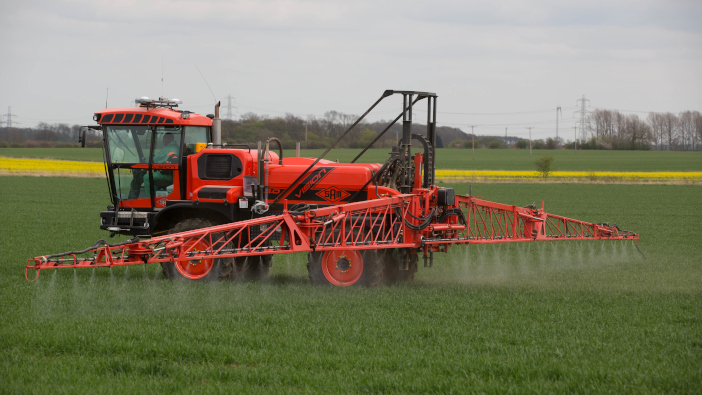
UPL is urging growers to go early with disease control programmes after a survey last year found that three quarters missed a T0 spray due to weather conditions.
While conditions this year continue to be challenging, UPL states that nearly all varieties are susceptible to yellow rust in early spring, thanks to the Yr15 breakdown, while the mild, wet winter has increased septoria risks.
“The problem is that there is so much for farmers to do at the start of the season,” explains Tom Wheelhouse, technical sales manager. “Most farms can’t afford to stand still because of the weather or ground conditions at this time of year.”
The survey found that growers prioritised nitrogen and spring drilling during this period, followed by micronutrient applications and herbicides. Spring fungicide programmes were fifth.
Tom continues: “The issue is tank mix compatibility. Naturally, farmers want to control weeds whilst they are small, or before the label cut-offs. Add in some micronutrition, and there’s a fear that the mix might already be a bit ‘hot’ on the crop, before you consider adding a fungicide.”

The survey results backed this up, with respondents highlighting concerns over crop effect and tank mix compatibility as reasons for not adding more products to tank mixes.
Tom believes that this could be a place for the new plant health elicitor products. “A product like Iodus (laminarin) is very benign in a tank mix but offers good benefits to disease control, especially Septoria. There are no reported crop safety issues with Iodus, and it has broad tank-mix compatibility.
“Iodus stimulates the plant’s defence mechanisms, providing added disease protection right through the season. Its good value per hectare for the disease control you get, which is an important consideration considering the current crop values.”
View from the field
Ben Allard, agronomist at Pearce Seeds, says that his crops are looking good following the favourable autumn growing conditions. He trialled Iodus in early-season disease control programmes a few years ago and now uses it across most of his wheat crops.
The ability to tank mix with other early-season applications was reportedly the deciding factor. “What gave us the confidence to make it my staple T0 product was its longevity. It gives protective activity against Septoria for 6-8 weeks.
“For the last few years, the weather window for applying T0s was so tight that we weren’t able to get them on. When we could apply them, things were delayed, which forced us to go earlier if there was a window in the weather.
“I like to refer to Iodus as a vaccine. The 6-8 week activity gives us a much greater range of timings from pre-T0 to after T0 when we can apply it and still get good activity.”
He doesn’t see it as a replacement to T0 applications, however. Instead, it is an additional option to the few actives available for septoria control and can be mixed with yellow rust chemistry, as well as supporting more expensive chemistry at T1 and T2.