


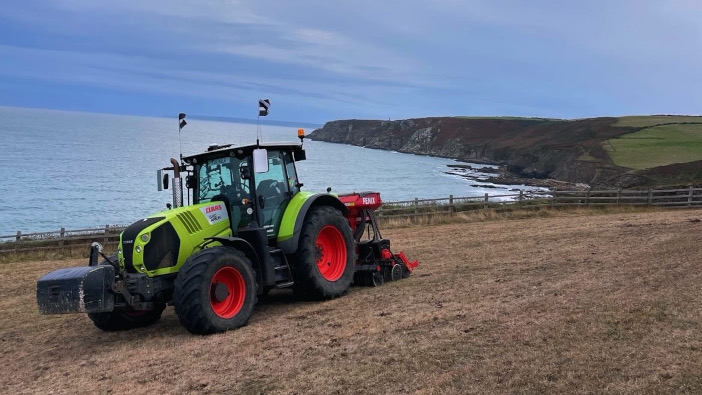
Finding a drill that can cope with a range of seed sizes, soil types and conditions can be a challenge. For most mixed and livestock farmers, this means having a machine capable of sowing seeds as small as clover to as large as wheat and barley. Another requirement is the ability to direct overseed while still being able to plant in ploughed and cultivated land.
WF Gluyas & Son, who farm near Falmouth in Cornwall, were looking for a drill to overseed red clover into their grass leys to reduce their fertiliser use when they purchased a Weaving Fenix drill in 2021. The farm has 700 Aberdeen Angus and Belgian Blue cattle, buying them as calves and finishing them.
They have also developed a handy contracting business thanks to the Fenix drill, according to Adam Tucker, who works for WF Gluyas & Son and operates the machine. He sows 100-150 acres of crops annually for neighbouring farmers on top of the farm’s requirements.
“We were attracted to the Fenix because the metering system was the best one on the market. It is useful for small seeds and quick to calibrate,” says Adam. “It also doesn’t have a metering wheel hanging off the back, which is one less thing to worry about, especially with our small fields. I can back it right into a corner and be away.”
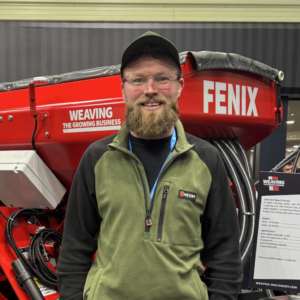 The uptake among local farmers for overseeding SAM3 and GS4 mixtures into herbal leys for Countryside Stewardship (CS) and Sustainable Farming Incentive (SFI) schemes created a demand for a drill capable of sowing into grass leys, which is how the farm grew its contracting service.
“We have sown pretty much everything with it: grass seeds, clover, SFI mixes, stubble turnips. We’ve even sown cereals with it, but because we bought the 32-disc model, the rows are closer together than we’d like for that crop. Even then, the customer was happy with the results,” explains Adam.
Adam uses a 160hp tractor to pull the drill. With the hydraulic fan on their Fenix, he says he can easily operate the drill at 1300 rpm, resulting in significant fuel savings. They also opted for the electric metering system, which allows Adam to change everything from the cab.
“You can adjust the seed rate and fan speed. You can also track how many hectares you have covered and how many kilos of seed are coming out of the metering system. As a contractor, this makes it very user-friendly and easy to create an invoice for the customer.
“The electric metering system also means that once you have calibrated one type of seed, you can save the calibration factor on your phone or note it down. When you change seed species, you have a good base to work from the next time you use that seed type.
“This saves so much time when swapping between different seed types. I quite often get people wanting a few acres of turnips sowing and then a few acres of grass after, so this metering system is perfect for that. It makes it as quick and as easy as it can be to go from grass calibration down to a turnip/kale seed mix, which is a much smaller seed.”
He has never experienced any problems with calibration or seed flow. Even with the small field sizes they typically find in their part of Cornwall, Adam says he can sow up to 50 acres per day with the Fenix.