


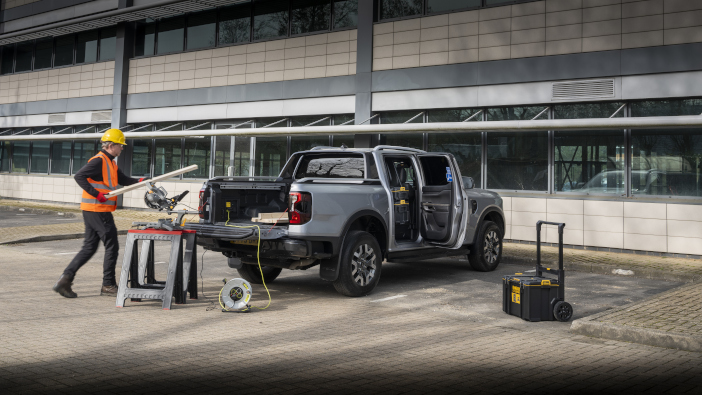
Two-seater Rangers, designed to meet new HMRC rulings on double-cabs, and an electric van that could be more than the name suggests
The changes to double-cab pick-up tax classifications in April last year left business owners with a costly choice. However, Ford aims to bring the double-cab Ranger back into consideration with a new two-seat version, with additional load capacity where the rear seats were previously fitted.
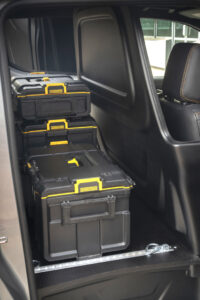
The company has worked to HMRC guidelines to ensure that the new model will be considered a commercial vehicle. The rear seats have been removed, along with the seatbelts and windows. These are replaced with a bulkhead, a loadspace liner and heavy-duty flooring with anchor points. The windows are replaced with aluminium panels. These changes are in place to stop conversions back to four- or five-seater vehicles.
This new design provides approximately 0.8 cu m of additional secure storage, especially handy for valuable items, such as tools, that you do not want to leave in the rear bed. This appears to be the main advantage over the single-cab Ranger.
 It’s available now, after launching at the Commercial Vehicle Show in April, at the same price as the standard double-cab Ranger. Initial models will feature the Wildtrak specification, with either the three-litre Ecoblue V6 diesel engine or the 2.3-litre petrol-hybrid powertrain. Both utilise a ten-speed automatic transmission. Ford plans to extend the range later in the year.
More than a name
Imagine my confusion, heading down to Basildon to be introduced to a commercial van named the Transit City. Yet despite the name risking putting off any potential rural users, the specifications of this budget-conscious electric van do mean there are some viable use cases for agricultural businesses.
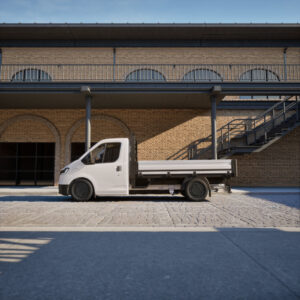
For starters, it’s the first Ford Professional vehicle in this segment to be offered with a chassis cab conversion, alongside the typical L1H1 (for payloads up to 1,085kg) and L2H2 (a larger 8.5cu m volume and capacities up to 1,275kg) bodies. Designed alongside businesses specialising in conversions, the chassis variant will be available in late 2026, with flatbed, tippers and box models coming in 2027.
The City has been designed for operators carrying loads for short-to-medium distances every day. The focus, therefore, has been on urban delivery drivers, though I would argue this would also suit rural businesses with charging facilities that offer a delivery service for produce, bales for stable yards and people such as fencing contractors who need to transport posts, rail and wire, and travel to a single location for a day.
It has been developed alongside the Chinese firm Jiangling Motors Co., Ltd (JMC) and will be build in the company’s Xiaolan plant and will come with a single specification. This includes a 56kWh lithium-iron phosphate (LFP) battery, which the company states can offer up to 254km of range. This is powered by a 110kW e-motor front-wheel drive driveline.
 According to Simon Robinson, chief engineer, the LFP battery is suited to regular fast-charging, handling DC inputs up to 87kW for 10-80% charging in 33 minutes and the ability to add around 50km of range in just 10 minutes. When using an AC 11kW charger, the charging time to 80% increases to 4.5hr, meaning this can comfortably be done overnight.
The specification includes adaptive cruise control, a heated driver’s seat (which is more energy efficient than warming the air in the cabin), keyless start and a 12in touchscreen with Apple and Android functionality. Automatic emergency braking, front and rear parking sensors, lane departure warnings and a rear camera are also included. There is no towbar in the current build, with no word on whether one will be added.
Pricing is yet to be revealed, but Ford noted that servicing costs should be 40% lower than combustion engine equivalents, with 25,000-mile intervals. Interestingly, there is little commonality of parts between the City and the rest of the Transit portfolio, and manufacturing in China does present some availability issues. Ford stated that its European bases would have an oversupply of parts. “The low complexity of the build will also help with this,” adds Simon.