


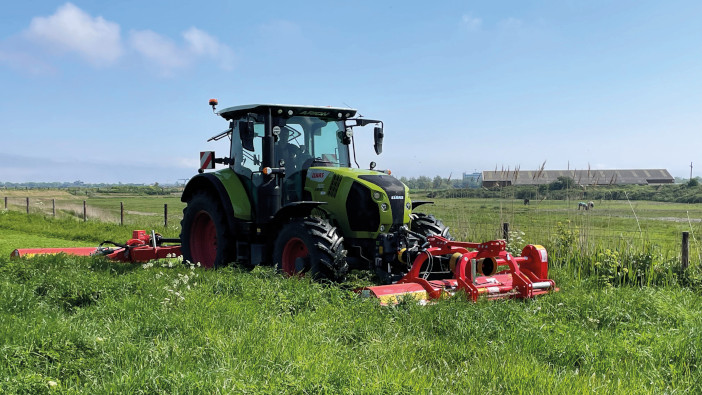
The scope of use for mulchers and batwing mowers has only increased as growers access environmental schemes and look to effectively handle crop residues and build organic matter in the soil. We spoke to key manufacturers about how these machines can play a key role in farming businesses.
According to Mike Britton, managing director of KRM Ltd, interest in the company’s range of mulching equipment has increased as more growers integrate Sustainable Farming Incentive (SFI) agreements and green manures into their rotations.
“Instead of incorporating covers with a shallow cultivator, our mulchers leave an even spread on top of the soil, which limits evaporation,” he says. “This holds moisture in the soil ready for sowing.”
The increased area of mulching operations was key in the development of the new Sprinter 8500P model, which the company introduced at Lamma. It uses a 2.8m front-mounted machine and two 3m rear flails, each with 1.6kg hammer flails, which are mounted on a 195mm rotor. While these are suitable for lighter material, Mike notes that the machine uses robust components, including a central gearbox with an internal safety clutch and a multi-V-belt drive to handle heavier scrub and stems up to 75mm in diameter.
“A lot of green manures are quite tall and difficult to cut,” he says. “This is why the front unit is so important – because you’re not pushing material into the ground with the tractor wheels.”
He concludes by saying that silage mower technology is now being integrated into larger mulching units. “The front unit on the Sprinter is not a rear-mounted machine turned around, but a specifically designed front mower with an overarching linkage that creates a pull effect. This means it follows contours better, with less wear than when you push a mulcher unit into a crop.”
For arable and grassland
Major Equipment’s Cyclone range is widely used across arable and grassland systems, as well as for cover crops and margin mowing, offering farmers a versatile and efficient solution.
According to James Cox, machinery sales for Wales, the Midlands and the south of England, the company is also unique in offering a front-mounted machine that extends to 6.3m wide.
“It weighs just under 2t, so it can be used by a wide range of tractors, depending on the cutting conditions and how hilly the ground is,” he says. The benefits of this are that customers can cover more ground in a shorter period with a single machine, and the tractor does not run over the crop before it is cut.
James highlights the cutting action of the Cyclone, which he compares to a disc mower, which uses rotors fitted with four blades each for a clean cut. Rotors alternatively turn clockwise and anticlockwise, creating a ‘blender effect’ that sees crops chopped multiple times for faster incorporation into the soil.
“A lot of growers use the machine after grazing to promote regrowth,” James says. “The clean cut allows the grass to recover quickly, and the machine also chops large cow pats which are then pressed into the soil by the rear roller to minimise nitrogen concentrations.”
While the Cyclone was originally developed by Major for their German customers to chop maize stalks and limit the spread of stalk borers, Major has seen success in the UK oilseed rape market.
“With fewer chemicals available to desiccate the crop, the oilseed being harvested is greener and risks blocking the combine,” James says. “A lot of customers are running the header higher and leaving substantial amounts of standing green straw, which is then chopped with the Cyclone.”
An even spread
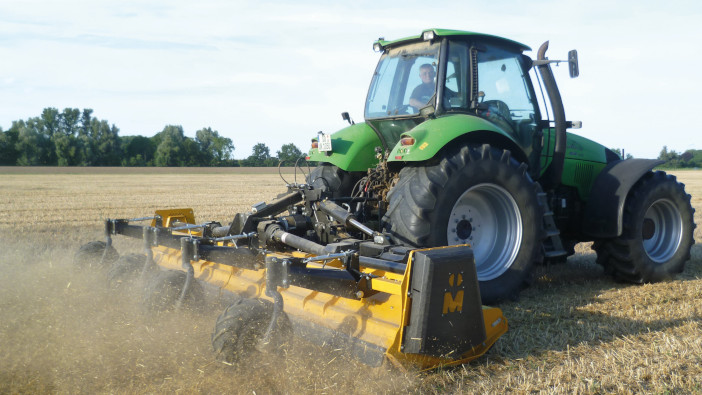
When discussing the difference between a batwing mower and a mulcher, Will Davies, southern area sales manager for Simon Richard Ltd, the importer for the Müthing GmbH range, says that while a flex wing rotary will leave crop residue in rows due to the direction of blade rotation, a flail will finely chop and then spread residues across the full width.
“We’ve seen a lot of interest as more farms put land and margins into SFI schemes,” he says. “Especially with cover crops, where they want a very fine mulch that they can drill directly into. Long stalks will wrap around the coulters.”
He highlights how the Müthing machines, such as the MU-Pro Vario, can be adjusted to suit the conditions and desired result. “The Vario bar can be steplessly moved closer or further away from the rotor to adjust the chop length. But what this also does is adjust the vacuum within the chopping area.”
So, when the bar is moved closer to the rotor, more suction is created. According to Will, this is particularly handy when the Müthing is mounted on the rear linkage, as it lifts driven-over crop to be chopped. The DuraX hammer flails are spirally mounted, which uses less power and therefore saves fuel. They rotate against a patented ‘Shark Fin’ removable shredding bar.
The closely spaced ‘Shark Fins’ mean that the long material is fed through the rotor a second time, ensuring a consistent chop length and mulch.
The rear support roller with its Starinth bearing system can also be easily adjusted to change where material is placed. For grass and cover crops, the standard is to have residue discharged behind the roller, giving uniform mulch and fast decomposition, but when working in maize or oilseed stalks, you discharge residues in front of the roller, pressing volunteer seeds into the topsoil for quicker germination.
 Something for every sector
According to David Perry, product manager for both Kverneland and Kubota flail mowers, the increase in SFI schemes, residue management, and diversification amongst farmers and contractors means that the flail mower market is continuing to grow rapidly.
“There’s a requirement for different areas, including hobby farms, construction sites and farming, so we have a comprehensive range to meet those demands,” he says.
Developments across both Kverneland and Kubota-branded machines have been focused on matching the increased horsepower of tractors. This includes larger machines having the gearbox drive mounted outside of the belt guard, and an increase in rear-mounted offset models to be used alongside front-mounted machines.
“It wasn’t that long ago that having 2.8m sticking out to one side of the tractor needed a lot of counterweights, but now most mid-sized tractors can handle it, and more are fitted with front linkages and ptos so we can increase the overall working width and output,” David says.
On the benefits of a flail mower, David says that they come with options to customise the chop. “Flails lift and pick up the crop for a more uniform finish, but we can add additional counter knives that keep material within the hood for longer. This improves the mulching, leaving a finer chop that decomposes rapidly.”
Flex-wing mowers
Spearhead are reportedly the market leaders in flex-wing mowers across Europe, and chief design engineer Neil Warren says that it continues to see increased interest from different sectors. “We have a comprehensive range that runs from quite simple machines for pasture and field margins to more intensive units for cover crop destruction, brash and crop residues.”
Updates to the company’s Multicut Proline machines include filling in channels and reducing areas where crop can build up, bringing it more in line with the flagship Stubble Master range. Neil notes that having the two ranges provides functionality at different price points, with the Multicut being an all-round machine suitable for a variety of cutting conditions, while the blade layout of the Stubble Master makes it more suitable for cutting back oilseed and maize stalks.
“The blades are mounted to have a more aggressive angle of attack,” he says. “Allowing growers to cut stalks at ground level and completely destroy habitats for pests and diseases.”
While the trailed flex-wing design means that front-mounted units are not available, he says that the design of the blades also creates enough suction to ensure that driven-over crop is pulled up into the cutting zone. “The blades have an angled fin which lifts the crop into a vortex. Once the crop has gone through the first blades, it is lifted to the roof of the machine and dropped back onto the straight mulching blades.”
He concludes by stating that running costs are typically lower for flex-wing units as well. “On our largest machines, there are 30 blades, each of which is cheaper to replace than a hammer flail. Then there’s the fuel and power requirement. Once up to speed, the flex-wing will continue to rotate under its own inertia.”
 Handling stubbles
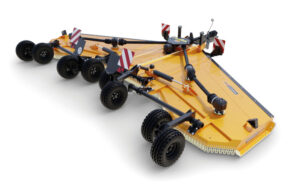
McConnel has expanded its Tuffcut flex-wing rotary mower range for 2026 with the introduction of the new 8.3m Tuffcut 830, joining the established 4.6m Tuffcut 480 and 6.3m Tuffcut 650 models.
The company states that effective residue chopping and even material distribution is key to achieving a clean finish and supporting faster breakdown of crop material. This is where blade configuration plays an important role. The Tuffcut range is available with a choice of blade setups, including McConnel’s X-Cut 4 and X-Cut 6. The X-Cut 6 uses four primary cutting blades per rotor, supported by two additional mulching blades set at a higher cutting plane. This gives the machine more cuts per revolution, helping to produce a finer mulch while maintaining a clean and consistent cut across the full width.
In stubble, that additional cutting action helps break down stems and crop residue more effectively, reducing material and leaving a more even spread behind the machine. Deck baffles support consistent mulch distribution, helping avoid heavy clumping and leaving a cleaner, uniform finish across the field.
The smooth, flat-top deck design brings further practical benefits for stubble and post-harvest work. By minimising areas where debris can gather, it keeps the machine cleaner during operation. For contractors moving between farms or blocks of land, this can also help reduce the risk of transferring unwanted seeds or material between sites.