


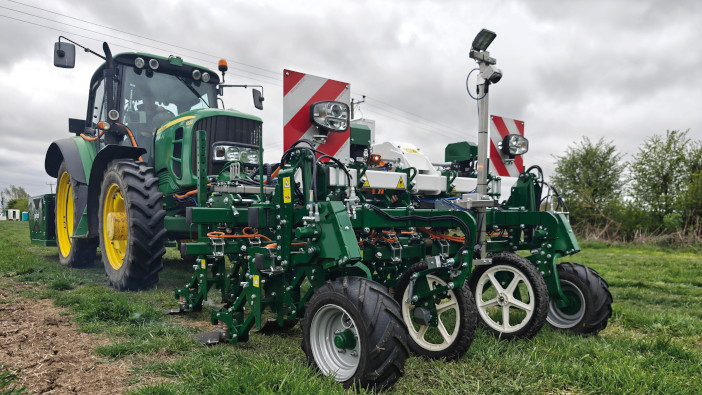
At its headquarters, near Peterborough, Garford showcased its electric weeder – the result of a two-year collaboration with Rootwave
Back in 2024, mechanical weeding specialist Garford Farm Machinery announced a partnership with Rootwave, the UK-based agritech firm developing electric weeding systems. While Rootwave has focused on machines for viticulture and orchards, Garford has integrated the technology into a new machine designed for high-value crops that have previously relied on manual labour.
At the company’s base, near Peterborough, we had the chance to see Garford’s electric weeder in action. Initially available in a 3m working width, the setup includes a 3m weeder on the front and a pto-driven generator on the rear of the tractor.
According to Jonathan Henry, managing director at Garford, it’s this generator where much of Rootwave’s technology is located. Power from the pto is transferred through a 60kW electric gearbox, producing a 400v AC current at between 50-60Hz. This is then split through two miniature circuit breakers, ensuring that the machine provides an equal current to the weeder at the front.
The left and right currents then pass through Rootwave’s proprietary power electronics, which convert the AC current into 600v DC and split the two sides again, providing six channels equal to the number of electrode pairs at the front. The electrical current is also converted into an 18kHz output. Jonathan notes that using DC current significantly decreases the risk to those around the machine.
A transformer steps up the voltage at a rate of 16:1 to ensure that there is enough current at the electrodes to effectively destroy the weed all the way down to the root.
Jonathan adds that using electricity is the only systemic method of weed control, in that no plant can survive prolonged exposure to the current. “It heats the cells, causing the plant to essentially boil. We know that sprays are losing efficacy, and that mechanical weeding has limitations. As long as the electrode hits the plant, electricity will have an effect.”
Adjustable use
The front frame is essentially a standard Garford design; the soil-engaging components are completely new. Two rows of six electrodes are mounted, and the angle of these can be adjusted to suit work on beds or in row crops. The downwards pressure of each electrode can be manually adjusted, for instance, so that the units working on the sides of beds do not disturb the soil.
The weeds are pushed down by the first row of electrodes, exposing a greater contact area. The second row completes the circuit, providing a second dose of voltage to ensure a full kill. The flat, malleable electrodes maintain ground contact, which minimises the risk of arcing.
The need for sustained contact with the weed does mean that the working speed is slower than other mechanised forms of weed control. As a systemic weed control, Jonathan says that it can handle high populations, but this will reduce the forward speed from a maximum of 5kph to around 1kph. Care also needs to be taken to ensure that no part of the cash crop comes into contact with the electrodes. This is not a system that will differentiate between the weed and the crop.
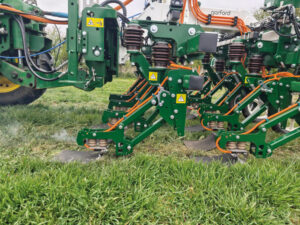 To address this, the machine is offered with a side-shifting frame and cameras. These will recognise rows and move the frame to ensure that the electrodes remain central between the crops.
Safety has been a key consideration, and Garford has reportedly overspecified the machine in this regard to build customer confidence. This includes a four-step system to turn the generator and electrical current on, with multiple safeguards that will shut the machine down. At the soil-engaging components, the electrodes themselves are isolated with rubber blocks, with a second set of isolators just below the frame.
Having the electrodes in pairs also means that the current runs in a complete circuit. This avoids any heating of the soil or conveyance of the current outside of the machine width.
The system also runs on a timer. Growers are expected to estimate how long each row will take, based on the weed burden and the length of the row. At the headland, the system will reset and will need to be activated again.
Control
The machine is controlled through a specially designed software from Rootwave – currently not integrated into the Garford terminal, although this is expected as the machine heads into full production. The screen gives an overview of the current output in each row, which can have minimum and maximum settings and be adjusted on the move.
The output will also automatically adjust based on weed burden and the impedance of the soil, monitored via the current running between the pairs of electrodes.
It uses a simple, visual layout to enable users to quickly see power levels, and electrode pairs can be switched off as required.
 Limitations to use
While Garford expects this to be more effective than both spraying and mechanical weeding systems, it still has limitations. Wet crops will limit the efficacy of the system, as the water conducts the current down the outside of the weed rather than internally. As such, Jonathan recommends that users wait until it’s dry enough to spray before use. However, as wind does not affect the machine, the window for weed control will be wider than using a sprayer.
While not necessarily a limitation, they also recommend that users target young weeds – around the first leaf stage – as this will speed up operation.
One of the biggest limitations will be the cost, at least for conventional growers. Jonathan says that the electric weeder will be around two and a half times more expensive than its mechanical counterpart. Combined with the slower working speed, this will make some growers think twice.
However, it isn’t really marketed towards conventional farms. The machine is designed for those growing high-value, specialist crops which have previously relied on manual labour or gas burners to tackle weeds.
“If you look at the labour costs, stagnated incomes and the difficulties of bringing in workers following Brexit, there is a clear demand for a machine that will control weeds,” Jonathan says.
The working width will also be a limitation for some. It’s currently only available as a 3m machine, although the company is working on a 120kW system, with two generators, which will enable wider machines to be brought to market. This will likely also come with a redesign, with the working elements shifted to the back of the machine.
High voltage operations
We were able to see the machine in action on a grass margin near the Garford Farm Machinery headquarters. Grass is reportedly a great crop to test the electric weeder in because it has a dense population – likely exceeding weed populations in regularly worked fields – and because you can see the difference between the rows quickly.
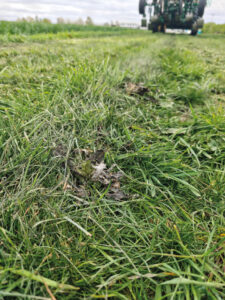
Tests done the day before were clear to see, with strips of brown, dead grass, indicating a near 100% kill rate.
Standing just a metre or so from the machine, we saw it travel slowly up the row. While arcing wasn’t eliminated, and likely cannot be, there were very few sparks, especially when you compare it to previous electric weeding systems from companies such as the Small Robot Company.
A few puffs of smoke, and the odd crackle as the electrode hit the plant were the only signs that the machine was really doing anything. That was until a few minutes later, when the affected rows had already started to darken.