


Following the announcement that Mitsubishi would once again import vehicles into the UK, the company has announced two new launches.
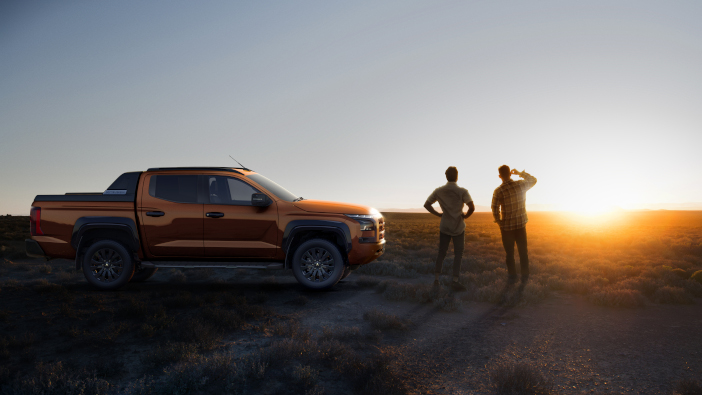
The L200 Series 7 pickup truck will arrive in the UK this summer, available in Titan or Barbarian specifications, with both featuring shift-on-the-fly two-wheel and four-wheel drive and seven terrain modes.
Titan models feature Easy Select, using a dial on the centre console to switch between two-wheel and four-wheel drive. 4H enables four-wheel drive at speeds up to 62kph, with 4L selectable when the vehicle is stationary for more difficult conditions.
A manually-operated locking rear differential is also included.
The Barbarian models have Super Select 4WD-II, with a lock centre differential to allow it to run in four-wheel drive at all times, on any surface.
2H mode sends 100% of the power to the rear wheels; 4H enables four-wheel drive up to 62kph and can be used on all surfaces, splitting the torque distribution 33:67 and automatically changing to 50:50 between the front and rear axles when conditions are more challenging.
According to the company, 4H is particularly useful for towing. The L200 has a braked towing capacity of 3,500kg and a gross train weight of 6,250kg, supported by Trailer Stability Assist, which prevents sway by controlled individual wheelslip.
4HLc is also available up to 62kph, which equally splits torque between the axles and locks the centre differential. From a standing start, drivers can select 4LLc for the most demanding conditions.
The Barbarian also includes Active Yaw Control – a first for this range. This improves cornering stability by lightly applying the brakes to the inside wheel and distributing torque to the rear axle, based on traction. This works in both two-wheel and four-wheel modes.
Both specifications come with Active Stability Control and Traction Control, as well as Hill Descent Control. They also feature seven selectable terrain modes: normal, eco, gravel, snow, mud, sand and rock.
“The all-new Mitsubishi L200 Series 7 delivers the robust capabilities expected from every aspect of this eagerly anticipated pickup’s arrival in the UK,” said Alex Sheward, head of sales at Mitsubishi Motors in the UK. “Optimised two and four-wheel drive capabilities and versatile drive modes enhance the L200’s exceptional abilities in every environment, making it a formidable contender for those wanting the ultimate workhorse pickup.”
 Plug-in hybrid Outlander
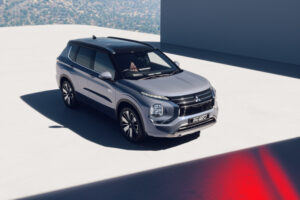
Available this month, the company will also introduce the plug-in hybrid Outlander, with Super All-Wheel Control, which incorporates yaw control and torque vectoring.
Three automatic drive modes are included: full electric, series hybrid and parallel hybrid, which are said to switch seamlessly to optimise performance.
In full electric mode, the vehicle is powered by two electric motors, switching automatically to series hybrid when the power demand is high or if the battery is running low. This starts the combustion engine and sends up to 120kW to the battery.
For continuous high-speed driving, parallel hybrid (from 40mph) uses the engine as the primary power source, with excess engine power used to recharge the battery.
The all-wheel drive system uses electric motors at the front and rear axle, which optimises torque distribution. This is typically split 60:40, but is constantly adjusted to suit traction demands.
Active Yaw Control controls the driving and braking forces to the individual wheels in response to the driving style, while anti-lock braking and automatic stability control are also included.
Like the L200, it includes seven terrain modes.
“The new Outlander PHEV is a truly adaptable family-oriented SUV, delivering permanent all-wheel drive and precise cornering, maximum stability and traction via Mitsubishi’s renowned S-AWC system,” said Alex. “It combines the economies and driveability of an electric vehicle with the usability of a hybrid: the versatility and benefits of its all-wheel drive and unique Super All-Wheel Control system sets apart the new Outlander in both PHEV and four-wheel drive segments.”