
Cannington Enterprises is built around efficiency. The family-run business operates a major biogas set-up, with
three digesters and three secondary tanks. These are fed on a mix of crops and food waste, and the company harvests more than 2,200ha each year – 1,600ha of maize and the rest made up of hybrid rye, winter barley and oats.
That amount of silage requires significant clamp space, something that is not available to the business, so it had
previously used a local contractor with its own bagging machine. “Bagging makes a lot of sense,” explains farm manager James Owen. “When conditions are good and we can travel on the fields, we can bag on site. This maximises our clamp space, while also reducing trailer traffic.”
Traffic is major factor in the decision-making. James explains that they use a Krone BiG X 1180 to tackle chopping work, which can fill a trailer in less than a minute when the going is good. On fields further away from the clamp, this can mean that up to 18 tractors and trailers are required.
“With bagging in the field, this can be reduced to just four, with one tractor running the bagger instead of two
machines on the clamp,” he says. “It’s far more efficient, as the forager is constantly running and we’re saving a huge amount on diesel.”
Bringing it in-house
James is quick to point out that the previous system worked well. However, having such a large area to cover meant the business couldn’t always afford to wait for a contractor. “We were looking for a solution that would allow us to bag ourselves, and we saw an advert for the Euro Bagging system.”
They got in contact with Conagri, the UK importer, and managing director Andrew Venton arranged for James and others from Cannington to visit the factory in Czechia and see a machine working in the field.
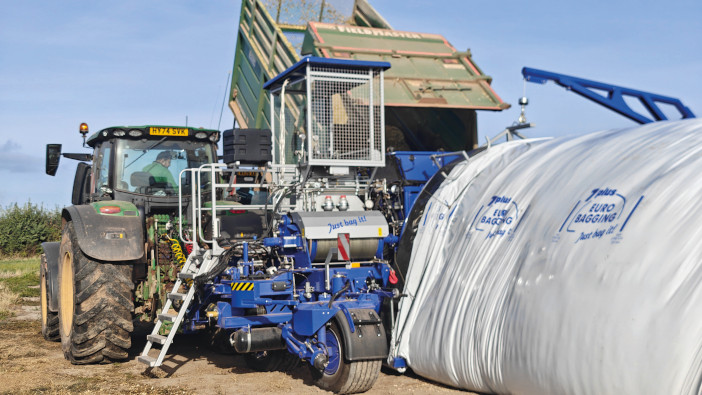
 “I was impressed with the simple, heavy-duty design of the machine,” James says. “It’s all built in-house, and
the controls are simple. It’s all handled from the John Deere cab, and the operator only have to get out to adjust the brake and the pressure, which are done on a platform on the machine.”
They opted for a trailed model instead of self-propelled, as it can be easily unhitched from the tractor, which can go on to do other jobs outside harvesting season.
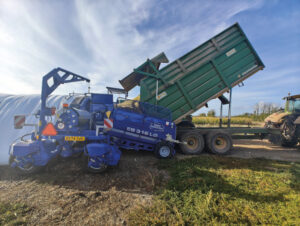
After agreeing to purchase the largest trailed model available, the EB 316 LG, the machine arrived on farm a week earlier than expected at the start of September – a good result considering how early the maize harvest has been this year. Product specialists from Euro Bagging also made the journey to Somerset to ensure that the machine was set up correctly and working properly, and Conagri has been on hand for after-sales support.
“They’ve been brilliant, including keeping a full stock of spares for us so that if we have an issue, such as one of the tyres bursting, we can be back up and running as soon as possible,” James says.
He adds that further savings have been noticed in the intense four weeks they have been using the machine. Sat on the back of a John Deere 6R 250, they are using just 150 litres of diesel a day, which, when combined with the savings in the number of tractors, should add up to a significant financial gain over each season.
Fast bagging
Even when reducing the number of tractors and trailers by more than three-quarters, he says the bagging system does not significantly affect how quickly fields are cleared. Whereas the previous self-propelled system would take about four minutes to bag a full trailer load, the Euro Bagging system takes four to five minutes, based on how full the 18t Smyth Fieldmaster trailers are.
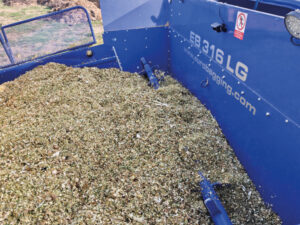
Forage is unloaded onto the conveyor belt and is pulled into the feeding system by two small-diameter rotors. It is then compressed and pushed into the bag, which expands as it is filled. The bags supplied by Euro Bagging extend to 12ft in diameter, compared to 14ft before, but James says he is confident they will fit 900t of forage into each.
The bags can then be left in the field, out of the way until the clamps start to run low. At this point bags will be opened and emptied one by one based on the biogas requirements.
“It provides winter work for the staff and can be done quickly,” he says. “A bag will take about a day to empty, with around 500t going straight into the digesters and the rest going into the clamps.”
 Meeting demand
James says they are now considering a second machine. This will not only speed up the harvesting process even more, as he acknowledges the single machine cannot quite keep up with the 1180 – a problem that was also present when they outsourced the work. The second machine would also give them the capacity to take on more land if required and offer contracting services.
“We’ve already had requests from some local farmers to bag their silage,” he says. “I estimate the machine would pay for itself within a couple of seasons. With contracting work, that could be brought down even further.”