


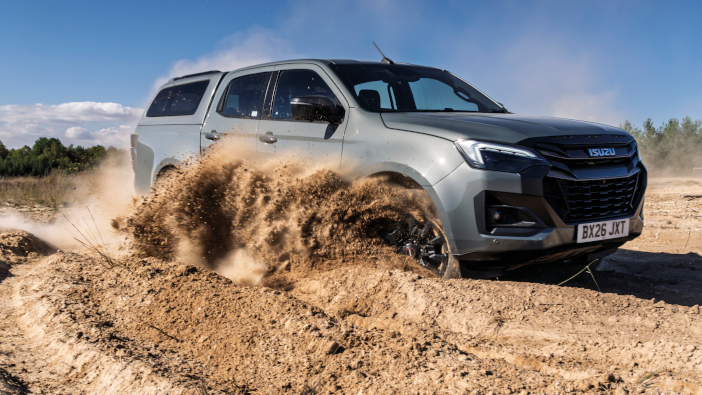
At the Hurn Proving Ground in Ringwood, we had the opportunity to put the new Isuzu D-Max 2.2-litre and its fully electric sibling through their paces.
Alan Able, managing director of Isuzu UK, started proceedings by acknowledging that the pick-up market had not been kind over the past 12 months. Overall pick-up sales were down 56% year on year, and Isuzu had seen a 69% drop in sales.
Some of this was due to supply issues and a production gap, in part caused by the switchover from the 1.9-litre engine to the new 2.2-litre, and the associated wait for UK approval.
“It isn’t all bad news, however,” he said. “The wider International Motors Group is in a strong position, able to offer a working vehicle to different demographics, whether that is through the Isuzu brand, the relaunched Mitsubishi range, or its wider range of imported machines.”
PR manager Brian Wheeler added that while it may seem counter-intuitive to offer multiple brands within the same segment, potentially cannibalising market share, the reality was very different.
“With the Isuzu D-Max we are targeting the Hilux, and when Mitsubishi originally left the UK market, we assumed we would take on some of those customers. That didn’t happen, and we haven’t lost customers due to the return of the brand. Customers are loyal, and the two brands can exist side by side.”
With that said, the company is clearly hoping to bring in new customers with its more powerful D-Max. Gone is the 1.9-litre power unit, replaced with a 2.2-litre engine that produces 400Nm of torque at low engine speeds to improve towing performance. It’s a good move, as while the previous-generation D-Max would always get where it needed to be, it often felt lacking, especially when pulling away with a load.
Aiding this is a newly designed variable-geometry turbocharger, which boosts the engine power at an earlier point to help with the throttle response.
 The rest of the engine block has been refined, with new pistons, a new cylinder block and head and low-friction bearings throughout, all of which the company says will help fuel economy. It is paired with the choice of a new
eight-speed automatic gearbox, or a refined version of the six-speed manual.
For tough conditions, it has an 800mm wading depth and 220mm of ground clearance, and can handle approach
angles of up to 30.5deg, departure angles of up to 22.9deg and up to 22.9deg of ramp breakover angles, depending on the model chosen.
The rear deck can hold 1t, and the towing capacity is 3.5t. It also benefits from a comprehensive advanced driver
assistance system, as well as a rear differential lock, hill start assist and hill descent control, and the company’s
rough terrain mode.
Specifications
As with previous D-Max models, the 2.2-litre is split into four specifications to suit different customer requirements. Its Utility model is available with a single or extended cab and comes with steel wheels and vinyl flooring. However, it does benefit from the complete advanced driver assistance system, a reverse camera, and
Apple CarPlay and Android Auto.
The DL20 is available as a double-cab only, has a choice of transmissions and is sat on 18in alloy wheels, with an 8in infotainment screen in the cab, rear parking sensors and a tailgate damper. The DL40 can be extended or double-cab, and gains LED headlamps, keyless entry and start, leather interiors and a 360deg camera and front parking sensors.
Finally, the flagship V-Cross is only available with the eight-speed automatic box, gets an updated 9in infotainment screen, heated seats throughout and an exclusive dark grey exterior.
The drive
These specifications are primarily focused on comfort. The actual performance of the machine is similar across the board, so how did the new D-Max handle the Hurn Proving Ground?
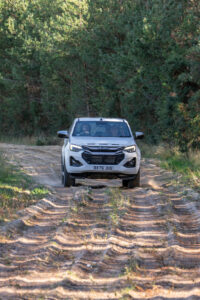
We were given a series of tasks, including road work, driving over sand and rough terrain, and tackling a course with steep hills. We tried the manual first, and the shifting is smooth, with good throttle response in each gear. Four-wheel drive can be engaged on the fly, with the low gearing available when you come to a complete stop.
We tried three specifications of the machine, with the manual box in both the Utility and DL20, and in both cases the pick-up was comfortable. If we had any complaint, it’s that the pedal bay is compact, so if you are wearing boots it can be difficult to find a comfortable position for your feet. This was especially noticeable in the manual version where you are operating the clutch.
The suspension managed to dampen a lot of the bumps at Hurn, including driving over a cannonball track and
tackling some dunes and sand tracks. The rough-terrain mode allowed us to be more aggressive on the sand, keeping that momentum and avoiding getting bogged down.
More importantly, however, it felt gutsy. It tackled the steep inclines well, and the hill descent control was very
impressive, gradually taking us down at a steady pace, even when the gradient exceeded 30deg.
Another issue that has been solved is with the automatic box. The previous generation would constantly shift at a
cruising speed, never quite settling, and while there was never a jolt to the driver, you could feel the transmission working unnecessarily. Here, the shifts were smoother, and it sat comfortably in one gear once you got up to speed.
Going electric
An all-electric pick-up truck is an interesting proposition, because its usability is so tied to its range and how well
the battery holds its charge. Heavier vehicles and towing vehicles can use that charge more quickly, and even a few miles can feel like a long distance if you run out of battery on a drive.
The D-Max EV claims a 163-mile range from its 66.9kWh battery, with some dealers reporting over 200 miles
depending on driving style. This is no small distance, especially when it can carry the same 1t payload and
tow up to 3.5t behind it as the diesel model. Jumping into the truck, it controls and handles like any other EV on the market, with nearly every part automated.
We were surprised at the sluggishness of the acceleration – something definitely not present on most electric vehicles – but it was comfortable and, to be frank, putting your foot to the floor is not the ideal way to maximise the range of an EV.
It did give us pause for thought, though, when faced with a steep hill and about 3t being towed behind. Would it manage the hill? Would the battery life drop at such a rapid rate that we would worry about getting back? While that sluggishness was still there – although it’s worth noting we had a standing start – you could compare the D-Max EV to the Little Train That Could.
While its acceleration won’t put it at the front of the pack, it continued to pull the trailer up the hill, never stopping or feeling like it was going to slip back. Perhaps more impressively, it only used 3% of the battery life during the towing test. One reason for this is the regenerative braking. The extra weight of the truck, compared to an EV car, and the load behind us meant more charge was reclaimed on the downhills, but considering we did have our foot to the floor to tackle the hill, I would have expected to lose a lot more.
According to Isuzu, the added weight when the EV is under a full load will become negligible to the power
consumption when travelling at a cruising speed. Unfortunately, we couldn’t test this on the day, so it would be interesting to see some real-world examples when these start arriving on farms.
Looking at the specifications, the interior is like the higher-specification diesel units. Like with most EVs, the
increased electronic architecture means you get a lot of comfort for your money. Isuzu has also redesigned the rear suspension to carry the additional weight of the battery.
It’s an impressive unit, and one that has a lot of the financial advantages missing from double- cab diesel units. It comes with a 3% benefit-in-kind rate, and 100% capital allowance, as well as being eligible to claim back the VAT. If you have the charging facilities, it’s likely worth at least testing if the EV can meet your needs.