


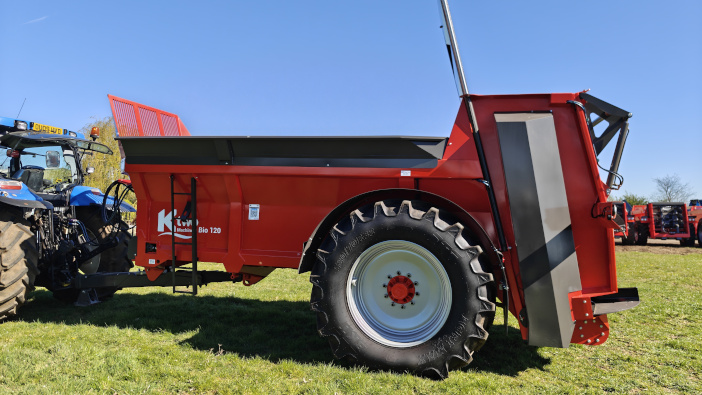
We travelled to Ktwo’s Aylesbury base to discuss how the new, compact Bio machines are helping operators on steep ground
Ktwo’s muckspreader range is split across four ranges, with the horizontal beater, spinning disc Bio models typically positioned at the top of the range, offering capacities from 12cu m and increasing to 36.3cu m.
According to Terry Kelloway, co-founder, they had been approached by customers wanting the fine shredding and 24m spread width of the larger spinning disc machines, but with a smaller capacity and compact build to ensure safe operation of steep ground. “A lot of these were working primarily on grassland, with light products such as chicken muck,” he says.
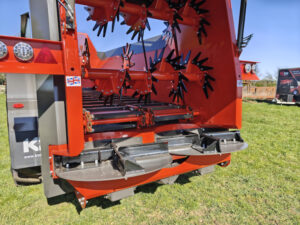
Working with co-founder and technical designer, Ashley Knibb, they set about adapting the smaller capacity Duo vertical beater spreaders. “We combined this with the spreading unit from the larger Bio machines,” Ashley explains. “This means that the smaller units still benefit from two 1,100mm spinning discs, and the twin horizontal beaters with a spiral tooth pattern.”
Ktwo’s standard features remain the same on the compact machines, including individual clutches for the spinning discs and beaters to minimise damage if a foreign object finds its way into the muck. Additionally, there is the option of weigh cells and automatic rate control, for which the take up rate is around 50%.
Using the larger spreading unit also has additional benefits, with a more pronounced increase in width at the backend to offer a wider spread pattern. The Bio 120 starts at 1.5m wide at the front, increasing to 1.8m at the spreading unit, with a moving slat and chain floor, adjustable canopy which is used to change the drop point onto the discs and which is also spring loaded to act as a breakback when larger lumps or foreign objects are pushed through.
“The only difference to the spreading system on the larger units is that we’ve reduced the overall height by removing the vertical combs that are required on the bigger machines because of the size,” says Ashley.
 Spreading benefits
The Bio 120 has a heaped capacity of 12cu m, increasing to 15.5cu m with greedy boards. “Customers have reported significant benefits when working on grassland,” Terry explains. “One told us that he was seeing 15% quicker regrowth due to the fine spread pattern of the Bio system, which was enabling him to cut ten days earlier. This has been backed up by his agronomist, who said that the well-shredded muck was integrated into the soil quicker, leading to better nutrient uptake and soil conditioning.”
Working on steep ground
Llewellyn Powell, who farms just outside of Knighton, purchased the Bio 120 last year and says he has seen a boost to the grassland where he applies chicken muck. “I’ve used rear discharge machines for several years, but when I started using chicken muck, I decided to opt for the Ktwo with spinning discs and horizontal beaters.”
He explains that the shredding of the muck has significantly improved. Whereas vertical beater machines would leave a visible layer of material over the ground and take a long time to integrate into the soil, the Bio system leaves a finer application, which is even across the full 24m working width, that normally washes in after a day of rain. He adds that when there are awkward areas in a field, the increased working width means that you can normally still cover the ground without having to get right into corners or close to obstacles.
“Even last year during the drought, the muck would sit on the surface until we had a drop of rain, then it would be gone, and the grass would green up almost overnight,” he says. “We went from almost no grass to having two inches of growth, so it was pretty clear that the crop was utilising the nutrients better.”
As well as chicken muck, Llewellyn adds that he regularly spreads cattle muck and digestate and seen similar results regardless of the material. “I was impressed with the system and wanted to try it with as many different things as possible to really test the versatility.”