


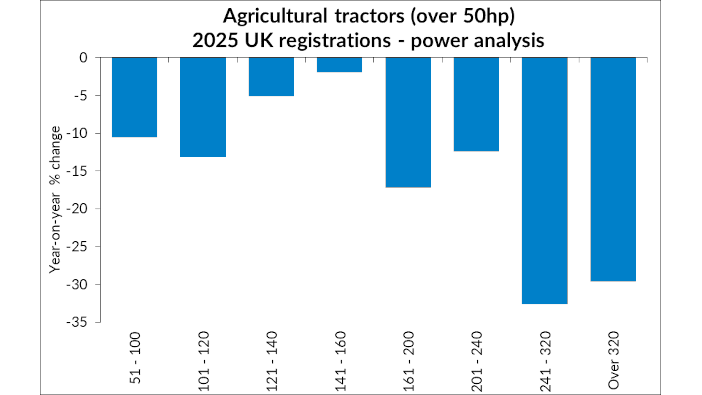
With 2025 registrations complete, the AEA has released the breakdown of registrations by power and region. High horsepower machines saw the biggest decline, with tractors over 240hp down by nearly a third. This contrasts with the 2024 figures, where registrations in the higher power band increased by 19.1%. This indicates the struggles with prices, yields and political pressures that arable farmers have felt.
Below 240hp, the overall registrations were down 11%. Interestingly, while it was high powered machines that saw the biggest decline, tractors over 240hp still made up 12.2% of the market, the highest market share recorded.
The drop in sales also impacted the average horsepower in the UK, which fell from 179.7hp to 173hp, just below the 2023 level. The total horsepower registered fell to a 24yr low of 1.52m.
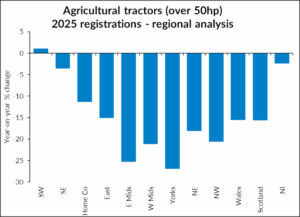
Only the South West of England recorded an uptick in registrations, with 1,338 machines registered, though this was only an increase of 15 machines (1.1%). The rest of the United Kingdom recorded drops, with Yorkshire and Humberside seeing a 27% decrease to just 520 machines. Other areas to see a decrease of more than 20% were the Midlands and the North West, with most areas seeing a decrease of between 10-15%.
 Market share
Competition law means that market share figures are delayed by 12 months, however we can now see how companies faired in 2024. Case New Holland remained at the top of the table with a combined market share of 29% (split 19.3% for New Holland and 9.7% for Case IH). This was up slightly from 2023, although John Deere remained the largest single manufacturer in the market with 28.1%, down from 30.3% the year before.
Agco was third with a total of 21.9%, split between Massey Ferguson (11%), Fendt (7.3%) and Valtra (3.5%). The only change in the rest of the market was JCB falling slightly below Same Deutz Fahr. Below Agco it was Kubota (6.1%), Claas (3.6%), Same Deutz Fahr (1.9%), JCB (1.8%), Agri Agro (McCormick, 0.8%, Landini (0.2%) and other brands making up 7% of the market, up from 5.6% the year before.