


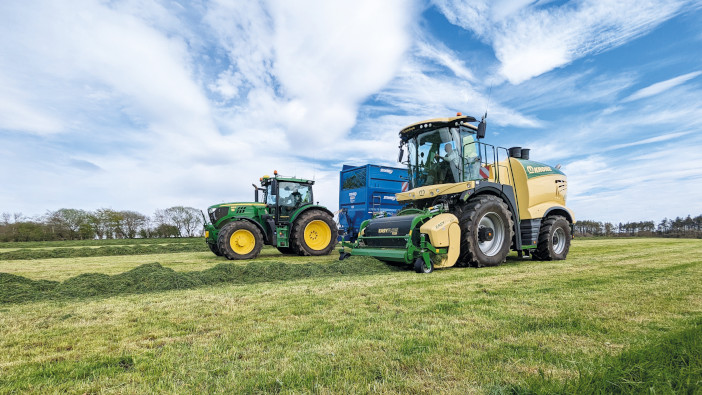
If the past few years have shown us anything, it’s that there is no fixed date to the silage season. With spring rapidly approaching, we headed up to Pontesbury Tractors to see what goes into getting a forage harvester ready for chopping
According to both Neil Edmunds, sales territory manager at Krone, and Roger Watkin, service technician at Pontesbury Tractors, nearly all Krone foragers undergo a full winter service. As per the company’s warranty terms, a Krone Authorised dealer can carry out this work.
With that said, there are areas of the machine that can be visually checked or, in the case of out-of-warranty or second-hand machines, can be repaired on-farm. It’s worth noting that machines under warranty can also be maintained on farm, but by an approved dealer as noted above.
According to Neil, much of what is true when walking around a Krone forager is true for others on the market, although there will be key differences depending on specification and proprietary offerings from manufacturers.
The starting point for any post- or pre-harvest check is ensuring that the machine is clean. A quick walkaround will highlight any major works that may need doing, especially around the tyres and the header. This will comprise checking for broken tines or damaged chains for the grass pick-ups, or the stationary knives or sickle discs on the maize header.
Roger notes that the checklist for winter maintenance runs through the machine from front to back, so he will typically start the in-depth work around the feed roller housing. “The front of the housing is disconnected and checked over,” he says. “Then we will check the wear plates for any damage. Last year, with yields down, people were cutting lower, so there is a higher risk of stone damage here.”
The team will also run checks on the metal detector, testing at multiple points to ensure it is running correctly. After all, a piece of metal flying through the rest of the machine could cause plenty more issues to be uncovered at the winter service. Once a visual check is completed, the piping and gearboxes are checked.
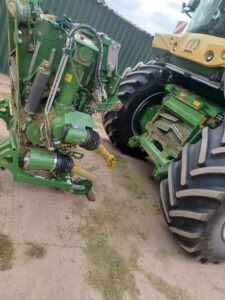 Once the checks around the feed roller housing and any repairs are completed, it is time to assess the condition of the drum. The knives and counterblade are checked for excessive wear and the lubrication systems are tested and topped up.
For those shifting between grass and maize, and changing drums to suit the condition, these checks will be done at the point of changeover to mitigate the risk of damage later in the season.
Roger says they also visually check the wear plates and belly plate at this point. “These are lined with Hardox so, as a rule, you shouldn’t see any wear for a minimum of five years, depending on the area chopped. We’ll also make sure that the drive belt is not showing any signs of damage, and strip down the corn cracker to check for wear.”
Once this is complete, it’s time to check the spout. Visual inspections of the lining and the accelerator back plate should highlight any areas of concern, although again this is Hardox-lined. The team will also check the rotation gearing and ensure it is working as it should.
Checking the power unit
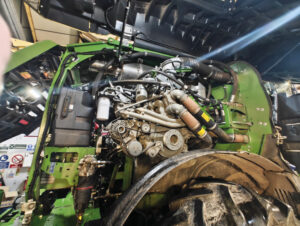
Krone fits two brands of engine into its forage harvesters: the MTU in its smaller BiG X range, and Liebherr in the larger units. While each of these will have its own servicing requirements, the key elements are the same, according to Roger and Neil.
The engine and gearbox oils are checked every 1,000 hours, but primarily once a season for larger operators. The main drive belt is visually checked to ensure there are no nicks. Filters are also checked and changed in line with condition or requirement.
At the wheels the plating is removed and the wheel motor oil level is checked and topped up as necessary. While here, they will also assess the independent suspension and the axles for signs of damage or operational errors.
 Software engineers
Of course, every new machine comes with a significant level of technology, and a key part of the servicing process is checking that the various systems are fully updated and working properly.
“Once the visual checks and repairs are completed, we will run through the processes to make sure that all of the software is working correctly,” says Roger.
This includes ensuring that the spout is fully calibrated and the automatic park system is working correctly. Engineers will also run through the engine’s recirculation system and perform any required updates to the operating software.
If additive is used, this system will be visually checked over, cleaned and tested to make sure it is correctly calibrated.
With many customers choosing to have the dealer-offered winter/spring service to ensure that machines continue running in the season, we asked Roger if there was an annual acreage that necessitated the service.
“Not really,” he said. “There are a lot of variables. Maize is harder on the machines than grass, but in 2025 grass harvests led to a lot more stone damage than normal. How stony the soil is; how wet it is when you’re harvesting maize – all these variables make a difference.
“Nearly all of our customers will opt for the service every year, because it gives peace of mind, and those with a warranty are required to as part of their agreements”