


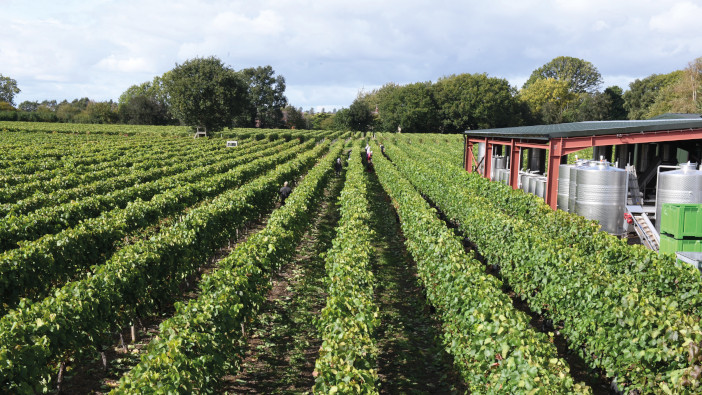
It was 43 years ago when Martin Vickers decided to plant 400 vines over 0.2ha. He was the third generation of farmers in Staffordshire, with two families tending to 485ha of arable ground, and as his son, Clive, puts it, the vineyard was just a ‘bit of fun’.
Of course, you wouldn’t know it now. Halfpenny Green Wine Estate has since separated from the main farm – Clive’s cousins still farm the neighbouring 325ha – and has grown exponentially to just over 8ha of vines, as well as presses, storage tanks and bottling plants, a restaurant and gift shop, as well as a craft village, with buildings rented out to local creatives.
The site is now run by Clive and his wife, Lisa. Martin sadly passed away last year, but left behind a substantial business that was well placed to capitalise on the growing UK viticulture market.
Clive explains that the land they were farming was perfect for vine growing. South-facing and not too high, on sandy, free-draining soil, it was sheltered enough to protect the vines and when it came time to send the first batch of grapes to be processed, they were so happy with the resulting wine that they added another 400 vines.
“By the time we got to 1989, my dad and I realised this had some real potential. Arable farming was on its knees at the time, and it was clear to us that we needed to change direction to secure our business,” he explains.
It wasn’t without its complications. Despite wine being a historic part of British farming, the onset of the First World War effectively destroyed an industry that was already in decline, as viable farming land was brought over to arable production. By the 1980s, when the Vickers established their first vines, the industry had started to develop again, but there was a clear lack of localised agronomy and varietal knowledge.
“We worked with some advisers and looked to varieties grown in northern Germany, including Chardonnay, to get us started, but it really was building up that knowledge from scratch,” Clive says.
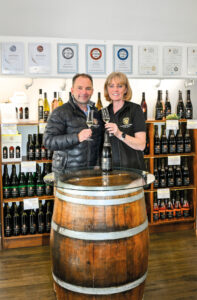 Added to this was the lack of consumer knowledge about UK wine. Clive says this was a hurdle that took a long time to overcome. “It was definitely slow and steady at the beginning. People would visit, try the wines and be impressed, but in the past decade we’ve seen demand accelerate rapidly.
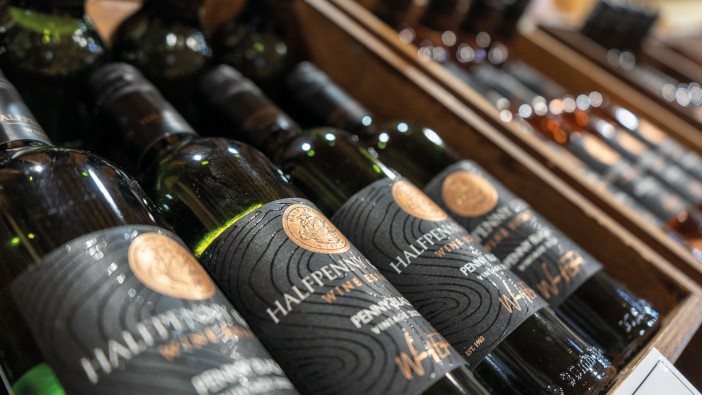
“This is partly due to Brexit and Covid-19, both of which forced people to look at UK products, but we’ve also seen increased demand since we started winning international awards – it just proves that UK wine can stand up with the best growing areas on the planet.”
Constant development
Vineyards are a time-intensive investment. Over the past 40 years, Clive has seen the varieties change, along with the choice of disease and pest control. “We have access to a much broader selection of grapes now, with whites, reds, rosés and sparkling wines produced on site.” He adds that a sparkling red is currently one of the most popular wines produced.
“However, changing the variety of grapes is not as easy as changing from cereal to cereal, or trialling a new maize variety. It takes three years for them to reach maturity, so any changes must be very carefully considered,” he says.
It is this time investment, and the fact grapes are front-loaded when it comes to cost, that can be a stumbling block for those considering it as a diversification. Clive notes that it goes further than this, as there is very little crossover between broadacre arable machinery and viticulture, meaning there is additional investment required there as well.
Keen to do their part to continue developing the UK viticulture industry, the Vickers have developed a contract winemaking enterprise, increasing the number of bottles going through the plant to one million each year. This is how Halfpenny Green itself got started, with its grapes going to Three Choirs in Newent, Gloucestershire, until the mid-90s.
“It’s beneficial for the growers,” Clive explains. “Grapes have an excellent return on investment, but the costs can be prohibitive. We want more vineyards in the UK because it increases the visibility of the wines produced here, and we all benefit from that. We offer 10-year contracts so growers can balance the establishment costs against the return, with clauses to ensure that the grapes meet the right quality levels.”
Climate challenges
While the warming climate has benefitted viticulture in the UK, Clive says it has not come without challenges. “The fact that the weather changes so quickly can be detrimental. The 2024 season was one of the most difficult I can remember because of the high rainfall. We struggled with disease pressure and overall quality. Last year, it was near-perfect conditions for most of the season, but was almost too dry by the time we came to harvest.”
He has also seen increased numbers of spotted wing drosophila – an invasive species that can cause significant damage – in the crop. Traps are being used to handle the pest, but combined with increased disease pressure, including resistant strains of powdery mildew, and a reduction in the number of actives available, Clive is having to adjust the agronomic practices to ensure a healthy crop.
“We’re integrating some of the same measures as broadacre crops, notably ensuring that our soils are as healthy as possible and using soil and tissue sampling to ensure nutrient levels are optimal so the vines are more resilient.”
Some parts of the job are more mechanised now. When the vineyard was first established, getting hold of viticulture kit was more difficult, and Martin and Clive used an imported Ferrari articulated tractor and a second-hand Massey Ferguson 135N to handle certain tasks, while pruning and weeding were done by hand. The Massey remains on the farm, used to back up a Fendt 207 Vario, which pulls the 16-bar mist blower and is used for the trimmers and deleafers.
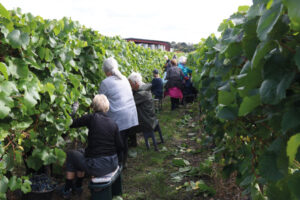 “We also perform some subsoiling and rotovating when required, but a huge amount of the work is still done by hand,” he says. “We’ve looked at self-propelled and trailed harvesting equipment and can certainly see the benefits from a labour and cost point of view. Modern machines are even gentle enough on the crop, but our vines aren’t set up for mechanical harvesting, which would mean significant disruption to our business to implement this.”
A community operation
Instead of mechanical harvesting, Clive works with the local community to handle the picking on site. As well as the 15 people employed by the business to work in the winemaking halls, part of the 85 employed in total to keep the shop and restaurant running 362 days a year, Clive encourages visitors to head out into the vines and try their hand at picking.
“Since Brexit, it’s become increasingly difficult to get enough contract pickers on licence, but people really seem to enjoy going out in the sunshine and picking the grapes. It makes them feel more connected to the product that they are drinking.”
The business has worked closely with Harper Adams University, setting up a small area of vines at the facility so viticulture courses can be held there, representing the increased interest in the industry.
Clive has established a winemaking co-operative, in which small-scale growers, including those with greenhouses, can send their grapes to Halfpenny to be processed. A flat fee is paid for the equivalent of one bottle (about 1kg of grapes), and the co-operative grapes are made into a rosé blend.
These direct-to and direct-from consumer streams mesh well with the craft village that Halfpenny Green has built around its winemaking business. And it extends to its commercial outlets as well.
Martin and Clive initially aimed to get wines into UK supermarkets, and succeeded, producing for Waitrose for several years. However, the business has now hired a full-time salesman who approaches farm shops and restaurants, some of which use the Halfpenny brand name, and others who contract a number of bottles with their own labelling.
They also sell through the Craft Drink Company, which opens doors to other outlets and has seen some bottles on the shelves at Marks & Spencers.
As for the future, Clive wants to focus on developing the wine, rather than diversifying again into something else. “We could look at other products, maybe spirits or beer, but that would distract from what we do well and would require a significant amount of investment. The viticulture industry in the UK is developing quickly, so there is always something that needs upgrading, and there is a bigger push for low- or no-alcohol products.”