


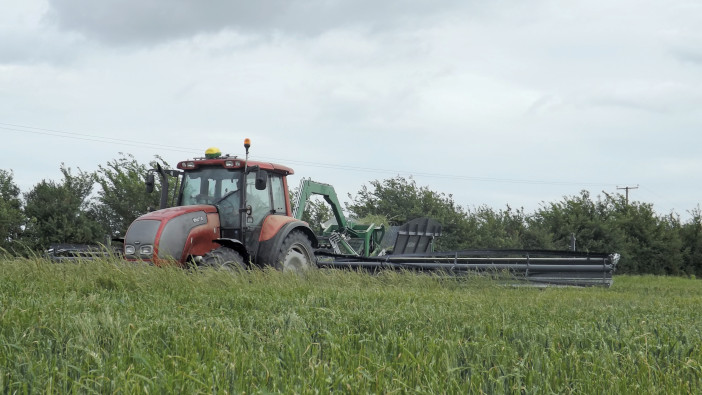
Despite his cheery demeanour, Kevin Smith admits that the past couple of years have been a struggle for his business. After three seasons travelling up and down the UK with a Zürn Top Cut Collect, the drought conditions in 2025 meant weeds struggled just as much as the cash crops, and work slowed.
Now the increased fuel costs, fertiliser costs and low returns on arable farming are causing headaches for Kevin, as they are for many farmers and contractors.
“I always think that no one wants to read about someone saying how bad everything is, because we all know what’s going on, but sometimes it needs to be said,” he notes.
He adds that this is compounded by a lack of basic infrastructure in the UK. “Farming is already isolated. As a contractor, I’m sometimes the only person a farmer will speak to during the week, and we can’t even get a good enough phone signal to make those calls. We’re 20 miles from Oxford, but you’d think we were in the middle of nowhere, and there doesn’t seem to be any real solution.”
The challenges haven’t dampened his love for farming, though; in fact, he’s quick to point out how resilient he believes the industry is. But like many, it has forced him to rethink operations, focusing on work that few contractors can offer, with either simple, easy-to-maintain, older equipment or new units that fit within a niche.
In a way, this is what he has always done, with conventional farming something he has built up in the background. Perhaps it’s because he didn’t grow up on a farm. “Some of my family farmed, or were contractors,” he says. “But they always told me to avoid it. I ended up working at a factory for a while, then on the party boats on the River Thames.”
It was while he was walking back from the boat that he saw a baling contractor working in the field. “I was captivated by it. Watching the machines going up and down the field. And I started to look into how I could get involved,” he explains.
In 2000, he invested in a Rekord mini baler and a compact Massey Ferguson tractor and started offering hay and straw. As the business developed, he then moved on to conventional bales and rented a yard that came with 81ha of grassland and enough storage space for 22,500 bales. From here, he supplied stable yards and continued to work with local farms to develop the business.
 Taking the risk
Once he was established, the first ‘risky’ purchase Kevin made was a Bale Bandit 100-bale packer. “People thought I was mad,” he says. “It cost £25,000, so it was a big decision to make, but I could see that it would mean we could get rid of the telehandler and free up an operator for other work.”
Despite some reliability issues, the risk paid off, and when he purchased the second machine, the first was sold for the same money he had paid initially.
There were some serious efficiency benefits as well. Kevin had fabricated a 16-bale grab for the telehandler to speed up loading and unloading, and he was initially dubious that the 21-bale packs created with the Bale Bandit would save time. However, he was able to stack these bundles, meaning 42 bales could be shifted at once – nearly three times what the grab had been able to handle.
When machinery hasn’t been available or within the right price range, Kevin has turned to fabrication. To expand the workload, he built his own treeshear, seeing that others on the market were priced at about £30,000.
“I found an old digger and then built the tree shear to fit that. In all, it cost me about £15,000, and I could go out and charge the same because the quality of work was the same.”
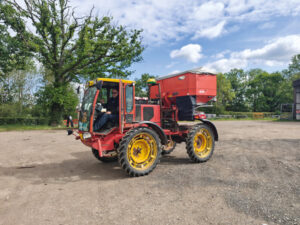
With each operation Kevin added, he was able to expand the farming side of the business a little more. Bit by bit, he took on stubble-to-stubble contracts, eventually getting up to just over 400ha of arable ground. He upgraded his tractors and invested in kit to keep this side of the business going, including a Claas Lexion 460 combine harvester and an original Agribuggy 1000 sprayer, with a fabricated frame that means the sprayer tank can be removed and replaced with a fertiliser spreader.
“The cost of equipment is such that I’ve had to rely on machines that I know will keep going, and that can be repaired in the yard if something does go wrong,” he says. The Agribuggy has proven its worth time and time again, Kevin adds.
The low weight of the machine means that even with the extreme weather events of the past few years, he has been able to continue operating, applying vital crop protection products at the right timings when others have struggled to get on the ground.
Can’t buy efficiency
The ongoing pressures on farming have significantly affected Pasture Care, and Kevin has found himself having to adapt more quickly than ever to remain profitable.
“I like to think I’ve always been slightly ahead of the curve,” he says. “But I don’t have the scale to compete when other contractors catch on.”
In 2022, when he purchased the Zürn Top Cut Collect mechanical weeder, he packed up conventional baling. “I only had two big customers left, and one decided to retire. To be honest, it was a relief because I was caught. My costs were going up all the time; I couldn’t justify investing in newer equipment, but I also didn’t want to let people down,” he explains.
At the same time, he saw the stubble-to-stubble work decreasing as more farms looked to development or environmental schemes to boost incomes. “The vast majority of that ground is now in herbal leys, or down as solar panels,” he says.
There have still been opportunities, however, just not in the same way. Kevin says you can no longer buy your way into efficiency gains, and there is only so much cost saving you can do.
“We’ve spent decades buying bigger equipment, and trying to maximise the area farmed so that the costs work out, but I don’t think that’s possible anymore, especially not for smaller contractors,” he says. “The big farms are getting bigger and are fully kitted out with machinery, so you need to offer them something that they either cannot justify or have not thought of.”
Instead, he has made tactical purchases to fill in gaps around the spraying and weed control. The latest is a 4.8m Simtech direct drill.
The reasoning behind this was similar to why he continues to use the Agribuggy – the lightweight design and the fact he can use a four-cylinder Valtra N174 on the front means he can get on the ground when larger equipment would make a mess. Focused on getting on wetter ground, he also specified the machine with blockage sensors.
“It also means I can continue working with those farms that have opted to go down the environmental scheme route,” he explains. “The Simtech is ideal for stitching in grass seed and cover crops, as well as working in arable rotations. It’s easy to maintain and will use less fuel than other machines on the market.”
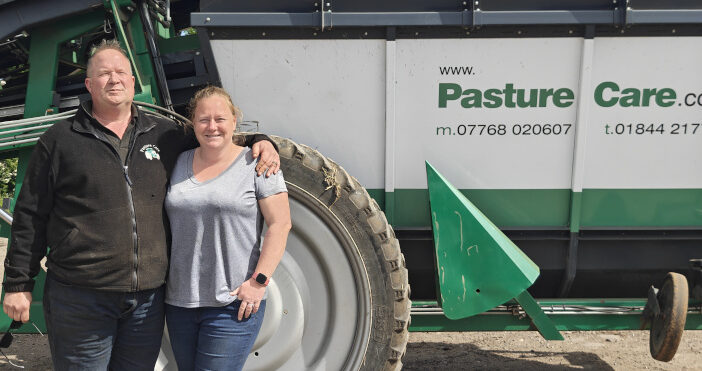
With his wife, Louise, he is also developing new outlets on the yard. They have set up a small van to sell coffee and farm produce to the cyclists and walkers that use the footpath running through and have expanded their poultry business.
“It started as a hobby, but it quickly got out of hand,” Kevin laughs. “We have built a processing unit where we can kill and butcher our own meat, both chickens and turkeys, and we are selling into local farm shops. I don’t want to be chasing work, so my focus has changed to having three or four key operations that are profitable; maximising my income without the expense.”