
A trip to the New Holland Zedelgem plant to celebrate 120 years of production gave us a chance to see how the company’s harvesting range comes together, as well as some of the latest products working in the field.
In 1906, Leon Claeys established a factory for harvesting equipment at Zedelgem, Belgium. It was a period of rapid growth for agricultural equipment worldwide – New Holland had been founded 11 years earlier in Pennsylvania, Henry Ford was a decade away from bringing mass production efficiency to the tractor market, and Fiat would introduce its first tractor in 1919.
All these milestones make up part of the history of CNH. Claeys introduced the MZ in 1952, Europe’s first self-propelled combine harvester, before being acquired in 1964 by Sperry New Holland (the result of another acquisition in 1947). In 1975, the company launched the TR70, bringing twin-rotor threshing technology to market.
It would take a few high-profile acquisitions to bring us up to date. Fiat Agri purchased grape harvester manufacturer Braud in 1984, two years before Ford acquired Sperry New Holland. Then, in 1991, the company was purchased yet again by Fiat Geotech. Throughout this, the Zedelgem plant has continued to play a key role in New Holland’s production of harvesting equipment, producing 240,000 machines since 1906.
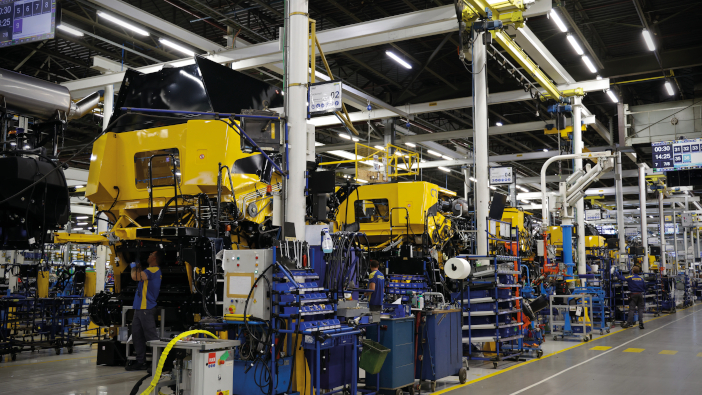
This has required investment. It would take a fair few pages to cover each update to the factory in the past 120 years, but focusing on the more recent past, in 2022 the company introduced fibre laser cutting machines, improving the processing of sheet metal during the component-making stages. This year, they were updated again with greater levels of automation and to reduce energy consumption.
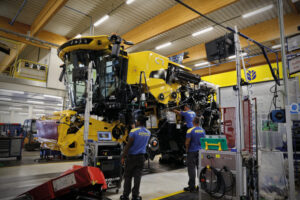 In 2023, the testing booths were expanded and updated. There are now four in-line booths, with the option to swap out testing equipment. In 2024, New Holland moved to an AGV assembly line, using automated guided vehicles to move sub-assemblies and machinery through the production cycle. Automated storage and supply chains have also been integrated into the system, enabling the company to track materials through the factory to improve traceability.
This year, and into 2027, the company is investing in automated bending equipment, which it says will boost productivity further and improve worker safety.
Large-scale harvesting
Up to 16 combines can be completed in a single shift. For the combine line, it was the introduction of the CR10 and CR11 machines that led to a significant redesign of how the factory operates, in part due to the size and complexity of the machines.
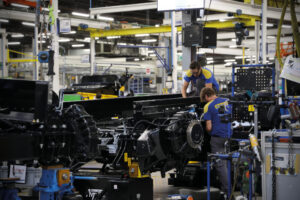
Zedelgem still runs a single production line, although this now makes a U-shape across the factory floor, with 32 positions – instead of 27 – and multiple sub-assembly points so that each key part of the machine can be bolted to the frame.
There is a bare-bones threshing unit at the end of a 60m conveyor. Crop is shipped into the factory and run through the threshing unit so that new components can be tested.
The plant is also responsible for the New Holland range of self-propelled forage harvesters, capable of producing two or three a day. Cabs come in from France, fully built and ready to be mounted, and there are demagnetisation units to ensure that parts around the metal detector do not interfere with the machine. Finally, up to eight large square balers come out of the factory each day, with a combination of both New Holland and Case IH models.
The production line for balers is set up so that each section should take one hour, with sub-assemblies coming onto the main production line.
Zedelgem has one paint shop, which is scheduled and automated to maximise throughput. A primer is applied, with some manual intervention to ensure that all components are fully covered, followed by the powder paint.
 Factory’s role
During a Q&A after the plant tour, we got a better indication of the factory’s role within the wider CNH system. One-third of all New Holland combines come out of Zedelgem, supplemented by two plants in Brazil, one in India and one in China.
A key change in recent years has been the shift to greater automation in the combine portfolio, with 80-90% of CR combines now being specified with IntelliSense, which monitors crop conditions and machine output and
makes adjustments to key components to keep the machine running at its optimum.
When asked if there was a chance for the IntelliSense system to be brought down to the straw walker models, we were told that there is some customer interest, but the differences in machine build present some complications. It is also a question of scale, as only 25% of the current production is straw walker machines.
Interestingly, the company saw its best year for combine production in 2023, coming out of the recovery period of Covid-19 and before global conflicts put greater pressure on input costs for growers. While production is currently running below capacity, the company said the updates to its line mean Zedelgem will be able to meet whatever demand there is.
Out in the field
Of course, we didn’t fly out to Zedelgem without seeing some machines working in the field, and New Holland had updates to its product line to show us. First was a series of developments on the FR Forage Cruiser self-propelled harvester range, including a 12-row maize header with a choice of large or small drums – although 70% of Europe will opt for the larger units.
An integrated wheel is also available to improve road transport of the header. The header is driven by an independent motor, enabling it to be run separately from the engine speed or forward speed, pulling forage into the machine, where it is pushed through four hydraulic feed rollers.
Swapping between maize and grass is said to be simple, which was especially important in the past two seasons, when growers took advantage of the mild autumn to get an additional grass cut. The FR also has what New Holland calls ‘the smartest spout in the industry’. It can be specified to include the NutriSense near-infrared crop monitoring system to detect and record feed constituents, as well as ForageCam to monitor the kernel processing score and suggest adjustments when this falls outside of the target.
IntelliFill automatically guides the spout to fill trailers evenly, while CropSpeed is a radar-based system that warns the operator before a blockage can occur.
There was another chance to see the WD170D+ wheeled loader – dubbed Forage Power, as it was specifically
designed for clamp work – with a reversible fan, Z-bar linkage and torque converter lock-up from first gear, and an engine output of 255hp and 1,300Nm.
A novel introduction for the company’s Big Baler range is Lidar guidance, which monitors the windrow and automates the steering, making it easier to collect forage when working around obstacles or when the man on the rake has left a curve in the row.
We also got the opportunity to drive New Holland’s new T7 XD tractor range, which was introduced at Agritechnica. Compared to the specialist T8 range, the company wanted to combine the power output with a more compact design that makes it suitable for in-field and on-road operations.
The range is powered by Cursor 9 engines, with a structural sump, featuring an engine brake, and the whole driveline has been beefed up to meet the demands. The transmission is split into four ranges, which the company says provides four points of optimal power transfer. Independent wheel suspension provides additional comfort and, depending on the region, the machine can reach up to 60kph.