


A contract with a local AD plant sees family-run farming and contracting business R & L Anthony Ltd, based near Bridgend in South Wales, handle around 70,000cu m of digestate every year. This is utilised by the 1,400ha arable enterprise as a valuable sustainable nutrient source.
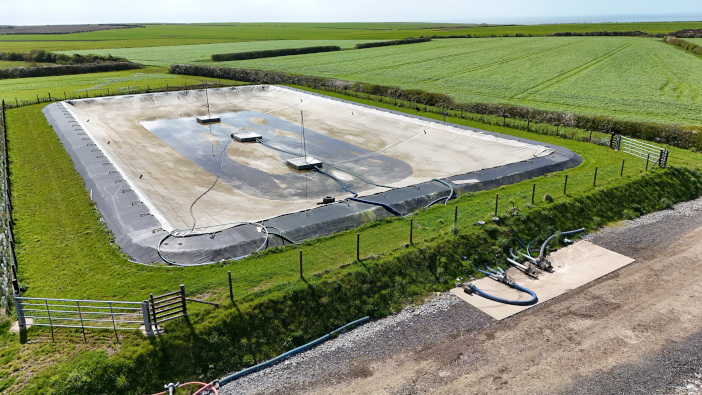
Digestate storage has to be both practical and environmentally secure, and three years ago the business chose a 4,500cu m Albers Alligator Bagtank supplied by UK importer Tramspread.
“We looked at several other options, and visited some 20-year-old Bagtanks to see how they’re performing,” explains Richard. “Being completely enclosed means we only remove what we put in, rather than adding a lot of rainwater. This design of Bagtank can be emptied completely – the sides slope down to a sump in the middle so there’s no sediment left behind.
“Digestate from food waste can contain grit from eggshells which don’t break down, and with the Bagtank it doesn’t build up,” he continues. “It has electric mixers which we run the day before and during spreading, and a couple of times over winter, and we’ve never had any issues.”
The partially recessed Bagtank is a permanent store with a low profile. Being self-supporting, it doesn’t require foundations, just a shallow earth bank with bag protection. The necessary groundworks were completed in-house during winter 2022 with the Bagtank installed in January 2023.
“It took less than two days to install the bag,” recalls Richard. “We were told we’d need 20 people, but this was only for a couple of hours during the final positioning. We had digestate in it that afternoon to settle it, and it’s been faultless since.”
The filling and emptying ports are positioned on a dedicated concrete pad which drains to an easily-emptied holding tank that catches any spills.
The Bagtank is located just over half a mile from a coastal path, and it’s screened from view by its earth banks. A fence prevents unauthorised access, and a double hedge has been planted on the exposed side for shelter.
“If I’m going to do something, I like to do it as well as I possibly can,” concludes Richard. “The Bagtank has no environmental impact, which was really important to us.”