


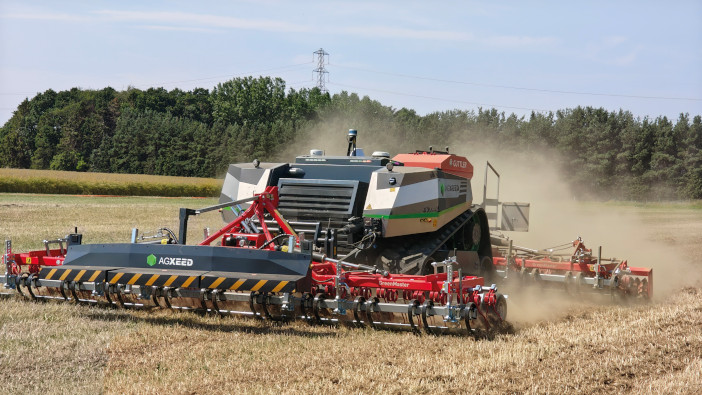
Based just outside Morpeth, the grassland and slurry specialist opened its doors to highlight updates to both the site and the product range.
Developed out of the Wox family contracting business, Wox Agri Services started with an agreement with German
manufacturer Güttler, initially bringing replacement rollers for power harrows.
In 2005, this developed into a full distribution agreement, with Wox importing and selling the GreenMaster tine harrow and overseeding system.
“It takes time for a new product to be accepted on the market, but we toured the country with that machine,” explains Geoffrey Wox, Wox Agri Services director. “We attended every sheep and cattle event we could find to highlight the benefits.”
It uses a front ripper board to pull out thatch and old growth from the sward, followed by two rows of harrow tines. Various specifications are available to suit conditions and different horsepowers.
The standard mounted unit has Güttler’s prismatic integrated into the build. According to managing director Hans Güttler, who attended the event, the inclusion of the roller came from observing livestock grazing grassland.
“If we look back at how we used to reseed grassland, we would let the grass go to head before we cut it, then we would sort the stalks and leave the seeds in the field. When we let animals in to graze, their cloven hooves would press the seed into the soil. Our roller imitates this on the GreenMaster.”
He adds that another benefit is that the design stops the roller from smearing the soil when turning on the headland, and as each link angles to the side, it provides additional consolidation to the tine rows.
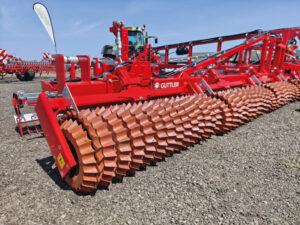 Larger models of the standard GreenMaster (6-8m) are mounted, with the seeder box over the tine harrow. These come with a coupling point so that the roller can be trailed behind. The Compact variant integrates the roller once again, even at wider widths, while the Alpin – designed for hilly regions – mounts the ripper board and harrows at the front, with the roller and seeding unit at the back of the machine.
The most recent updates have included hydraulic adjustment of the unit and a hydraulic fan for the seeder box. There is also the option of synthetic rings on the roller, using the same design to retain the aerating effect on the soil, but keeping the weight down.
“We recommend running the GreenMaster twice – each time at a different angle – to get the best coverage,” says Geoffrey. “It’s like two coats of paint instead of one. It always looks better.”
Hans adds: “It would take a standard grass harrow three passes to match one pass of the GreenMaster, so running twice is the equivalent of running six times with another machine.”
Putting tines in the ground
Another Güttler product that has proven successful for Wox is the SuperMaxx tine cultivator, with the option of a seeding unit. Geoffrey says there had been demand for tine drill, but when it was launched in 2007 there was some scepticism about the machine.
“That changed when we had a very wet autumn in 2008,” he says. “Our demo run after that proved the benefits
to a lot of growers.”
The narrow 12mm tines can be spaced out across either five or seven rows, depending on the amount of residue in the field. Each of these are protected with a double spring, which creates a vibrating effect that spreads to neighbouring tines to fissure the soil. There is no roller on the SuperMaxx models. Instead, at the rear, twin rows of tine harrows drag soil back over the working area.
Geoffrey says he had sown all his cereal crops with the SuperMaxx on the family farm around the site, and the crop of LG Typhoon he showed us on the day looked even and healthy.
“There is a serious issue with costs at the moment. Firstly, I genuinely do not see how some farms can justify the cost of a new drill,” he says. “Whether it is used as a cultivator or a seed drill, the SuperMaxx can reduce fuel consumption to as little as 5 litres/ha with the 5m model on the back of a 120hp tractor.”
The SuperMaxx can be fitted with a 610-litre mounted seeder unit, but Geoffrey recommends combining it with
a front tank and press to balance the tractor and increase capacity.
More generally, he is critical of the move to cover crops and says integrating well-cared-for grassland will be more beneficial to many farmers.
“A lot of cover crops have no inherent nutritional value and are doing very little to the soil that grassland cannot do. With a five-year grass ley, you can overwinter animals and get high-value silage crops, while improving the overall resilience of the field.”
 Application technology
Wox Agri Services not only distributes products within the UK, but also manufactures its own slurry application
technology, as well as offering Gollmer and Hummel drag hose and Shug couplings.
There was a novel experiment done on the day with a length of drag hose pulled between two Fendt tractors to
show the strength.
Geoffrey says the hiring of Edward Collins kickstarted the company’s own manufacturing process. “Edward worked on the contracting slurry application side of the business and could see ways that would improve the operation.”
After a trip to the US to see if there were suitable alternatives, the company developed the Invader engine pump, with a Volvo engine, in 2010, and followed this up with the Tempest mounted reeler in 2014. The Viper hose humper came in 2016, followed by an offset variant in 2022. This was launched alongside the Scorpion reeler, which has an integrated driveline and capacity for 1,000m of six-inch pipe.
“There is a clear crossover market for both our slurry equipment and the grassland conditioners from Güttler,”
says Geoffrey.
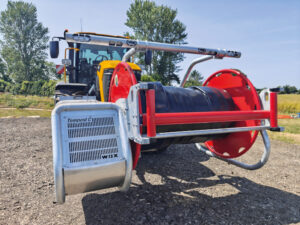
On the day, the company introduced its next innovation for slurry application – the Tempest C mounted reeler. This differs from the original version as it has an integrated compressor mounted at the side. It comes with many of the standard features, including an integrated, sealed drive unit and a front grip to push slurry out of the pipe as it is reeled back in.
The actual reel is narrower than the standard Tempest to ensure that the compressor fits within the same width,
which means capacity is reduced to 600m of six-inch pipe, rather than 800m or 1,200m on the standard, but the
compressor enables the line to be fully purged with minimal effort.
The compressor unit is imported from German manufacturer Rotorcomp, with a tooth belt drive, start-stop from the cabin and sensors that stop the unit if the temperature is too high, or if a filter is blocked.
A neat feature is the laser-cut ‘bash bar’ that is mounted above the reeler and stops pipe swinging back into the tractor windscreen when it is retracted.
New workshops and pre-owned machines
As part of the event, Geoffrey gave us a tour of the newly completed workshop, where Güttler equipment is assembled, shafts and spare roller rings are kept in stock and second-hand equipment is refurbished.
There is a welding bay, but Geoffrey has kept all non-essential equipment to a minimum. “I can’t see how some
companies justify having their own steel-cutting equipment or painting bays. There are local companies that
provide that service.”
The workshop was recently extended to provide more stock room and greater space for assembly, and Geoffrey has invested heavily in the site to make it a nice place to work. This includes underfloor heating for winter work. Solar panels are mounted on top to keep costs down.