


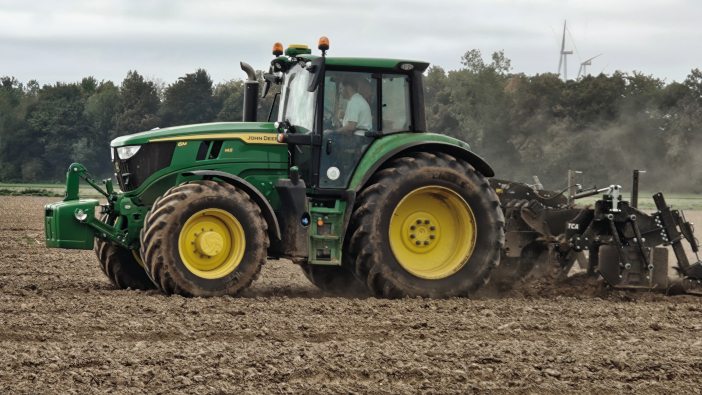
A cab overhaul and updates to the suite of technologies might not sound like the biggest launch, but John Deere is betting that greater functionality and comfort across its 6M and 6R ranges are key for its farming and contracting customers.
Chris Wiltshire, tactical marketing manager, John Deere UK, explains that the company wants to be able to offer ‘something for everyone’. Many of the options and functions previously available on the 6R and larger machines have been brought down to the 6M range so that growers using tractors from 150hp can have greater access.
“We expect some shifting between the ranges from certain customers; those who wanted more comfort and technology, but didn’t necessarily need the larger 6R,” he says. “However, our updates to the 6R and range of packages will continue to make that appealing to those who need a larger frame, precision and comfort.”
Scott MacKenzie, go to market manager for the 6M, walked us through the range, which covers 17 models across five frame sizes. This starts with the short-frame 6M 95, 120hp with Intelligent Power Management (IPM) from the four-cylinder PowerTech EWS engine.
Four-cylinder models run up to 177hp with IPM, before the six-cylinder PowerTech PVS is introduced for models between 171hp and 249hp. The large-frame 6M 240 and both extra-large-frame models use the PowerTech PSS engine, topping out at 281hp with IPM.
It is at this top end where one of the biggest changes has been made. Most six-cylinder models (barring the 6M 185, the 6MH 155 and the 6M 240) are now available with the newly developed 50kph e19 transmission. Smaller models retain the PowrQuad, AutoQuad and CommandQuad options, and the continuously variable AutoPowr is
available across the range.
It is built around the PowrQuad gearbox, with a new double-clutch design for smooth shifting through the 19 gears. The mechanical transmission features proportional valves, along with sensors – such as an inclination sensor – and an intelligent engine management system to automate functionality.
Jumping into the cab, we were able to put the e19 box through its paces. In fact, we were able to test some of the extremes of it. That management system will automatically adjust the gearing when under load, minimising the risk of stalling.
We were told to speed up to 15kph and then drop the mounted cultivator into the ground. Not great for the wearing parts, but a decent test of the machine under peak loads. We made a mistake, hitting the wrong saved cruise control and dropping the cultivator before we realised we were rapidly accelerating to 25kph.
 Sometimes, a mistake can be the best test, as while the deceleration was possibly a little more sudden than John Deere would have liked us to see, the tractor did automatically move back down the gears and find a comfortable speed and gear for us to operate at. To further automate the system, skip shift will jump multiple gears based on acceleration and load to help the machine get up to speed quicker, while scroll shift keeps the clutches partially engaged for faster shifting.
According to John Deere, these additions help to cut fuel consumption by about 5% when compared to its CommandQuad Plus gearbox.
New control scheme
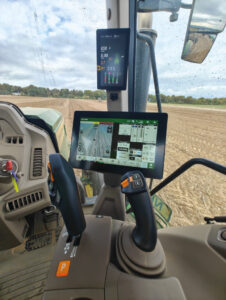
While the cab build remains the same as on the previous generation, the new layout has brought the 6M in line with the company’s larger machines. Customers can start with a basic set-up, with mechanical or electric SCVs and a corner display, and scale it up to a compact CommandArm layout with the G5 CommandCenter terminal and the CommandX Plus joystick.
There is a familiarity with this system, which John Deere believes will make it easier for operators in larger fleets to switch between tractors. The CommandX Plus becomes available on machines specified with the e19 and AutoPowr gearboxes, with six assignable buttons, two speed settings and Isobus control.
The display enables access to John Deere’s precision farming systems, as well as providing key machine data. Like on other machines in the John Deere range, the layout of the display can be arranged to suit the operator. It also comes with remote display access, enabling managers to support operators from the office, and dealers to access and diagnose issues.
We were impressed by the performance of the 6M in the field. The e19 gearbox was responsive, and the control layout felt intuitive. The fact that a base version is also available, and the lower-horsepower models remain in place for loader work, means there should be a machine to suit most farm sizes, although a full-specification model may be difficult to justify economically given the availability of packages on the 6R.
 New cab, new drive experience
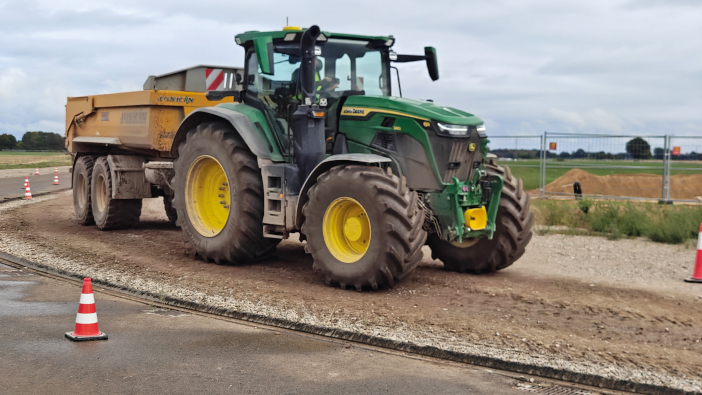
Speaking of the 6R, the large- and extra-large-frame machines (6R 180 up to the 6R 260) have undergone a series of updates. The 6R has always been viewed as a contractor’s machine, considering an increased amount of roadwork alongside in-field operations. These updates are based around this, with a new Sports Package Pro specification that the company says will provide more automotive-style comfort.
The TLS Pro front-axle suspension is a big part of this. The damping and suspension can be adjusted from the cab, and will work automatically based on the load, speed and driving conditions. Each set-up is also fully calibrated based on the frame of the 6R. This is combined with hydraulic cab suspension, with low-friction cylinders and a new cab mounting.
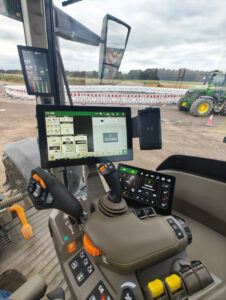
The cabin has been revised as well. The steering column is narrower and features automatic realignment, as you would find in a car. The steering system also adapts based on the speed, meaning it becomes stiffer as you speed up. The pedals are redesigned to give more automotive-like responsiveness. This includes greater deceleration when lifting off the drive pedal – matched by pulling back the drive lever – and progressive braking based on how firmly you press down on the pedal.
The frame has also been redesigned, with forward-angled C-pillars and an angled rear window for greater visibility.
Noise levels are reduced thanks to the relocation of the valves to outside the cab, and sound-absorbing material in the floor. The e19 transmission is now available, and the CommandArm and display provide access to the full range of precision farming systems.
 Getting behind the wheel
We were able to take the 6R around a small track, with a trailer behind. This wasn’t the ideal test, as we couldn’t achieve the top speed of 50kph (technically 55kph) due to the short straights, and to be frank, the updates made to the 6R are the sort you realise over a full day of work.
The cab is comfortable and quiet. Visibility is also excellent, as we could see directly down the sides of the steering column to the front axle. With the integrated front camera enabling a clear view of the front linkage, this will be ideal for those running triple mowers.
Control is easy and intuitive. We drove the 6R second and could really see the familiarity between this and the updated 6M models. As is sometimes the case when you can’t push the machine to top speed, we did find that the combination of seat suspension, cab suspension and front axle suspension seemed to battle each other over rougher sections, but at field speeds or top speed, this would likely even out.
We also found the deceleration to be a little sluggish when we lifted off the drive pedal, but this would be something you would get used to after regular use and would be able to better predict.
Rather than one big change, John Deere has opted for a cumulative effect with the 6R. Each new function may seem small in isolation, but together it does align with the 6R being a contractor’s machine. The focus on drivability will likely pay dividends for those covering long distances between the yard and the field.
Further to this is the single-line, fully integrated central tyre inflation system, which the company says can increase tyre pressure by 1bar in under five minutes.