


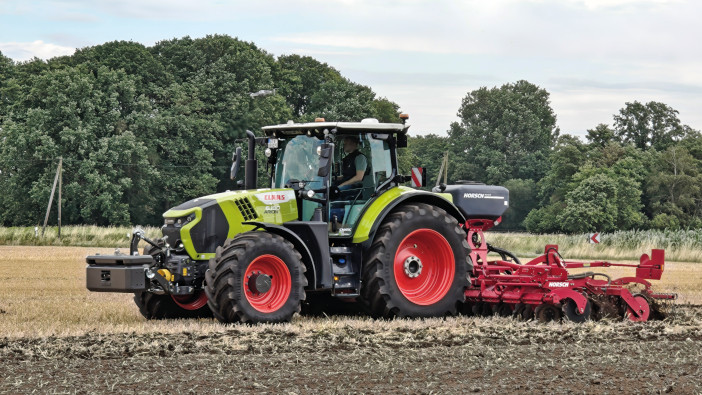
The past year has seen major developments in the Claas tractor portfolio, with the Axion 9-series bringing with it some key updates to modernise the high- horsepower range. These updates were so successful that the company walked away with the Tractor of the Year High Horsepower award at Agritechnica.
And the launches didn’t stop there. The Claas stand in Hanover saw another surprise in the shape of the Arion 6.190 Cmatic model. This flagship model boasts the Claas Power Management (CPM) system, a boost setup that pulls another 20hp out of the DPS six-cylinder engine, taking it from 185hp to 205hp. Maximum torque is 849Nm, available at 1,500rpm.
The 6.190 Cmatic also saw the new styling from the Axion 9-series brought down. The company has now filled out the range, adding the 6.160 and 6.140 machines. These retain the DPS engine, although without CPM, offering 165hp and 145hp, respectively, and torque levels of 703Nm and 640Nm.
Like the flagship, they are only available with the Cmatic continuously variable transmission. Developed in-house, the gearbox brings down the same intelligent functions as seen in the high-horsepower range, including Auto Load Anticipation, which detects potential load spikes – when implements are lowered into the ground, for example – and increases the engine speed automatically.
The trailer stretch braking system applies the trailer brakes when the drive lever is pulled back, which the company says will provide gentle deceleration, especially when travelling downhill, minimising the risk of the tractor being pushed and potentially jack-knifing. Wheeled loader mode simulates the driving characteristics of a wheeled loader to make loader operations smoother.
Importantly, these models do not replace the existing Arion 600 Hexashift range, but will be offered alongside.
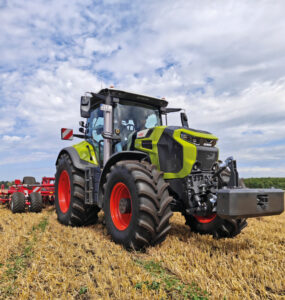 Greater operator comfort
As part of the new design, Claas has integrated the Proactiv front-axle suspension, and a fully suspended cabin. The option of a new operator’s seat, with semi-active suspension, massage functions and climate control, is available and the controls have been laid out on the armrest in the familiar Claas style.
The Cmotion multi-function joystick offers transmission and speed controls, as well as eight configurable buttons,
linkage control and the headland management system.
As a nice-to-have, the infotainment system can be specified with Apple CarPlay or Android Auto, while operational details, including machine parameters, Isobus and the Cemos machine learning system, are displayed
on the Cebis terminal.
As expected, the Arion 6-series is delivered guidance ready, with the option of GPS Pilot, while telematics data and job sharing are available through the Claas connect system. Dynamic steering is also available to halve the steering wheel turns from lock to lock.
Axion 8-series
Alongside the Arion 6, Claas has continued to integrate its new design, cabin and precision systems across the high-horsepower range. Newly launched, and available to order this summer, the three-model Axion 8 Cmatic series uses FPT engines to produce 240hp, 270hp and 290hp rated powers, with the Dynamic Power intelligent boost pushing this to 264hp, 291hp and 313hp.
Full torque is available at 1,400rpm, with the flagship 8.290 producing 1,282Nm and the 8.270 and 8.240 offering
1,215Nm and 1,132Nm, respectively.
Like the Axion 9, automation has been at the forefront of development, with intelligent adaption of the engine and transmission to distribute power across the machine as it is required. Auto Droop is also included, designed to reduce full consumption while providing the maximum possible power. The engine ticks over at just 650rpm, and it is possible to reach 50kph at 1,400rpm.
Auto Load Anticipation is included, while Cemos Dialog uses various parameters to make suggestions to the
operator to improve machine performance, including ballasting and tyre pressure recommendations.
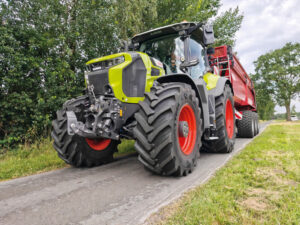 Automation continues through the GPS and headland management systems, enabling the machine to automatically start the pre-programmed headland sequence based on the GPS position. Using the Claas connect system, task information can be pre-loaded, and the system will suggest an optimal route across the field. During operation, the machine can automatically switch between reference tracks, based on the position of the tractor and the direction.
Full autonomy
Like the Xerion 12 and Axion 9, these three models can be fitted with a vehicle control unit (VCU), which connects to the Isobus to enable the tractor to complete tasks fully autonomously, including following reference lines, steering around obstacles and on the headland, and employing variable rate and section control when using application data.
Task data is shared live to devices linked to Claas connect, as well as machine parameters. While the machine works autonomously, the driver remains in the cab to monitor the quality of work. It is also possible to override the machine at any time.
Big tractor, bigger cab
The same cab introduced on the Axion 9 has been brought down to the Axion 8, with the familiar Claas control scheme, and a choice of seats, with 50deg of swivel movement (10deg to the left and 40deg to the right).
The Cmotion joystick is installed to handle the most common functions, while the ElectroPilot enables up to 30
hydraulic and Isobus controls to be configured.
Claas says the noise level in the cab does not exceed 67dB, while the new mechanical four-point suspension has
been tuned to work with the front axle suspension system, minimising the clash of movement sometimes caused by multiple systems working at once.
Around the back of the machine, the rear linkage has a maximum capacity of 9,700kg on the smallest model, increasing to 10,200kg on the others, while the standard front linkage can lift 5,900kg.
For hydraulic power, customers can choose between a 150-litre/min system or 205 litres/min, both of which are
load-sensing. The latter comes with the option of one 140-litre/min 3/4in coupler.
 Five new Volto models
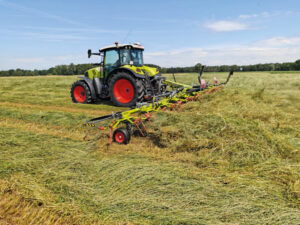
Alongside the tractor launches, Claas announced a series of new tedders, positioned below the 1300-1500 TS range, which was revealed back in 2024.
The five new models share a lot of features with the larger units, including a new power train with sealed rotor
gearboxes, reinforced rotor shafts and a fine-tuned spreading angle adjustment. Four of the models are mounted,
starting with the Volto 700 with six 1.5m-diameter rotors for a working width of 6.6m. The 800 extends to 7.7m, with six 1.7m-diameter rotors; the 900 is 8.7m with eight 1.5m rotors and the 1100 increases to 10.8m with 10 1.5m rotors.
The trailed 1100 T shares the same specifications as the mounted machine. Every machine is fitted with 9.5mm tines, which the company says enable the machine to collect the crop layer by layer.
The Permalink HD drive uses finger clutches to transfer power, even when angled up to 180deg, as well as sealed
gearboxes with input shaft speeds that have increased by 50%.
Mounted models feature a new compact support frame that keeps the centre of gravity close to the tractor, while
the mechanical suspension has been swapped out for a hydraulic system that helps to centre the machine when lifting and lowering, as well as stopping it from rolling back on slopes.
First look at electric Torion
At Agritechnica, Claas showcased a new all-electric version of the Torion 537 wheeled loader. During the event, we were able to get a closer look at the Liebherr-built unit.
As standard, it uses a 32.3kWh lithium-ion battery, with space under the hood to specify a second unit to bring the capacity up to 64.4kWh. According to the company, the single-battery unit has an average running time of eight hours, depending on the operation, with regeneration when braking or travelling downhill. A choice of charging systems is available, bringing the charging time down to just 90 minutes.
Beyond the change in power supply, Claas says the Torion 537e Sinus is comparable to the diesel model. It has an
operating weight of 5,910kg and breakaway forces of 48kN, thanks to Z-bar kinematics.
Hydraulic supply is rated at 75 litres/min for fast response times, and the Smart Loading system is available to coordinate different functions during repetitive tasks.