


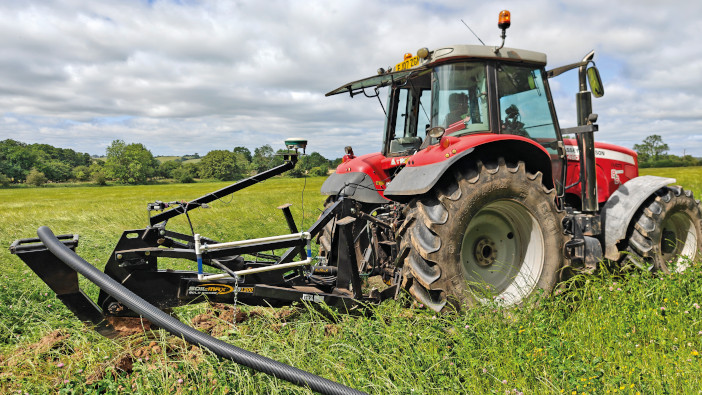
Imported into the UK through drainage contractor Tony Bullock, the Soil Max range of machines is designed to put drainage operations within reach of farmers and new contractor entrants.
Based just outside Draycott, Tony Bullock has been draining since the 1980s, now joined by his son, Tom, who splits his time between drainage and work on the family dairy farm in Eccleshall.
Tony says he was ‘being nosey’ on social media in 2022 when he saw a video of a Soil Max drainage plough
working in America. “I messaged Cody Harrison [head of business development for Soil Max exporter Farm-X] and went to see him at that year’s Cereals,” he says.
“From there, we started helping out with open days and demonstrations, hoping to show that you don’t need a huge self-propelled machine or a massive tractor and trailed unit to install, replace or maintain drainage channels on farm.”
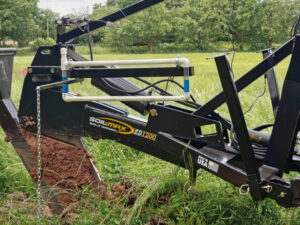
The Soil Max range includes two tractor-mounted models, the ZD1200 and ZD1600, and the Pull-Type trailed unit. All are built from T1 steel, which the company says provides excellent tensile strength while reducing the overall
weight. Hardox-equivalent wear points are bolted onto the soil-engaging edge to limit maintenance costs, although this will depend on soil type.
The 1200 can put in lateral pipes up to 130mm at a depth of 1.2m, while the 16000 can handle pipes up to 290mm at depths down to 1.6m. Tony says horsepower isn’t really an issue; instead, you need a well-ballasted tractor. In ideal conditions, the 1200 can be mounted on a 4.5t tractor, increasing to 9t for the 1600, but he recommends ballasting up to about 8t for the 1200 to ensure traction.
 The Pull Type can work down to 2m, laying 290mm pipe, and needs an 11t tractor up front.
While it’s not recommended to install drainage systems in less-than-ideal conditions, if traction is an issue, each model has a tow hook. This means an additional tractor can be attached, adding the required traction without
putting torsional stress on the mounting tractor.
Getting it right
“The big benefit is cost,” Tony says. “Drainage is vital to keeping fields in good condition, but the cost of entry is huge. These are priced so that larger farms can justify the investment and maintain fields with lateral pipes, or mains if one of the larger models is chosen.”
It can also provide an entry point for contractors looking to diversify. The fact that it is a plough-type drainage unit means work can be completed faster than with a trencher. It enables smaller jobs to be completed within a tight time frame such as the window between harvest and establishment of the next crop.
When we visited Tony, we saw the 1200 model in action, mounted on a Massey Ferguson 6480 with just 145hp under the bonnet and a small ballast on the front.
The dry ground and grass coverage meant traction was a little tricky at times, but Tony and Tom went through the process of pre-ripping before putting the pipe through.
Each machine can be specified from a simple unit with hydraulic adjustment, enabling the depth and angle of the blade to be adjusted via the tractor spools, with a water level mounted on the machine for a clear view of how the plough is positioned underground.
“From here, we can bolt on a series of extras to make operation easier,” Tony says. “Laser guidance is available, as is a gravel box if required. It can also be linked to a receiver and any guidance system with a water management module.”
Guided drainage
The unit we saw used the AgLeader system. Tom walked us through the terminal and how it worked. “Once you
have your base station set up in the field, you enter survey mode and drive up the first row where you want to lay your pipe. Then you enter your minimum and maximum depths, the size of the pipe being used and whether you’re going to pre-rip the site or not,” he says.
If pre-ripping, you can input the offset. “When you’re installing drainage systems, you want the pipe to lie on fresh, unworked ground, so you pre-rip just above the desired depth,” he adds. “This makes its easier on the tractor, especially if conditions are tricky.”
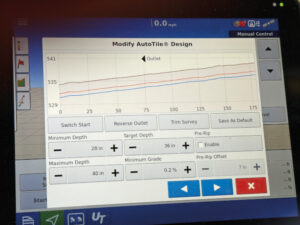 Once all the data has been processed, the guidance system will automatically adjust the depth of the plough within the window of the minimum and maximum depths, allowing the operator to focus on adjusting the tractor based on conditions.
“It’s a really simple system,” says Tony. “But that doesn’t mean it is for everyone. You still need to understand the concepts of drainage; where the pipe needs to be laid and whether there are any obstacles in the field.”
In fact, the Soil Max range will help with this approach, Tony believes. By having an effective drainage system at a
cost-conscious price point, farmers and contractors can take their time and install systems piece by piece.
“If you’ve got a wet spot in a field, work from the outside towards the centre of the worst-affected area,” Tony concludes. “Sometimes a couple of laterals at the outskirts of the area will solve the problem, saving you time and money. If it doesn’t fix the issue, you have the machine to add more pipe as needed.”