
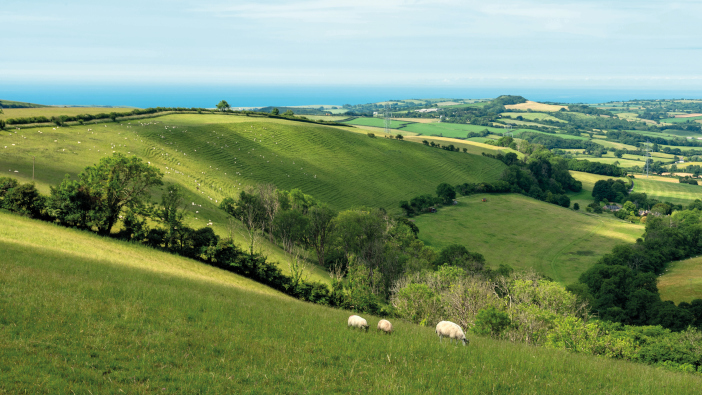
The first-ever Land Use Framework has been published; a plan to deliver new homes, nature restoration, clean energy and food security. A statement from Defra says that the Framework ‘demonstrates clearly that there is enough land to deliver the government’s objectives, provided we use land more efficiently’.
It is based on advanced land use analysis and sets out plans to maintain food production in England by updating land classification and mapping to ensure the best farmland is used for this purpose, with any impacts of land use change monitored through the UK Food Security Reports.
Sector growth plans, including those announced for horticulture and poultry, will be used to improve productivity and profitability, while tenant farmers will receive increased support thanks to reforms to the Farm Tenancy Forum.
Payment systems are to be simplified, and land data submissions will be digitised to streamline communication between farmers and government bodies, and up to £50m will be made available for farmers to trial sustainable management systems on lowland peat, as well as agroforestry and other resilient farming approaches without being locked into permanent changes.
The new Farmer Collaboration Fund will unlock around £30m for collaboration between farmers to support land use change.
As well as protecting food production, the Framework aims to ensure that enough land is available to meet Environmental Improvement Plan targets, with the Environmental Land Management Schemes being used to help growers adapt to climate change.
Financial incentives will be available for farmers to focus on areas that will have the greatest impact and new guidance will be made available for planners and tree officers to fill urban parks, woodlands and streets.
The report comes as the Department for Energy Security and Net Zero announced plans to cut red tape and allow farmers, as well as other businesses, to install a single, small onshore wind turbine without planning permission.
The full report can be read here.
Environment Secretary Emma Reynolds, in a speech at the Royal Institute of Chartered Surveyors, said: “Our land is a vital national asset, but it is finite. We cannot be held back by the false choices between building homes and producing food, restoring nature and supporting farmers, or delivering clean energy and protecting landscapes.
“With better data, smarter tools and strategic planning, we can meet all these needs. This ensures people can manage their land in the way that works best for them while unlocking growth, strengthening food security and protecting our environment.”
Jake Fiennes, Director Conservation, Holkham Estate said: “How we use our land has never been more important. As we balance the needs of nature, food production, energy, housing and infrastructure, Defra’s Land Use Framework is an important step towards a strategic approach.
“I am pleased to see Defra’s Land Use Framework published today and am fully supportive of its ambition. This framework should act as a helpful guide to use land is the most efficient and effective way.
“The Land Use Framework provides the opportunity for change and a new way of thinking about how we best use our land.”
Industry response
NFU President Tom Bradshaw said: “It’s positive to see an explicit recognition of multifunctional land use and a commitment to maintain food production within the framework. This commitment, alongside the repetition from Defra that food security is national security, is vital as the global geopolitical situation continues to become more uncertain with the war in the Middle East and ongoing war in Ukraine.
“The Land Use Framework is a step in the right direction, but challenges remain about delivering against the ambitious objectives as the first 2030 milestone approaches. Delivering on all objectives with existing land is an ambitious aim and will require clear guidance, the right policy framework and incentives, to avoid unintended outcomes and ensure that all farmers and growers are able to meet the ambitious productivity objectives within the framework.
“Important questions also remain on a long-term vision for food and farming. From the 25-year Farming Roadmap to the delivery of the Farming and Food Partnership Board, we want to work with government to drive these policies forward to create confidence and profitability for farming and growing businesses and ensure 2026 sees British farming achieve all it is capable of.
“We will work through the detail of the framework and will continue to engage with Defra with further feedback from farmers and growers.”
Glen Tarman, Policy and Advocacy Director at Sustain, said: “The publication of the Land Use Framework is a genuinely significant moment for food and farming – this is a policy tool that has been talked about for years and which has the potential to help join up the many competing demands on England’s land. We are pleased to see it finally arrive, and our consultation response, backed by 21 organisations, helped push for the stronger, more ambitious framework than many feared.
We particularly welcome the emphasis on multi-functional land use, valuing the multiple ways that land can deliver for food production, nature recovery, climate goals and energy, and it is a welcome advance to the fragmented approach of the past. Although hard choices are still to come on land use, this publication is a positive beginning to build from. The Framework’s principles must now be matched by funded, joined-up policy – from improved Environmental Land Management schemes to far better cross-departmental working – if it is to drive real, equitable change on the ground.”
Martin Lines, CEO at Nature Friendly Farming Network, said: “We have long said that farms can do much more than simply produce food, and this report rightly highlights the wide range of goods and services our industry can provide. Its emphasis on multifunctional land use – delivering multiple outcomes from the same piece of land rather than separating nature and food production – must be at the heart of our thinking for the future.”
Vicki Hird, Strategic Lead for Agriculture at The Wildlife Trusts, said: “The Land Use Framework must guide how land is used and managed – for food production, development, renewable energy generation and other multiple purposes – whilst creating the vital space for nature to be restored and climate adaptations delivered. The Framework marks a positive change in Government’s willingness to deliver changes in land use at scale. However, the scale of the environmental challenge means that today should be a starting point for further action and ambition, such as an increased budget for the nature-friendly and climate-resilient farm transition.”