


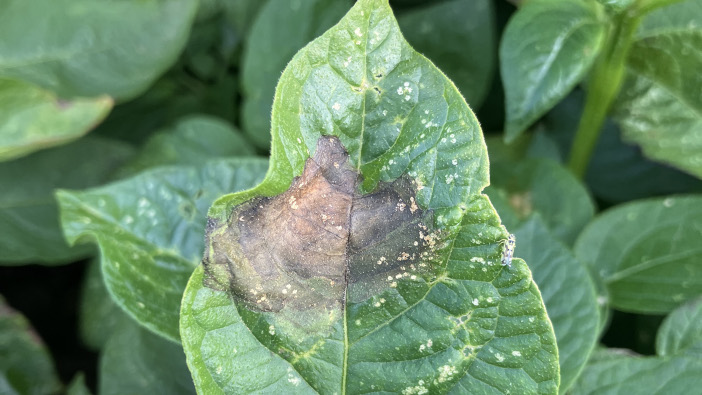
New data from Richard Austin Agriculture has demonstrated how biostimulants can reduce the impact of late potato blight and increase yield.
It comes as the first case of the EU_43 blight mutation has been seen in the UK.
“Blight control is becoming increasingly challenging as new strains continue to emerge and resistance to some fungicides continues to develop. This trial looked at how biostimulants such as Sirius and Trident Plus could be used alongside a conventional fungicide programme to support crop performance.
“The results were encouraging in terms of yield and crop response, but further field-scale trials will be needed to better understand their role within an integrated approach to late blight management,” says Richard Austin Agriculture trials manager, Michael Rodger.
The variety Melody was used, with biostimulants applied from July to October, along with fungicides Enervin and Privest. The best yield from the trials came from a mixture of Sirius and Trident Plus, which also had a comparable percentage of blight infection to using just Privest and a lower percentage than the combination of Phusion and Enervin.
“Biostimulants may help reduce the impact of late blight indirectly by improving plant resilience rather than directly controlling the pathogen. Silicon can strengthen plant cell walls and create physical barriers that make infection more difficult. It can stimulate natural plant defence responses so the crop reacts more quickly to infection,” adds Michael.
He suggests that the improved plant vigour, nutrient uptake and stress tolerance that can be seen from biostimulant applications help to maintain plant growth and yield.
“Some products may also influence leaf surface characteristics, which can make conditions less favourable for pathogen establishment. When used alongside conventional fungicide programmes, these effects may help support crop performance and contribute to an integrated approach to blight management,” he says.