


Limagrain Field Seeds is expanding its variety trials with a new UK farmer-led demonstration network.
The company hopes that this will give growers a more practical view of how varieties perform in real-world conditions, separate from small-plot data.
Nicolle Hamilton, marketing director at Limagrain, says the aim is to give growers a different perspective.
“We want to offer growers a more meaningful way of looking at our varieties—through a farmer lens,” she says. “That means taking them out of controlled conditions and putting them into real farming systems, managed by farmers making commercial decisions every day.”
She added that while formal trials and the AHDB Recommended List will remain benchmarks, they do not always reflect the realities of field-scale farming.
“This is not about replacing trials—it’s about adding another layer,” she says. “Farmers want to know how varieties establish, how they cope with different soils and how they perform under lower inputs or after cover crops. That is where this approach adds value.
“It’s about working with farmers, listening to them and learning from them.”
Heather Oldfield, cereals product manager, adds that the focus will not be on identifying a single, standout variety, but understanding where different genetics fit.
“There is no perfect variety,” she says. “Success comes from putting the right variety in the right place. What works on one farm may not work on another. These Demo Farms help us show those differences in a way that is much more relevant to growers.”
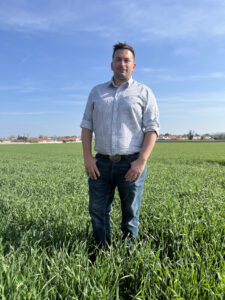
The farmers
The first two farms in the network are based in Suffolk and Staffordshire and are said to offer two contrasting systems.
Ryan McCormick hosts the East Anglian site at Dennington Hall Farms, with a highly integrated system that combines arable, livestock and environmental management.
The farm has a 12-year rotation and an emphasis on soil health, with cover cropping, minimal cultivation and livestock grazing. His trials include comparing multiple varieties under different establishment systems within the same field to give a clear view of how different genetics respond.
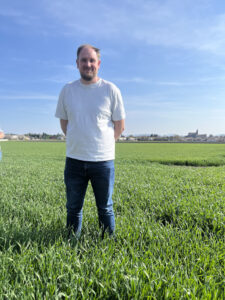
In contrast, Rob Atkin’s Staffordshire farm operates across a wide variety of soil types, from heavy clay to high organic-matter silt. The farm includes combinable crops as well as beef and sheep, with a growing focus on soil health and cost control.