


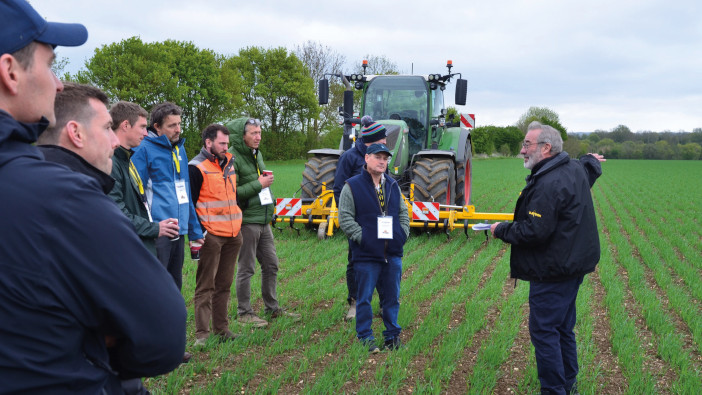
Change was the theme of Claydon Drills’ open day, held at its Wickhambrook Farm and HQ in Suffolk.
The need to reduce costs due to poor grain prices drove the development of the first Claydon drill. “Change nothing and nothing changes,” said export manager Simon Revell as he took visitors through the soil pit.
He questioned whether those who don’t change will be forced to do so. He noted that growers in southern European states like Bulgaria and Romania are having to abandon some crops, after getting just 350mm of rain and summer temperatures of 40 °C, often for weeks on end.
It was rather apt that as we toured the farm, there wasn’t a cloud in the sky, with a brisk wind blowing over already dry soils. The crop of Bamford wheat, drilled on 28 September, looked good, despite no meaningful rain falling throughout March and April. One reason, said Simon, was that it had put down roots quickly thanks to a living and well-structured soil.
Soil heath
With no organic manures, soil health is achieved through a combination of chopped straw, minimal disturbance and the biological benefits of catch and cover crops. Digs across the farm found worm counts as high as 52 in a 20cu cm block. “They work for free, and where worms go, roots will follow,” he said.
The farm aims to improve soil resilience. The Hanslope clay has responded well to over 20 years of minimal disturbance, with organic matter now at 4%. “Every 1% increase in organic matter can boost the water-holding capacity of soil by 275,000 litres/ha,” Simon added.
More importantly, perhaps, reducing soil leaching and improving the availability of nutrients to plants can equate to 13.6kg N/ha. Phosphate is prone to locking up in heavy ground, but the Claydon system and catch and cover crops help to free it up.
Now fully integrated into the rotation, the system has a summer catch crop, followed by a winter cover and then into winter wheat or a spring crop, with the same catch and companion, before a second wheat or spring crop.
There are added benefits. The combination of summer catch, overwinter cereal and spring oats gives three weed-cleaning opportunities.
Claydon Drills CEO Jeff Claydon has no figures for the seed bank reduction, but he said: “You can just see we are going in the right direction. The humidity in the catch and cover crop is causing the weed seeds to germinate.
“I used to believe that stopping the weeds from growing between harvest and the next crop was the right way to go. But with soils being dry, they don’t germinate until the next crop goes in.”
 The spring oat crop was drilled on 23 March at 4cm to access a moisture band running through the soil. This and a friable bed are the key benefits of the root diversity from a fast-developing mix of phacelia, vetch, linseed, crimson clover and buckwheat.
Pulling up a plant revealed that the soil was still moist, and roots penetrated the soil. Some wet areas had needed mole draining and a roll, Jeff noted.
He admitted that, as it was only their first full season of catch and cover cropping, there is likely more to learn. Although it is probably not a deliberate Defra strategy, the Sustainable Farming Incentive payments of £163/ha for a SOM3 summer catch and £128/ha for a CSAM 2 multispecies winter cover made it easier to ‘play’ with the idea, he suggested.
He said the field of spring oats looks good above the ground due to what is happening below. “The soils have better structure and more life. Roots are getting down, and they are picking up the nutrients and moisture better.”
As a result, this season, much of the winter wheat was drilled in September, something he is keen to continue.
Jeff was asked why he didn’t just leave the summer catch in. He said it would cause too many problems, including slugs and a carpet of volunteers and grassweeds left to deal with later.
This is one reason why the catch and cover crops were sown at 80% of the recommended rate last season. Given the soil conditions, he was confident they would get away, plus he wants an open crop so he can spray off both with one clean hit.
Putting metal in the ground
When it comes to establishment, it is no surprise to hear Jeff say direct drilling is key. The principles of good establishment apply to catch and cover crops, too.
“You need moisture and good seed-to-soil contact to get the crop away. Moving soil adds time and can result in a loss of moisture. It can work, but the weather needs to be on your side.”
The straw harrow can be equipped with an applicator, but Jeff believes that broadcasting seed from this is just ‘taking a chance’. Broadcasting into a previous crop can create problems like higher slug pressure. Direct drilling is more reliable.
Jeff said it makes better use of the drill. “We are drilling catch and cover crops outside the winter and spring crop drilling window. Of course, there is a cost to it, with fuel, labour and wearing metal, but the payments cover this, and we’re getting the reward of the cash crop getting away, a more even crop and better soil resilience.”
Updated mechanical hoe
Claydon is trialling its Terrablade Inter Row Hoe with a Tillett & Hague camera system. It comes after problems with the RTK guidance system, where the machine veered from the rows in undulating terrain.
The system follows the rows using green/red ratio colour camera technology and corrects steering through the Isobus system. So far, some 30ha have been treated using the system to good effect.
In the field, the unit had done a good job of dealing with weeds. The front bar is set at 325mm to hold the blade flat and shear weeds off at the crown. It works in almost any crop established by a Claydon drill. The only point of caution is that care is needed with OSR. Even with the accuracy of camera-guided steering, wheel marks can cause damage to stems, Jeff noted.
