

 The recipient will exhibit successful rotation strategies, regenerative practises and disease management, while achieving consistent yields and showing a deep understanding of the markets
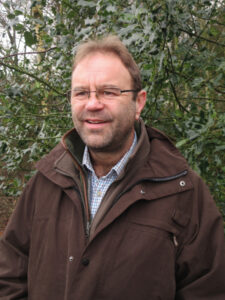
Colin Chappell – Chappell Farms
Winner of Protein Crop Grower of the Year in 2023, and a finalist last year for Cereal Grower, Lincolnshire farmer Colin Chappell runs a carbon negative arable operation growing milling wheat, milling oats and marrowfat peas, with the rest of the farm split between environmental measures, forage barley and occasional energy crops. Crusoe has been the wheat variety of choice until recently, with an average yield of 10.5t/ha and a carbon cost of less than 200kg CO2eq/t.
Winter barley has replaced rye as a forage crop, bringing harvest forward to get ahead of blackgrass, while seed crops of winter and spring wheat, winter barley and oats add a premium for the farm. The focus with all crops is nitrogen use efficiency, with total applied reducing by a third in the last five years, which, in turn, has reduced fungicide applications.
Companion cropping and three years of spring cropping within the wide rotation helps with weed control, while the addition of legumes ahead of the primary wheat crop enables nutrients to be recycled through the soil.
Russell McKenzie – DJ Tebbit
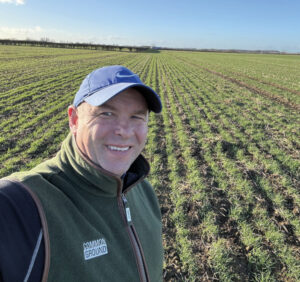 Russell McKenzie farms 140ha and has brought down the level of cultivations with the aim of reaching no tillage. The key crop is winter milling wheat, with yields exceeding 11t/ha using 260kg/ha of nitrogen, which he says is due to strong soil health and a mix of cover and catch crops.
Varieties are selected based on disease resistance scores and Russell aims to adopt a new variety each year, completly refreshing the staple over a four-year period. This is backed up by on-farm trials that allows him to recognise positives and negatives on his own soil. The chemical programme is tailored to each variety, allowing flexibility based on the prevailing challenges in a year. Biostimulants are now being trialled, with applications Luxor and Calfite said to boost yields by around 1t/ha at a lower cost to synthetic fertiliser.
Jamie Stokes – Stokes Farms
 Third generation farmer Jamie Stokes opts for a high input, high output approach across the 900ha Cambridgeshire farm, with spring and winter wheat, barley, beans, spring oats, some onions and rotational grass. He doesn’t aim for yield, instead looking at margins and profitability, benchmarking the farm against the Farm Business Survey and integrating flexibility into the rotation to tackle a blackgrass and ryegrass issues.
Sprayer capacity has been increased, enabling the farm to move quickly despite challenging weather windows. For the same reason, 14 different varieties are used across the primary crops to extend the drilling and harvesting windows, ensuring seed only goes in the ground when conditions are right. Profitability and quality of life are at the forefront of the business, with Jamie noting that practises are adopted for these reasons, but each has had the secondary benefit of reducing the farm’s environmental impact.
The 2026 National Arable and Grassland Awards will be handed out in a ceremony at the end of the first Agronomy Exchange event. For more information, head to www.agronomyexchange.com