



 Combining the remaining crop grower categories, as well as Farm Manager of the Year, the winner of Crop Grower will show a deep understanding of the markets they serve, as well as efforts to boost yields and margins, while minimising the environmental impact their rotation
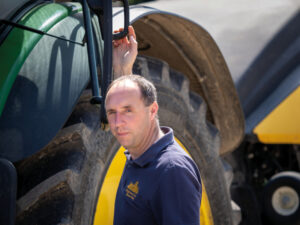
Simon Andrews – Porchester Farms
Winner of the 2025 Farm Manager of the Year category, Simon Andrews heads up Porchester Farms, part of a heavily diversified estate with arable and forage crops, as well as permanent pasture for 1,400 ewes. The arable rotation comprises milling and seed wheats, winter barley for seed and feed, winter oats which are milled onsite for the estate’s own horse feed business, winter oilseed rape and peas and beans for seed.
Grass varieties are chosen based on the end market, soil type and the length of ley. For performance racehorse feed, Shakira and Excellent are the preferred options. Maize is chosen based on the energy output, but earlier varieties are preferred as an entry into wheat. Where maize cannot be grown, wholecrop cereals are used for the digester and provide blackgrass control.
Efforts to boost soil health include the use of digestate and sewage sludge where possible, as well as reduced tillage. The business has also utilised alternative sources of nutrition, including fermented molasses, and uses tissue sampling to adjust applications to the plants needs.
Richard and David Anthony – R & L Anthony
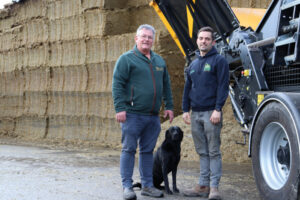 R & L Anthony comprises two separate businesses: the farm run by Richard and Lyn, and a contracting and holiday home enterprise run by their son David and wife Emma. Covering nearly 1,400ha across South Wales, the farm has achieved average wheat yields of 10.1t/ha, and 4.8t/ha for oilseed rape.
Forage crops have become more important to the business as cereal prices remain low, with maize sown and harvested in-house, achieving nearly 45t/ha with impressive starch levels. The family sows two varieties alongside each other, to extend pollen availability and boost cob size. Inoculants reduce clamp losses across maize, wholecrop and grass silage.
Across the full rotation, the Anthonys aim for three crops in each two-year period, established with minimum or zero tillage. Cultivation is done strategically to disrupt pest lifecycles and soil health is bolstered by organic nutrition, including composts, digestate and manures.
James Fostkett – James Foskett Farms
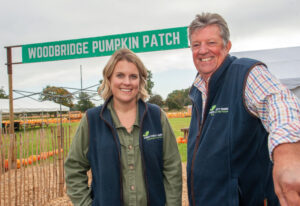 James Foskett Farms produces organic vegetables and potatoes, in addition to a full conventional rotation of vegetables, cereals and forage crops. A key part of the business is the organic carrots, which James states benefit from the free-draining East Suffolk soils and microclimate which protects from spring frosts and extremes in heat.
Crop covers are used to promote early growth, with flame weeders to manage weeds without chemicals. The rotation also includes grasses and clovers, as well as cover crops to maximise soil health. Solar panels power the cold stores, and James notes that to ensure freshness, the bunches are picked by hand and immediately placed in water to maintain freshness, before being washed and transferred into storage. The rapid handling extends the shelf life and helps to minimise waste.
Harvest begins in late May and runs through early November, with more than 1.5m bunches of organic carrots delivered to customers, making up around 35% to the overall turnover.
Anthony Snell – Windmill Hill Fruits Ltd
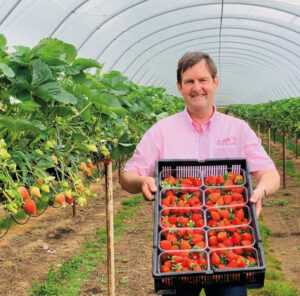 Anthony Snell of Windmill Hill Fruits Ltd recognises the importance of integrated pest management when growing 204ha of strawberries, raspberries, blackberries, blueberries, and blackcurrants. Beneficials are introduced to the crops to handle pests, and the climate under the polytunnels is carefully managed to aid this. He notes that this helps to minimise the use of chemicals throughout the growing period.
Rainwater is collected, and recycled after use, feeding the trickle irrigation system while solar panels have been installed to provide around 40% of the required energy across the business. New packhouse and coldstore facilities have been established in recent years, and the company has shifted to in-house nursery production where possible; vertical integration that helps maintain control over plant quality.
Further diversification comes in the from of British Frozen Fruits, an online store that delivers twice weekly and makes up a significant part of the company’s turnover.
John Weir – J & N Weir
 J & N Weir grows 60ha of ware potatoes, with another 4ha grown for seed to be used in-house. Around half of the area is irrigated, with an additional borehole added to minimise the reliance on groundwater. Varieties are chosen based on the end market, with around 75% contracted.
Solar panels and turbines have been installed to minimise energy costs, with the coldstores run when energy is being generated. Ethylene is used to limit spouting and the company is now looking to varieties that can help to manage potato cyst nematodes. Trials have been held on the farm, and resistant varieties have been added to the rotation, along with DeCyst trap crops to limit cyst numbers.
John Weir adds that the whole process, from planting through to harvesting and storage, is handled in-house, with independent agronomic advice. He says that quality is key and enjoys the challenge of getting potato growing right.
The 2026 National Arable and Grassland Awards will be handed out in a ceremony at the end of the first Agronomy Exchange event. For more information, head to www.agronomyexchange.com