



 In consideration for this award, the panel of judges will evaluate candidates based on their exemplary performance in meeting key performance indicators, such as yield per hectare and its impact on the final product (e.g. litres of milk per hectare). The successful recipient will exhibit a dedication to maintaining soil health and will be capable of showcasing a strategic selection of grassland varieties. Additionally, the efficient and minimal use of fertilisers will be a contributing factor in the selection process. Sponsored by OMEX Agriculture.
Andrew and Claire Brewer – FG Brewer
FG Brewer encompasses just over 400ha of Cornish farmland, with a focus on dairy production from a 450- to 500-head Jersey-cross herd. Milk yields have reached 6,500 litres on a pasture-based system, with beef calves also finished on grass.
The grassland is a major part of the farm’s plan to build a circular economy. Compost is produced on the farm from treated bedding, which not only reduces ammonia losses, but also unlocks insoluble phosphorus, making it available to grasses when applied. Yield analysis suggests that fields getting a compost application outperformed untreated pasture by 30kg DM/day.
The treated bedding also improves the application of slurry, with the reduction in ammonia levels leading to a noticeable easing of the smell. The combination of compost and slurry, alongside lime, gypsum, salt and some digestate from a local biogas plant, mean the farm does not buy any bagged nitrogen, phosphate or potash.
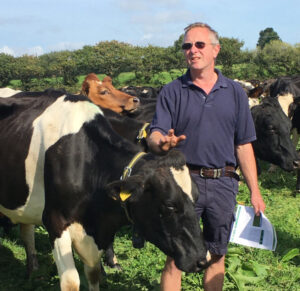 Careful attention is paid to grazing levels to ensure that fields remain in peak condition, while cattle get all the nutrients they need. Training of the six full-time operators includes recognising easy indicators for this.
Grassland is also recognised for its role in sequestering carbon, with the hope that carbon credits could be used either as additional income or to offset operations on the farm.
According to soil sampling on a 2ha basis, the Brewers have achieved sequestration of 25-100t of carbon dioxide equivalent/ha on grassland.
Tom Moore – Hereford, Ludlow and North Shropshire College
The success of the changes Tom has implemented to the college’s dairy herd and grassland can be seen in the production results. Over the past four years, milk production from forage has increased from 986 litres to 4,500 litres, with dry matter reaching 10-12t/ha on average. This has not only improved profitability, potentially saving the farm and the dairy herd, but has also gone a long way in showing best practice to students.
The farm was converted into 21 paddocks, with new cow tracks and water mains installed to ease grazing rotations. About 10% of the farm is reseeded every year, with a particular focus on fields with a high weed pressure.
One-third of the farm is soil tested to plan for lime applications. Any reseeding operations are done in the autumn. Weed pressure is also reduced by rotating gateways to the paddock to minimise poaching.
Benefits from moving to a grazing system, with cattle outside for up to 10 months of the year, include youngstock growth rates increasing to 1.1kg/day, with a mortality rate of less than 1%. Herd fertility has also improved significantly, with 83% in calf within six weeks and 91.7% within 12 weeks. The increased profitability has enabled the farm to grow the herd size, looking at grazing genetics to further boost grass use and continue overall growth.
Slurry and fertiliser are used at a rate of about 180kg N/ha on the grassland, with monitoring done through Agrinet alongside monthly testing.
Alwyn Phillips – Penygelli
Penygelli was the first UK farm to introduce TechnoGrazing; splitting its 65ha into 1ha paddocks and rotating grazing of the 30 Limousin sucklers, 200 Poll Dorset ewes and 200 Texel ewes every two to three days. Alwyn is also part of Ram Compare and GrassCheck GB, recording data from each facet of the business to make informed decisions.
 For example, reseeding is based on yield monitoring, with the overall aim to keep clover levels high enough to make a noticeable difference to nitrogen and protein levels. This has led to a reduction of synthetic fertilisers by more than half. By benchmarking, he has been able to increase grass utilisation from 66% to more than 80% in the past five years.
The farm is also part of the Prosoil and Prosoil+ projects, as well as being an Ibers participatory research farm. Earthworm numbers, grass rooting depth, soil and air temperature, and water and rainfall infiltration are measured, as well as compaction, to highlight potential problem areas. Alwyn has also undertaken carbon measurements, comparing levels across differently managed fields. Results from the past three years indicate 80-100t carbon dioxide equivalent/ha, far above the soil carbon baseline.
Fields used for silage are not set aside at the start of the season, but kept in the grazing rotation and cut when grass covers exceed 3.5t DM/ha, using the farm’s own equipment.
