


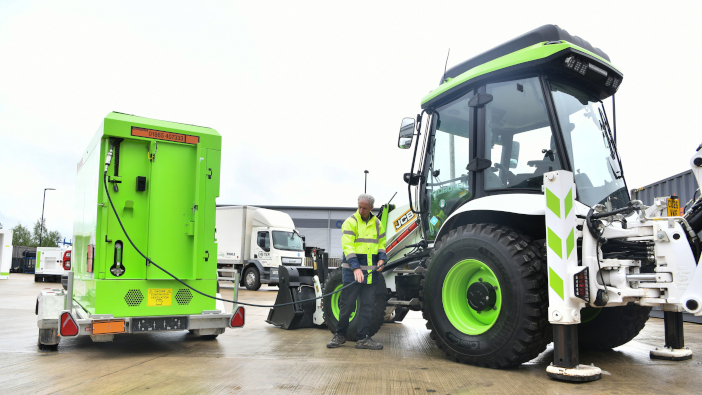
Alternative fuels remain a major talking point for power-intensive, off-highway operations, and HyKit has now taken strides to improve infrastructure and availability for hydrogen
Whereas the shift to electric power has its place for a lot of on-highway traffic – despite some questions about the well-to-wheel emissions and how green electricity production is in the UK – when it comes to larger equipment and off-highway, electric has limited potential.
Even those companies utilising electric power note that machine size and the length of operation are limiting factors.
So what options are out there for the agricultural and construction markets if the planned phase-out of fossil fuels continues? Methane is one option. With some investment, it can be scrubbed and made usable on dairy farms, giving it a relatively broad customer base.
While the combustion of biomethane releases carbon dioxide, the EU Emissions Trading System (EU ETS) considers it a net-zero fuel source as the emissions are part of the carbon cycle already. Hydrogen, on the other hand, lacks an easy infrastructural answer within agriculture, although it is possible to invest in electrolysers. The benefits of hydrogen are that it has almost no emissions, though depending on the burn temperature, there is a risk of increased nitric oxide and nitrogen dioxide levels, which have to be mitigated with engine technology such as exhaust gas recirculation.
HyKit
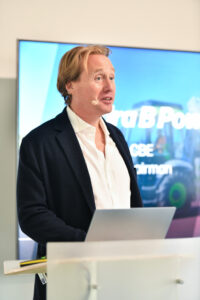
HyKit is a joint venture between Jo Bamford CBE’s HydraB group, JCB and investment firm HyCap. Its new facility in Bicester has created 30 jobs in the area, and is another step to a nationwide hydrogen infrastructure, developing alongside JCB’s integration of hydrogen engines into its portfolio, and Jo’s own range of alternative-fuel buses under Wrightbus.
At the opening, he said that he was excited about the energy transition and UK manufacturing in general. He noted that there were opportunities for industries in the UK to become global leaders in green fuels. “There is no point competing with China on batteries, so we must drive volume and cut costs with hydrogen,” he said.
The first product out of the Bicester site is the MHR-X75 mobile hydrogen refueller. More than 90% of the components used are sourced from the UK and Europe, and the unit combines both an on-site storage solution and a transportable refuelling system. It can carry 75kg of hydrogen, pressurised to 635bar, reportedly enough to fill up to five machines on site, with capacity for partial refills after this.
Each refuelling takes approximately 10-15 minutes, although this will depend on the machine being fuelled. Dr John Vinkers, director of engineering, said that the tank has a general setting to refuel machines with an H35 connection, but that this software can be optimised in collaboration with other manufacturers to speed up the process. This has been done with JCB’s hydrogen backhoe.
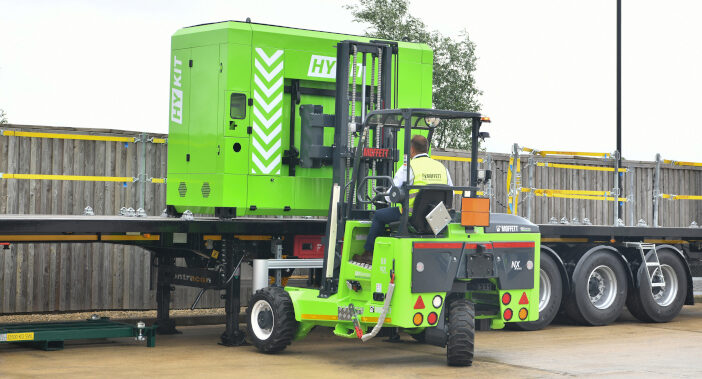
The MHR-X75 can be delivered as a single unit on a trailer suitable for pickup trucks, or eight can be purchased on a 40ft flatbed. The flatbed units include a linkage attachment, enabling them to be lifted off and transported around the site with a telehandler. “What we didn’t want to do is use forklift tines, because you don’t want the forks to accidentally pierce the tanks,” John said.
Mitigation of risk when dealing with pressurised natural gas is key, so the MHR-X75 includes leak detection and emergency shutdown, as well as remote monitoring and diagnostics.
Modular systems
Jo explained that the green transition was like three motorways side by side. Each had its place because if everyone moved wholesale to one solution, it would congest the infrastructure. The MHR-X75 represents the first step in direct-to-consumer hydrogen delivery, complementing distributor Ryze Power and producer Hygen Energy.
“It will take time,” he said. “We own each step of the process, and it can still be difficult to coordinate. This is the missing piece of the puzzle, which gives us something to replicate and build upon.”
The refueller has been designed to be modular and scalable, enabling HyKit to respond quickly to demand. John notes that this is not an alternative to the small number of fixed hydrogen stations in the UK, but an option that could be used across the industry.
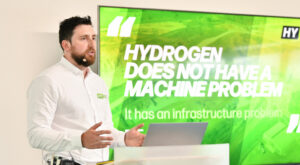
“A flatbed of eight units will still likely cost less than a fixed station, so there is potential for those businesses to invest in this system and use the fixed station as a filling point for our refuellers.”
The biggest benefit is the ability to transport fuel in a similar style to diesel, making it easier for companies to switchover. “People want consistency. They want the fuel to work in a similar way to what they know, and for the fuel to be there when they need it,” John said. “This enables greater access to hydrogen fuel, which will then drive demand for the machines.”
HyKit and the wider group of companies owned by Jo are also working to set up nodes across the UK, which will again improve the availability of hydrogen across various sectors.
As for why the agricultural sector should look to hydrogen, instead of methane, Jo called methane a stopgap fuel. He pointed to the potential emissions from methane and said that future legislation could affect its viability.
“People want their fuel to cost the same, do the same job and be available when they need it,” he said. “Hydrogen is scalable, and we are actively developing the infrastructure. The ability to store and utilise hydrogen is a major step in its acceptance as an alternative fuel.”