


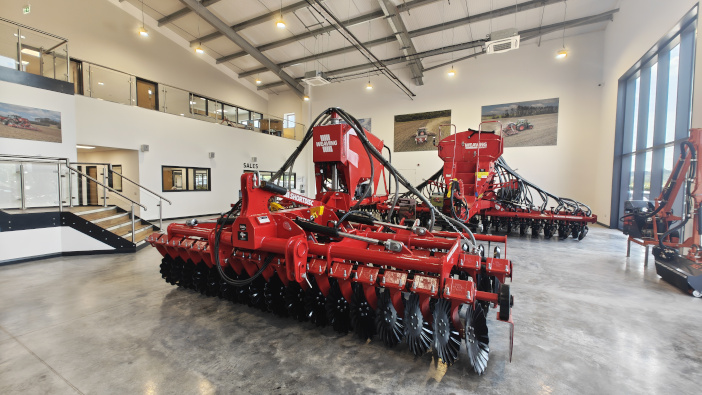
Evesham manufacturer Weaving Machinery has invested heavily in its premises, enabling larger machines to be made and a greater stock of spares to be offered
When we visited Weaving Machinery back in 2023, the company was celebrating its 40th anniversary and putting plans in place to significantly renovate its offices with a new showroom, after a similar investment in the factory. According to sales director Simon Weaving, this is the result of increased success both domestically and internationally for the company.
It’s a massive step for a company that started in the 1980s importing machinery from mainland Europe, piecing together power harrows and tine drills, and stocking spares for direct sales and refurbishment work. “By selling these products direct, we were able to see what our customers needed and started designing our own machines from these requirements.”
Simon, alongside his sister Sarie and their father Edward, saw the growing demand for low-disturbance farming in the UK. What started as importing American-built drills and fitting Accord metering systems has developed into a full range of low disturbance, medium horsepower drills that sit at the centre of a broad portfolio including Agrimaster hedgecutters, Mammut concrete mixers – of which Simon says there is an agricultural market for mixing different crop varieties ahead of drilling – and silage equipment, and Weaving’s own range of electronic gates.
Facelift
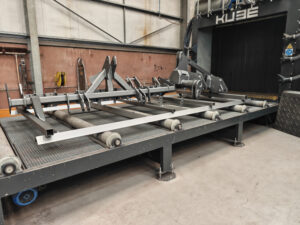
The investment in the factory started in 2020 – an increase of 20,000sq ft and a complete reshuffle of the manufacturing process. This included the purchase of a Kube 2.6×2.6m automatic shot blasting unit, said to be the largest in the UK at the time. This enables the largest chassis produced by the company to be shot blasted in a few minutes, with shot recycled to minimise waste.
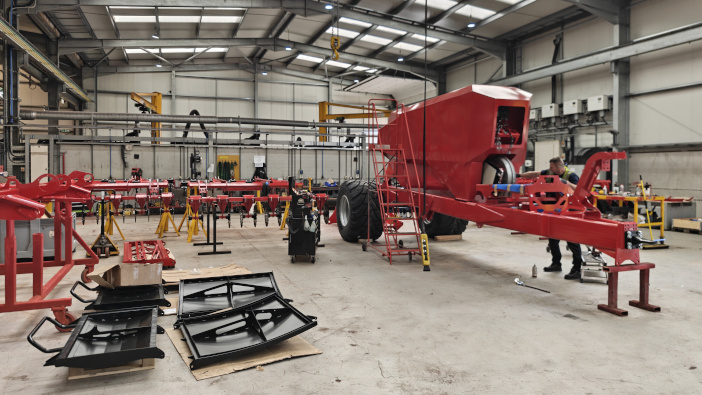
There have also been changes to the welding set-up, with larger jigs brought in to enable parts to be rotated – these speed up the construction process significantly.
Simon noted that much of the machining work is done off-site now, with the company working with various local companies. “We used to have lathes here, but there are local firms that have a far greater capacity,” Simon says. “This means it’s more cost-effective to work with them. We could have invested in our own laser cutters and CNC bending equipment, but we’re less than an hour from Birmingham, where there are several great businesses doing this at scale.”
 For Weaving, this isn’t just a time efficiency, but a cost efficiency. Simon acknowledges that machinery costs are one of the biggest challenges for farmers and contractors now, compounded by increased input costs. There has also been greater investment in cast parts, as well as tubular steel, to increase the overall strength and reliability of the machines produced.
“We’re doing our best to stabilise costs,” he says. “Using outside suppliers is part of this, and buying local where we can. Unfortunately, when it comes to steel suppliers, using British steel would significantly increase our costs, so we buy Swedish steel instead. Similarly, some of our parts must come from abroad to try and minimise cost increases.”
The company is transparent about this, and equally transparent about its own pricing. Weaving publishes its prices on its website so that customers know what they will pay before enquiring. A lot of the investment has also gone into spare parts. Weaving built its reputation on spares and refurbishments, and this remains a core part of the offering. The new factory includes an automatic picking system for small components, capable of holding 80t of parts, as well as increased warehouse space where larger parts are held.
“We still have parts for some of the original machines we imported, because there are still units out working and customers want that same reliability,” Simon explains.
Customer-facing investment
The new 7,000sq ft office and showroom replaces the previous cold store that the company used. It includes an open-plan machinery display, meeting rooms, a larger canteen and a customer-facing store for spare parts. This includes a smaller 40t automatic picker.
“It’s a nicer environment for customers who are passing, and makes us more visible,” Simon explains.
It also improves collaboration within the business. Sales and design teams work closely together, with meeting spaces in each area so that new product ideas or updates to the existing portfolio can be discussed quickly and easily. Investment in 3D design software enables the company to digitally assess every component before 3D printing a prototype to ensure that each part will fit and interact with the machine as planned.
Importantly, the business has left space for further expansion as it continues to increase its market share both domestically and abroad. The ground has space between the new offices and the factory, enabling the factory to be extended as wider working widths and greater order numbers come through.
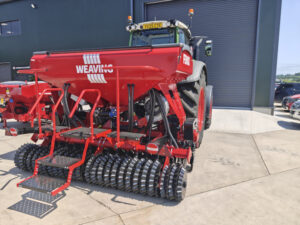 There’s also substantial yard space available, both for stock machines and potential expansion in the future.
Simon also notes that Weaving has taken steps to bring the 70ha of surrounding farmland in-house. This provides ample testing capabilities for the company, as the soil ranges from Grade 1 vegetable ground all the way to boulder clay.
“By bringing this back in hand, we can not only test our machines in a range of conditions, but we can also practice what we preach. We can show the long-term benefits of using a low disturbance system.”
New machines for Cereals
The opening of the new showroom and offices also enabled Weaving to preview some of the machines that will debut at Cereals 2026. The headline machine was undoubtedly the 12m Sabre tine drill, which Simon explained had been two years in development and was essentially a ground-up project, with only the wheels and the paint colour remaining the same.
Rows are spaced at 250mm centres, fixed to four 3m wings that can each oscillate 60deg to follow ground contours. This is thanks to a new holder design behind the main tank, under which the wings are mounted, giving them a wider range of movement. Each Sabre tine is preceded by a cutting disc so that it can break through the soil crust, or vegetation and crop residues. Automatic pressure control is also standard.
To fold down to under 3m, the wings will lift and move forward around the hopper, which has a capacity of 6,200 litres and can be split three ways. Calibration remains central, under the hopper with individual metering to the left and right of the machine. An additional option of an Avadex applicator is due to be introduced.
Control is via Isobus, with the option of a new Topcon display. Simon recommends a tractor from 300hp for the new 12m Sabre.
There is also an updated version of the 3m Lynx entry-level direct drill. This is available as either a 32-row, 90mm spacing, or a 24-row 120mm spacing. The 1,500-litre hopper can now be split 60:40 for grain and fertiliser, with each product individually metered into a single venturi before being delivered to the coulters.
This means that only one distribution head is required, keeping the complexity and cost down. As standard, it will feature RDS Isocan controls, with the option of full Isobus control. As a mounted unit, it weighs around 3t, so Weaving will also offer a retrofittable wheel kit, turning the Lynx into a trailed machine and reducing the overall horsepower requirement to just 90, depending on conditions.
 New applications
Technically making its debut at Lamma, the company also showed its front tank spreading system, comprising a 1,200kg capacity front tank and a spreading bar with splash plates available in widths from 6m up to 12m.
It uses an electronic metering system and will enable fertilisers or small seeds to be applied to the soil ahead of the rear implement, adding an operation to a single pass. It uses a hydraulic fan to push product along the working width, and includes an operator platform for easy loader, LED road lights and hydraulic folding.
It uses the RDS Artemis Lite control system and can be specified for individual row shut-off.
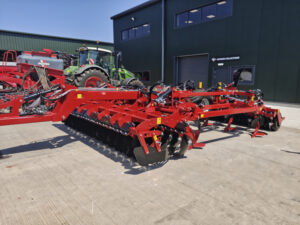
The final new product is the Raptor one-pass cultivator, capable of working down to depths of 9in and comprising two rows of 560mm cutting discs and two rows of sprung-loaded tines – individually pressurised to 900kg. A row of levelling discs and a full-width roller complete the machine, with the option of a small seed applicator.
It will initially be available in widths of 3m, 4m and 5m with potential for a 6m unit later and uses a lower link arm attachment to enable tighter turning. Tungsten and chromium cast parts are used throughout the working zone of the machine, and control is via a simple switchbox, meaning it only requires two hydraulic spools.
Simon notes that the 3m version requires just 160hp, depending on conditions, to work at speeds around 10/11kph. However, much of the testing has been done with a Fendt 728, which runs at 283hp+.