


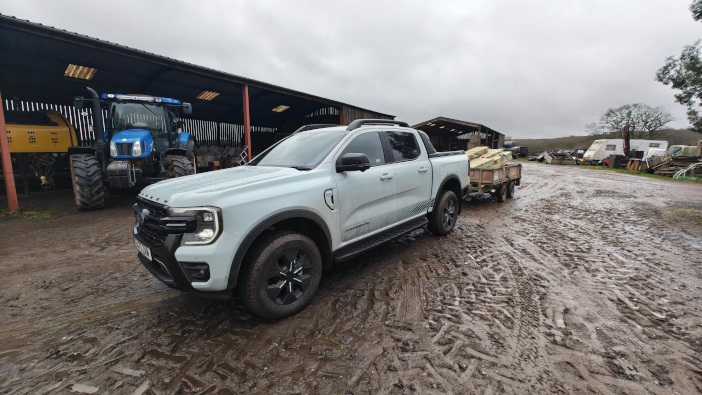
If the switch to fully electric feels like a step too far for many farms, with concerns over the range, and how off-road conditions and towing will impact this, then the PHEV Ranger from Ford proves to be a tough, comfortable middle ground.
We were sent the vehicle in its PHEV-exclusive Stormtrak specification, which bulks out the standard features with the previously optional Pro Trailer Backup Assist, a 360deg camera overview of the machine, LED headlamps, a flexible racking system and an uprated sound system. It also comes in a very nice, if hugely impractical, Chill Grey livery that is about as good at hiding dirt as a white truck.
Stormtrak models also benefit from 18in, matte black alloys. Our model was shod with Continental ContiCrossContact rubber, said to be good for about 70% road work and 30% off-roading. Ideal tyres for most farms, as most of us try not to get stuck in a muddy field.
The cargo bed has a 940kg capacity, making it suitable for some substantial loads, but falling foul of the new tax rules that came into force in April 2025. It’s wide enough to fit a round bale in, and comes with in-cab control of the shutter cover, as well as an electric button at the rear of the cargo bed to open and close it. To further increase the capacity, this can handle a towing load of 3,500kg when using a braked trailer.
Working on the road
Jumping into the cab, the Ranger is comfortable and comes with all the modern conveniences you would expect from a truck that has a £52,000 price tag. The infotainment system is controlled through a large central console, as is the climate control and other nice-to-haves such as the heated seats and steering wheel.
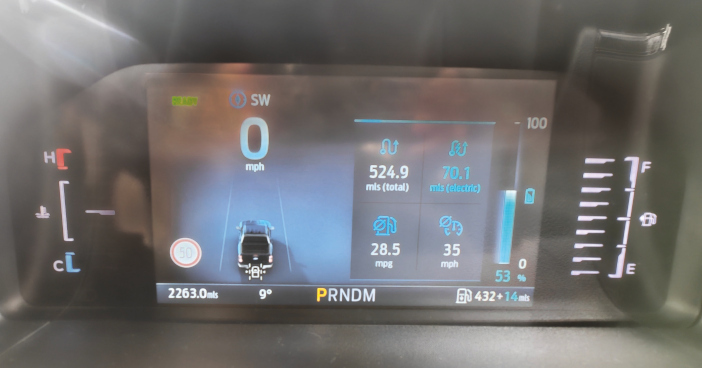
You have a row of tactile buttons underneath, and traditional dials for volume and to control the overall temperature. Then the bulk of the screen is reserved for Ford’s own navigation and media systems, or switches to Auto Android or Apple CarPlay if you connect your phone. Directions, either from Google Maps or the integrated navigation, also pop up on the digital dash, which has a clear layout, highlighting total miles travelled, miles travelled on electric power only, the miles/gallon and the estimated miles left in fuel. It also shows the charge of the 11.8kWh battery.
In the centre console, you have a rotary dial to switch from neutral to reverse or drive, with a second dial to move between the various driving modes, and buttons to control electric performance, two-wheel and four-wheel drive. It always takes a moment to get your head around a new vehicle, but for the most part, the Ranger felt intuitive.
Despite relying heavily on the 2,3 litre EcoBoost petrol engine, because the battery only has enough charge for around 28 miles, the Ranger is remarkably quiet – genuinely almost as quiet as a full EV, even when running solely on petrol. The ten-speed automatic gearbox runs smoothly, with no noticeable jolts when shifting, even when suddenly dropping down the gears because of a steep hill or traffic ahead.
The battery gives you some options. You can run in true hybrid mode, which significantly increases the miles per gallon. At one point, we were exceeding 70mpg before the battery was used up, and it dropped down to the expected range of around 30mpg. If you’re planning on doing some very local running around with the truck, the 28 miles available through the battery is ample, and if it does run out, it will seamlessly switch to petrol. You don’t need to worry about finding a charger either, as you can charge using the petrol engine.
We tried the charging method, and it didn’t appear to impact the fuel economy. On a 40-mile drive, we were able to charge the battery 25%, though on longer drives, you will notice that it struggles to charge much above 80%. Through the regenerative braking, the battery is always charging a little, and we noticed the number of miles done solely on electric power would creep up even though the battery was drained.
 If we had any minor gripes, and these are minor, it would be around some of the driver assistance systems. The automatic high beam seemed to recognise oncoming traffic fine, but when we were behind another car, the high beams would stay on. This could be due to the height, as the Ranger certainly positions itself high, and it was no real issue to switch this off. Similarly, we turned off the lane assist feature when travelling at night, because in areas where there were no streetlights, the system would constantly cancel and restart, leading to multiple, distracting notifications on the dashboard.
Hauling
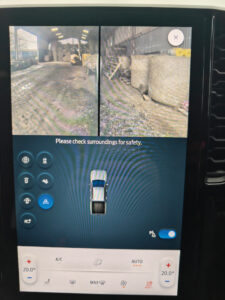
On the farm where we tested, we were able to hook up a trailer with fencing equipment, taking it close to the towing capacity. The Ranger automatically recognises when a trailer is attached and adjusts the driving style and the cameras that come up on the central screen during driving. This includes left and right cameras that show up when indicating, so you can see if anyone is attempting to overtake, and watch so that the trailer follows exactly.
While it wouldn’t necessarily be used regularly for this, we did circle the block in full electric mode to see how the battery held up with the increased load, and we were impressed. It lost a few miles because of the increased weight – as you’d expect from electric vehicles – but not an excessive amount, meaning you probably could do some local deliveries just on the electric charge if you were inclined to do so.
The instant power that the electric drive provides also came in handy when we stopped on a steep hill with the trailer. According to the contractor we were with, he wouldn’t have stopped on that hill with a trailer in his diesel Ranger, so he was very impressed when this managed to pull away easily.
Despite its bulky dimensions, the Ranger doesn’t feel like an oil tanker to manoeuvre either. With the trailer attached, we were able to turn in the yard without dinging the trailer against the truck or doing any reversing. Without the trailer, it feels like a much larger machine than it is, and after driving it for a few minutes, it’s clear that this is just as comfortable navigating traffic in towns, or nipping to the shops, as it is handling heavy loads for work.
Getting it stuck
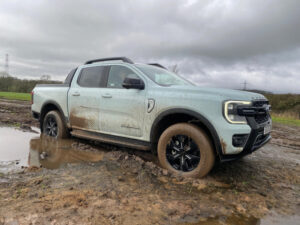 No one chooses to get a vehicle stuck – unless you’re off-roading, and you’re unlikely to be off-roading in a brand-new Ranger but each to their own. However, it’s a fact of farming that occasionally you will have to traverse some muddy fields and bridlepaths to get where you need to go.
Luckily, we had a cleared-out muck pile and plenty of rain, providing the perfect place to put the Ranger through its paces. We went in two-wheel drive initially, and saved the electric range for if we did encounter a problem. The fact that electric drive has instant torque theoretically means that we could feather the acceleration and slowly pull ourselves out of most situations if needed. However, the Ranger was more than capable of handling everything we threw at it.
We shifted to the high four-wheel drive range at one point, and deactivated traction control so we could wheelspin to find some traction, but never found ourselves in a situation where we genuinely felt it wouldn’t get out. And this was on tyres designed primarily for road work, so with true off-road tyres, we likely wouldn’t have had any issues at all.
A true all-rounder
The new Ranger Stormtrak feels like a real all-rounder. It has the comfort and mod-cons to handle long drives, and the 70 litre fuel tank combined with the battery meant that we were able to do a 400 mile round trip on a single tank. Your own tolerance for the automated systems and driver assistant features might vary, but these can be easily deactivated.
It’s easy to drive, and powerful enough to handle all the tasks we threw at it. The fact that the cargo capacity is less than a tonne, and therefore subject to the new HMRC classification, might put some off, as might the high price point – although other specifications will come in a little cheaper.
The question will be whether farmers see the real benefit of switching to a hybrid. The benefits are there, and there certainly wasn’t a drop in power or capability, but only having a 28-mile range, it’s hard to see many purposefully utilising that, or charging it to get the maximum electric mileage. The hybrid system feels like a background feature most of the time, adding the odd mile here and there to extend the range on long journeys. It could be that traditional petrol and diesel Ranger models still end up being the choice of growers.