


A North Warwickshire farmer-contractor explains how data-led maize variety selection, moisture management and realistic dry matter targets are driving consistent forage performance
Alistair Trivett’s farming and contracting business, Trivett and Sons, is thriving through a diverse rotation that balances both beef and arable enterprises.
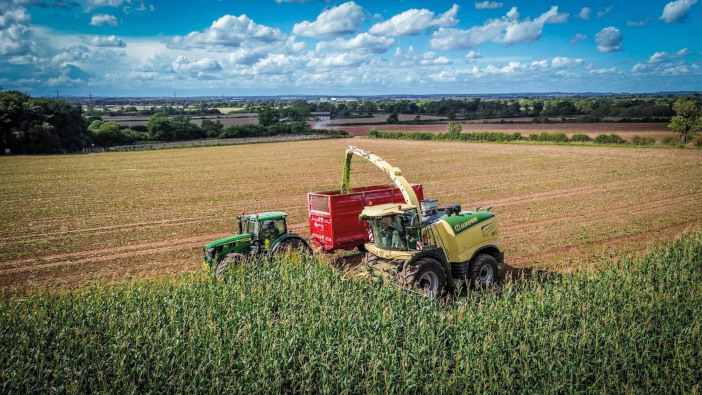
Farming and contracting 1,052ha of maize and over 2,600ha of grassland, Alistair’s attention to detail defines his approach to forage production, particularly maize, which is a crucial part of the feedstock for the dairy and beef enterprises he supports through his contracting services.
A third-generation farmer at near Baxterley, Warwickshire, Alistair works alongside his father, brother, and two full-time staff, along with several seasonal workers brought in during the busier summer months. The family-run farm is home to a 100-head beef suckler herd, located in an elevated position in North Warwickshire.
Maize is key
Maize plays an essential role in the Trivett’s farming operation, not just for their own cattle but for their contracting customers too. As well as harvesting for their own livestock and customers, the business also supplies maize silage to Feedstock Supplies in Wiltshire, a forage and feeds merchant serving anaerobic digestion plants and feedstock.
“Maize has become a vital part of our rotation, particularly as a break crop between milling wheat and sugar beet,” says Alistair. “However, selecting the right variety is not a one-size-fits-all process – it’s about knowing the land and understanding how different varieties will perform across the varying soil types and weather conditions.”
He notes that the sandy soil on one part of the farm is ideal for earlier maturing varieties, and that they avoid growing the crop on heavy clay, when possible.
“It’s about finding the balance and understanding that you can’t just throw any variety into the ground, you need the right one for your conditions.”
When it comes to maize variety selection, the Trivett’s approach is firmly rooted in performance and reliability.
Alistair says: “It’s not just about yield but also factors such as dry matter content, starch levels, and the variety’s ability to stand strong in difficult weather conditions.
“The key is to ensure that the variety suits our system. In dry years, we focus on varieties with good drought resistance, and in wet years, standing power and early vigour become crucial.”
They use data from the farm’s John Deere mapping system and a close relationship with seed suppliers to inform decisions. This year, they will plant Grainseed maize varieties for the 13th year in a row, having had positive experiences with both their early and later maturing types.
“Earlier varieties gave us the ability to get maize in the ground early and take advantage of a good weather windows while later maturing varieties offer a more forgiving harvesting window,” says Alistair.
Last season, they grew both Myrdal and Lovely, two varieties that illustrated contrasting agronomic characteristics within his local conditions.
“Lovely is very quick,” he explains. “It gets away fast, and it wants to be ready early, which is great in a short season.”
“By contrast, Myrdal’s strength lies in its uniformity and ability to maintain plant health as it approaches harvest. Myrdal stays green – It matures more evenly from the bottom up, so the plant holds on to that structure and allows the cob to finish properly.
“In a year like 2025, I could quite happily have grown Myrdal across the board.”
The importance of variety choice is further emphasised by Alistair’s attention to dry matter content. For dairy cows, they aim for a dry matter content of around 30-33%. He says that farmers would previously pay more for higher dry matter maize, but that’s no longer the case.
“The market has shifted, and while dry matter is important, we also have to look at how the crop will perform in the clamp.”
Managing rotations and tackling weeds
The Trivetts have also honed his skills in managing crop rotations to prevent issues with soil health and weed resistance. Maize is planted as part of a rotation alongside the milling wheat, followed by a break crop like fodder or sugar beet, then a second wheat.
“It’s all about maintaining a balance in the soil and ensuring we get the best crop quality each year.”
One challenge faced by the farm, and the land he contracts, is blackgrass, which has become increasingly resistant to herbicides, he says.
 “Maize offers us a good tool in controlling blackgrass. We can use the crop’s herbicide programme to tackle the weed more effectively, and it also gives the soil a break from constant wheat and barley rotations.”
Their approach to soil health is proactive – they use cover crops and manage soil moisture carefully to ensure that the soil remains in optimal condition for maize and other crops.
“On our heavier fields, we winter plough when the conditions are right. It helps lock in moisture, especially in dry years. We grow winter cover crops on the light soils which are grazed off by sheep before spring cultivations that aim to preserve soil moisture”
“Keeping the soil moist is vital for good maize establishment, as it helps the seeds get going early in the season.”
Achieving consistent results
The Trivett’s consistent results over the years have been the product of a meticulous approach to farming, with a focus on precision in variety selection, crop management, and harvest timing.
“Our John Deere Harvest Lab shows that we can achieve 16-17t DM/ha averaged over the farm and that’s our aim, so we need consistence across every acre to maintain this on the farm,” Alistair shares.
However, he says that the real goal is to make sure that each crop performs consistently, regardless of the challenges. The weather is always a factor, but he believes that they have adapted to it.
“Doing most of the chopping myself I’m able to fine tune the cropping on our farm and identify best practice from my customers.
“Partnered with Grainseed’s technical varietal advice we have increased tonnes in the clamp and with our chopping capacity can optimise silage quality for our cows and customers.”
Looking Ahead
As they look to the future, the Trivetts remain focused on refining their maize and arable systems to meet both feedstock demands and the pressures of the marketplace.
“This year, we’ll continue with our strategy of early maturing varieties, but we’ll also be introducing more varieties with improved resistance to drought and disease,” says Alistair.