


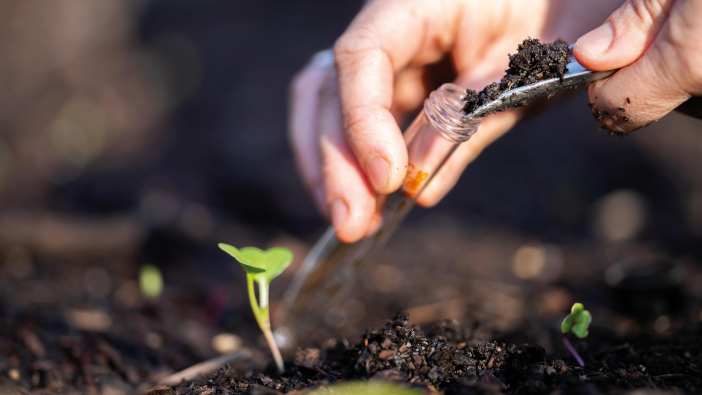
Nutrition is the biggest expense a grower will face when establishing a crop, so efforts are taken to make sure it is matched to the requirements of the soil and the crop. Soil testing before establishment gives an indication of what these requirements may be, but it becomes more complex when tissue or sap analysis in the spring shows there are deficiencies within the plant.
“When we look at macronutrients, phosphate is often the one that gets locked up,” explains Farmacy’s head of soil services, Jade Prince. “Growers will see indices of two or three, but this fails to show what is available.”
She adds that pH can give some indication, with soils that are too acidic or alkaline stopping the cycling of phosphate. Add to this the fact that phosphate is a static nutrient within the soil, which needs to be placed within 2mm of the root for effective uptake, and it is only absorbed by the plant when it has less phosphate internally than is present externally.
Get biology moving
An issue that Jade sees when it comes to nutrient uptake is soil temperature. “Soils really need to be about 12C to kick-start the biology and cycle nutrients,” she says. From a seed perspective, a lower soil temperature means delayed germination, but germination nonetheless. This means that pushing drilling back to combat grassweeds or getting spring crops in early could hamper nutrient uptake.
There are some simple pre-emptive steps that can be taken, starting with ensuring that soils are warm enough to keep that biology active.
Acidic soils can be caused by a multitude of factors, including slow water movement caused by compaction or a chemical imbalance within the soil. Gypsum may be a solution to this, with a wider range of options depending on the cause. Alkaline soils can benefit from an application of citric acid or changes to the cropping. “A legume cover or companion crop will help acidify the rooting zone, unlocking nutrients for the cash crop. Winter covers that contain buckwheat will also help,” Jade says.
Micronutrients and plant stress
Phosphate is a tricky, but essential part of the nutrient make-up. More difficult to monitor are deficiencies in micronutrients. Jade says these (molybdenum and boron in particular) are key for the plant to absorb nitrogen, turning sugar into protein.
“When micronutrients are lacking, it often shows in the same way that a lack of nitrogen would,” she says. “The crop will yellow, and the first instinct is to apply more nitrogen.”
However, plants are looking to dilute nitrogen, so this can be an unnecessary step that will cause a rush of growth, but only as a way to limit further stress in the plant. It will not address the main issue.
“There needs to be some regional awareness around micronutrients,” Jade says. “Another complication is that while tissue sampling will show micronutrient deficiencies, it really requires a sap analysis to get a full picture of the forms of nitrogen within the plant, giving an indication of plant health.”
High sugar levels will show that the plant is not converting this into carbohydrates and proteins, indicating something is out of balance
Sap analysis of new growth in the plant will show whether nutrients are moving internally as they should. A difference between old and new leaves may indicate that reserves are being used to drive new growth, and deficiencies may present themselves later in the season.
Immobile nutrients found in old growth but not in new growth show that an application will be required to maintain plant health and yield.
The bigger picture
Jade is quick to point out that plant stress will not always be due to nutrient issues, however. Weather conditions during the previous two seasons mean waterlogging and drought stress have been widespread.
“Plant stress typically shows in a similar way regardless of the reason, so it could be that there are no deficiencies in the crop. Once the waterlogging has subsided or the drought has finished, the nutrients will start to cycle again, depending on soil type and the speed of biological activity.
“A combination of soil and sap sampling and attention to the wider field conditions will help inform these decisions.”