


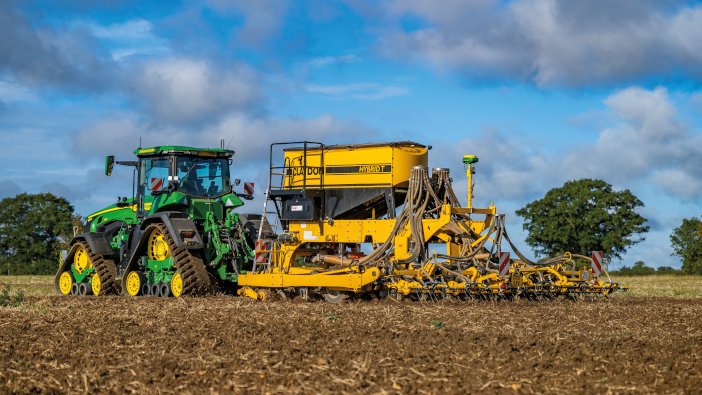
Direct drilling provides South Norfolk farming and contracting business A.J. Alexander & Son with a whole range of benefits: better soil structure, the same or higher yields, lower production costs and far greater efficiency than previous plough-based and min-till crop establishment methods.
Based at Bush Green Farm, Pulham Market, the business has become an enthusiastic advocate of the Claydon Opti-Till System which is used on 2000ha of owned and contract farmed land.
“We started out with a desire to do less but achieve more and the Claydon Opti-Till System we’ve operated for seven years has made that possible,” Rob Alexander states.
“Our predominantly sandy clay loams are renowned for collapsing if overworked so we particularly like the fact that we can leave the soil in a stable condition until we’re ready to drill. Our cropping is quite mixed, from wheat, barley, peas, beans and oilseed rape to maize for AD and grain maize, but the Claydon has given us the ability to slot in and out of those.”
He adds that over the last 25 years the approach to crop establishment has changed. They initially moved away from a plough-based system which consumed over 55 litres/ha of fuel. When they moved to non-inversion, basically tines followed by a disc drill, he says that by keeping topsoil on the top, the subsoil underneath, and the drainage open costs came down. That saved 20 litres/ha of fuel and time, not only in terms of labour but also machine hours.
“Subsequently, we looked for a more risk-averse approach which would maintain soil structure right up to drilling so that it would carry the machines better, but once we had placed the seed, we still had those drainage channels underneath.
“Our introduction to Opti-Till came with the purchase of a second-hand Claydon drill, which for five years was faultless. It’s a very simple machine and the wearing metal is simple to work with. Over those five years we went from drilling 10% to 15% of our planned cropping area with it to over 60%.”
 The business then upgraded to a new 6m Claydon Hybrid T which he says provided more integrated controllability of the NutriSeeder and the seed and fertiliser hoppers. A.J. Alexander & Son utilises variable rate applications and the new machine allowed them to vary rates across all three hoppers by linking them to the John Deere GreenStar system.
“We use the Claydon much more now, not just in the spring but also for planting autumn-sown cereals, oilseed rape, beans and other crops. The evenness of establishment across the field is very noticeable, including the headlands because now we are turning on firm, solid ground and the last pass over those areas is loosening the soil and drilling the crop. Undoubtedly that has helped our headland approach and increased yields.
“Our current system is to use a Claydon Straw Harrow to create a chit and help to decompose surface residues, then follow straight in with the drill. Fuel use for our seeding process is about 17 litres/ha and our 6m Claydon Hybrid T easily covers 40ha a day, so we are doing more with the same operator and less machinery. The Claydon System has enabled us to reduce production costs and be more profitable at a time of very low commodity prices.”
Improving soil health
Rob explains that over the last 20 years, they have integrated organic matter to improve the health of the soil. They’ve worked closely with specialist livestock producers to develop straw-for-muck arrangements.
“One concern when considering direct drilling was how we would be able to incorporate muck and get it through the drill. That’s not been a problem. It is important to use a good spreader and break the manure down when it is applied but then the drill has incorporated that quite well. The levelling boards at the back then distribute it over the rows, which concentrates the nutrients where they are needed,” he says.
“Worm numbers in our soils have increased dramatically. We wouldn’t have seen many 25 years ago when power harrows were following ploughs, but now every spit of soil contains handfuls of them. The interaction between what we’re doing to the soil and what it is doing itself with the worms and organic matter has made the structure more resilient and stable. The natural drainage channels allow water to pass through during heavy rain, the fine crumb structure on the surface breaks down nutrients and residues making them available to the crop, while the roots pick them up in the drainage channels.
“We still have the same challenges as all other farmers in this area. We have had grass weed problems over the years – I do believe that’s a battle we’re winning. Direct drilling produces less disturbance, so we’re able to keep grass weeds underground, but we have now got the TerraBlade hoe as an option that’s not the can or the sprayer.”
Yield – the ultimate yardstick
“What we found valuable was the team at Claydon taking us to their own farm, where they’ve learned and worked with the machines. They shared their experiences and knowledge. Likewise, we’ve shared our experiences on the more stubborn contract land we’ve taken on, which hadn’t benefited from a non-inversion approach.
Rob does note that there were concerns about whether direct drilling would reduce yields, but says that this was not a reality. If anything, they’ve increased, mainly due to headlands becoming more productive. He has also seen improvements in crop quality, including a minimum of a one-point increase in bushel weight. The slightly wider Claydon rows don’t fully close in until two or three weeks before harvest, so ears receive more sunlight, resulting in higher bushel weights and yields.
“During our journey from full plough tillage to non-inversion, then direct drilling, we have found that fields now travel a lot better. Sprayer tramlines are now nowhere near as deep, and even after rain in July and August, our combines are not cutting in like they were. We still have balers, muck spreaders and trailers running over our fields, but because the excellent soil structure supports them, remedial action is not required to loosen everything up.
“We’re also finding that we don’t need to run the drill’s leading tines as deep, which reduces the power requirement, so in future we may end up with the same size tractor pulling an even wider drill to further improve efficiency.”