


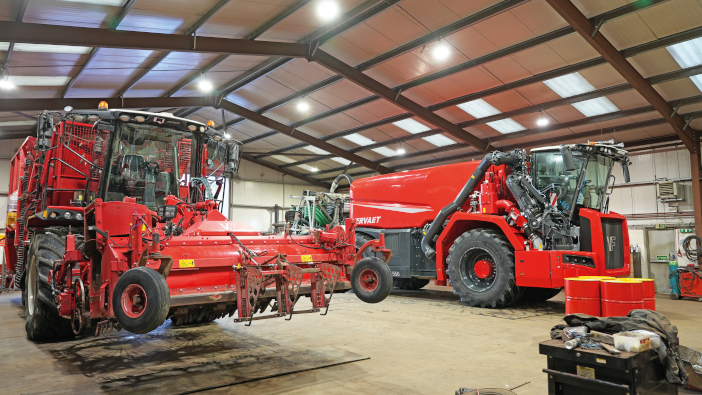
J Riley’s open day in January highlighted its beet harvester refurbishment process. We headed over to Norfolk to get a better idea of what’s involved
During the open day at the end of January, the company had on display a fully refurbished 2003 Vervaet 17-T. According to managing director Matt Carse and service manager Harry Skeet, it is the most comprehensive refurbishment the company has ever undertaken, with every part of the unit checked over, repaired or replaced, and resprayed to have it shine alongside the brand-new machines on display.
The refurbishment process is a key part of the offering from J Riley Beet Harvesters. Trade-in machines are put through a 672-point appraisal, with the company able to increase the value and the reliability of the machines, while also providing peace of mind with a special warranty on refurbishments.
“We have requests from growers and contractors of all sizes,” explains Matt. “Most who buy new, trade-in every two seasons or so. We’ll then refurbish them and move them onto customers who are lifting a smaller acreage. Their machine is then traded in against the refurbishment and comes through the workshop again to go on to a different customer.”
J Riley conducted 40 appraisals in 2025, making it a significant part of the company’s turnover. It’s also a unique offering compared to its competitors in the UK market, following in the footsteps of Vervaet, which offers a similar service at its Netherlands base.
Front to back
The appraisal covers the machine from front to back, ensuring that all parts within the main structure are checked. J Riley has invested in its staff to ensure that these can be completed quickly and will even fabricate parts, including turbines, on-site to complement its own comprehensive stock of parts.
Gangs of three or four engineers will go through the machine, remaining in close contact with the end-customer to offer a bespoke service. “Some of our customers are pretty handy, so we’ll supply the parts, and they’ll bolt them on themselves,” says Harry. “Others aren’t concerned about respraying or are lifting smaller tonnages and so will not have all the wearing metal replaced or repaired.”
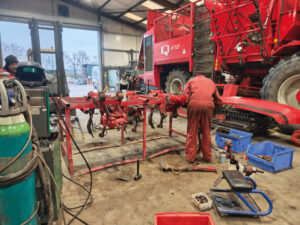 Costs can quickly rack up when multiple parts need replacing, so J Riley works on a repair-over-replace mentality. “Vervaet makes a reliable product, so most of the work will be focused on the soil-engaging parts,” Harry adds. “We still check the full driveline, the hydraulic motors and the major components, and provide a season’s warranty, depending on the tonnage, on all these parts as well.”
The machines are cleaned off and stripped to various sub-assemblies, including toppers and lifting units, so that multiple repairs can be carried out at once. The company has its own paint shop on-site, meaning that components can be painted, or the whole machine can be resprayed – although Matt acknowledges that this is rare.
Each potential repair is initialised both when it is found and when it is repaired, giving traceability in the unlikely event of a failure later. Once the refurbishment is complete, the machines are valeted and run for up to six hours to ensure that every part is running correctly.
“We also make sure that a second person, from another team, looks over the machine and the checklist,” says Harry. “No one wants to criticise their own work, so this way we can ensure everything leaves the workshop in the right condition.”
Two decades and still running
The refurbishment process ensures a constant run of quality second-hand machines available to the UK market. Matt and Harry are both keen to point out that there isn’t really a cut-off when it comes to the age of the machine, beyond what is cost-effective to keep running.
“The majority of machines now would be after 2003,” Harry notes. “Vervaet made some major changes to the beet harvesters at that time, introducing hydraulic drive to the lifting shares, but since then, there’s a commonality of parts between the machines. Some have more electronics, more automated functions, but the actual soil-engaging parts are very similar.”
This means that it’s not uncommon for 20-year-old machines to come into the workshop, often with an end-customer working on a small scale, who wants to bring the operation in-house and take control of the timings. Matt says with a smile that he knows of a couple of machines still working, which date back to 1997.
Linked to the refurbishment process is the company’s offering of a Beet Chaser; adapted Beet Eater machines that can haul beet from the middle of the field to the headland to unload into piles or into trailers. “These tend to be requests from larger contractors and growers,” he says. “It’s a niche market, but one where there is potential for growth.”
 Keeping lifting going
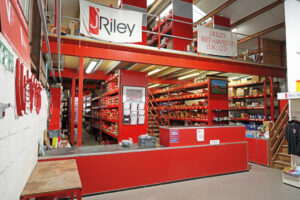
J Riley covers the whole of the UK from its base in Norfolk, with technicians travelling from Cornwall to Inverness, and across to Ireland as required. To maintain backup, this requires a significant amount of stock to be held on site, both to aid with the refurbishment process and to keep operators running in the case of a breakdown.
Around £1.5m worth of parts is stocked. In 2007, the company renovated its old workshop into a warehouse, building the two-day workshop where repairs and refurbs are completed. The commonality of parts helps to keep stock levels under control, but Harry notes that they always keep a minimum of three of each common wearing part – such as webs – in stock.
“We send parts out from here via overnight courier, and if there’s something that we don’t normally stock that is keeping a machine from operating, it’s only a six-hour drive to the Netherlands to collect a part,” Mat concludes.