


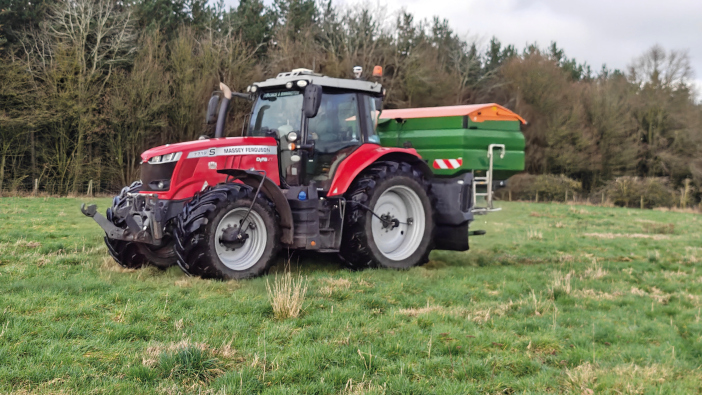
During our visit to Amazone’s headquarters last year, we heard that the late Dr Heinz Dreyer had worked since the 1980s on creating a fertiliser spreader that could automatically adjust every aspect of the spread pattern.
This has come in stages, with systems like WindControl changing disc speed to accommodate for crosswinds (and warning the operator if the windspeed is too high for spreading); ArgusTwin, which uses radar to monitor the lateral spread pattern and make adjustments as required; and additional options such as CurveControl which uses a yaw sensor to measure the angle of the turn and adjust the fan of product from each disc to avoid over- and under-application of fertiliser when navigating field corners.
According to David Thomson, marketing manager at Amazone Ltd, the most popular UK specification represents just one level within a wider portfolio, with more advanced technology available.
“Most will now go for hydraulic drive, as well as the AutoTS system, which adjusts the drop point of the fertiliser onto the disc, while border spreading adjusts the vanes while the discs continue to spin to minimise the risk of fertiliser wasted in hedgerows, or making its way into watercourses.
“We’re also seeing more interest in WindControl, as a way to increase the number of viable spreading days throughout the season.”
He adds that it isn’t necessarily farm size that dictates the investment in these systems. Growers who are interested in the technology are focused on return on investment. As an example, Amazone states a potential 1% yield increase when using WindControl because the fertiliser is placed where it needs to be. “It doesn’t take a big area with a 1% increase to start seeing returns on these systems,” he says. “And WindControl is just one part of the overall system.”
AutoSpread
AutoSpread was introduced on the ZA-TS 01, currently available as a pre-series machine with capacities of 4,200 litres and 5,000 litres and spread widths up to 54m, which can be split into up to 128 sections. The plan is for the 01 series to eventually replace the existing ZA-TS range, with a wider range of capacities and lower specification options to suit different buyers.
The first models into the UK will all be with the AutoSpread system (around £4,190, with two years of AmaConnect included); for the system to work, it also requires the ArgusTwin system, priced at £7,965, and it is an additional £520 for CurveControl. It’s a chunk of money on top of the base retail price, but the company states that the peace of mind supplied by these systems, in addition to potential savings in fertiliser and yield increases, will help to justify the expense.
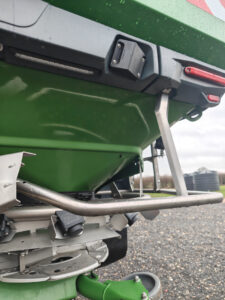 Using the seven sensors mounted around each disc as part of the ArgusTwin setup (14 in total), as well as two additional radar sensors higher on the rear of the machine, the AutoSpread system measures the deceleration of the fertiliser granules to predict where it will land.
This is essentially a compact version of the technology used in Amazone’s testing hall, where it has developed not only the physical systems to adjust applications, but also the software that enables the spreader to determine the type of fertiliser and its spreading characteristics.
We got a glimpse of this on the day before we started work. Using the new EasyMatch function in the company’s free MySpreader app, we were able to discern that the closest match in Amazone’s database of fertiliser types was Nitral I-55 Agrial – not the exact fertiliser being used on the day, but close enough for the spreader to automatically calibrate itself.
It works by having the operator use the app to take a picture of the fertiliser being spread; EasyMatch then uses artificial intelligence to analyse 250 parameters, including granule size, shape and structure of the fertiliser, providing settings that can then be wirelessly transferred to the machine through AmaConnect.
According to David, this not only speeds up the set-up of the machine, but enables fertiliser with lost labels, or which is stored in bulk, to be spread as accurately as possible, even when correct setup information may not be available.
Another neat feature that has been added to the machine is a visual indicator when approaching the required load. Users can input how much fertiliser they need to spread and, if they are loading bulk product, the work lights will come on to indicate when that amount has been reached. They will flash intermittently when the load is 1,000kg away from the target, speeding up when there is less than 200kg to go, and staying constantly lit when the target is reached.
In the field
One of the benefits of AutoSpread – and much of the Amazone technology stack – is that it works in the background. The Massey Ferguson used on the day had its own Isobus screen, an Amazone AmaTron terminal and a secondary iPad which acts as an extension to the AmaTron system. It would be easy to be overloaded with facts and figures.
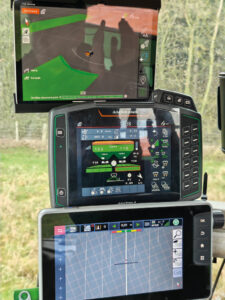 Instead, the bulk of the data is provided via images. The section control and the spread pattern show as an arc behind the digital tractor twin. There’s the total weight of product in the machine, as well as application rate and disc speed, and if one disc is not receiving enough fertiliser due to uneven loading, the disc will show yellow on the screen, turning red when no fertiliser is present. A small directional arrow and wind speed are also displayed if WindControl is active.
The optimised display comes after the company brought software development in-house, moving away from the previously used Müller-Elektronik system (now part of PTx Trimble).
The AutoSpread system monitors the spread pattern and adjusts without the operator knowing, providing an overview after three uninterrupted runs in the field. It requires a little bit of trust because of this, as the maximum spread width would see 162m of the field fertilised before the operator is informed of any changes, but from what we saw in the field, you can run safe in the knowledge that the unit is working.
As mentioned, we were running with the system’s best guess at what the fertiliser required. When we finally saw the changes that had been made, it highlighted the potential variations in fertilisers, from bag to bag, and based on the conditions.
In the small grass fields we worked in, this was enough for the machine to recognise that the disc speed needed to be reduced from 800rpm to 670rpm, and that the direction of throw should be brought round from 240 to 212. To adapt to this, the machine also adjusted its switch-on point by 0.8m.
All of this was done without notifying us through the terminal. David notes that the changes were significant enough that after those three uninterrupted runs, the operator would likely be advised to use the EasyCheck mobile test kit to validate the spreading characteristics. Handily, the redesign of the machine includes a box to hold the test kit within the mudguards, meaning operators do not have to carry it in the cabin.
“The machine is continuously validating the spread pattern, meaning that even variations between bags of the same fertiliser can be accounted for,” David concludes. “It isn’t a replacement for operator experience, but it is peace of mind for an operation that often can’t be validated until stripes appear in the crop.”