


The first ever Agronomy Exchange event took place on the 11th February, providing agronomists, farmers and industry professionals with insights about future agronomy practices and technologies
What will agronomy look like in 2050? Louise Penn, farming consultant and agronomist at Ceres Rural, explained that it was occasionally disheartening to spend her time doing the same things and utilising the same tools that her older colleagues were, despite agri-tech developing at pace.
She noted the challenges facing the industry, including yield plateaus, price fluctuations and extreme weather, and said that artificial intelligence would be key to helping agronomists and growers navigate these challenges. This was backed up by a poll taken of those in attendance, who highlighted AI and robotics as the two key pieces of agri-tech for the future of farming.
Louise said that the amount of data collected on farms was currently making it harder to find the right course of action, and that AI would be key to cutting through the noise and making agronomy more predictive and less reactive going forward. When looking forward another 25 years to agronomy in 2050, she believed that things would look very different:
- A more sustainable product from carbon-neutral or carbon-negative farms
- Fewer chemical actives, with a greater reliance on biological products for nutrition, disease and pest control
- A lower overall cost per tonne of grain produced, with a wider variety of crops grown due to the changing climate
- Fully autonomous farms
Behind all of this would be AI-generated reports, which would be personalised to each farm, or field – or perhaps even on a sub-field level – reviewed by agronomists and the grower to make more informed decisions.
Agronomy now
But that’s jumping forward, not only through the decades but to the end of the conference, where Louise gave the keynote. Tom Allen-Stevens, founder of the British On-Farm Innovation Network (Bofin), opened the agenda with a discussion about the role of science and technology, and the opportunities currently available to growers.
 Again, AI was key to this, with Tom stating that there were ten million trillion trillion combinations of decisions which had to be made between establishment and getting crops to the consumer. It’s a mind-boggling statistic, and one which highlights how the correct use of AI could help pull together data to make these decisions clearer.
He then shifted to talk about the work that Bofin does. Its use of new technologies and on-farm trials is designed to build a culture of sharing within the industry. “Farmers are peer learners, preferring to learn from other growers,” he said. “Most will wait to see something succeed on another farm before taking the risk.”
He added that growers who did take risks and trial new methodologies and equipment deserved payment for this. Bofin facilitated this through private and Government funding, with projects currently valued at £14,277,466, and £500,000 paid out to those growers using their land for trials.
Precision breeding was the focus of the next stage of trials. PROBITY is a three-year project, funded by the Farming Innovation Programme, in which three precision-bred cereal varieties would be trialled in on-farm conditions, taking pre-commercial traits and seeing them through to markets.
“We see that growers are keen for precision breeding of traits, rather than genetically modified crops,” he added.
The most recent announcement from Bofin is LLS-ERASED, which will use precision breeding to reduce oilseed rape susceptibility to light leaf spot – said to cost the UK £300m in crop losses. This is funded by the Farming Futures R&D Fund, with several innovation centres and commercial breeders on board as partners.
It’s currently an England-only project, and Tom acknowledged that precision breeding was currently caught up in regulation, which was making uptake impossible. However, he hoped that results from these two projects would help build certainty within the industry, leading to a ready marketplace when legislation allowed.
Driven by biology
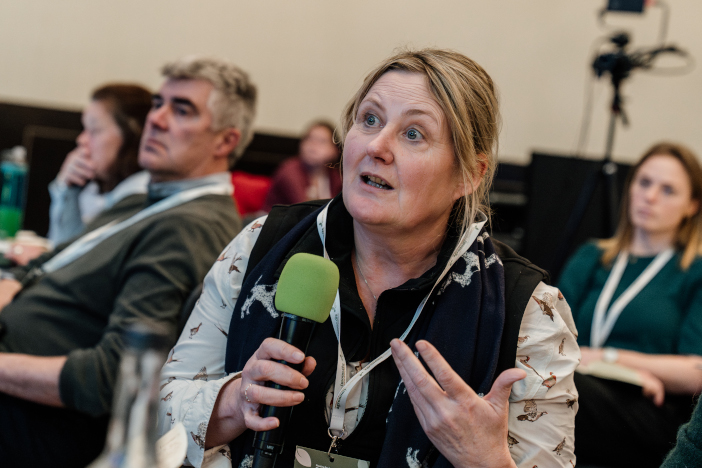
Elizabeth Stockdale, head of farming systems research at NIAB, was joined by Bek Hirstman, agronomy and environment manager (cereals and oilseeds) at the AHDB, to give a talk on soil health next. Elizabeth made an interesting point at the start of the talk, noting that soils do not adapt, so talking about resilience in the traditional sense (i.e. the measure of something’s capacity to adapt) wasn’t always helpful.
However, soil is driven by the biology within it, rather than the physical or chemical make-up, so while we cannot change the backbone our soils, we can change how that biology reacts to stresses, which in turn will build resilience.
Bek took over from here, discussing the AHDB’s soil health scorecard, which was a simple way to assess the biology. Within a 5m radius, soil digs and randomised core samples were taken to show worm counts and possible compaction. “You really want to see a good number of adult and juvenile worms to show good breeding potential.”
The simple colour-coded scorecard highlights areas where growers can make changes; these changes could be establishing a cover crop to vary rooting depths or using green manures to feed the biology within the soil.
“Soil organic matter impacts everything,” added Elizabeth. “Our soil is a complex mix of organisms which chew through organic matter, then dispel leftovers for smaller creatures and the plant roots to take up. Whether your soil is predominantly bacterial or fungal will also make a difference, as bacteria will respond better to freshly added organic matter, cycling it for fungi within the soil.”
She said that scientists were still trying to unpick the vast amount of interactions that take place under our feet, but there were some key mistakes made currently that made this even more complex. “We need to understand what we are measuring and stick to one method of measurement, because different tools will give very different results. Take carbon, soil organic carbon makes up around 58% or soil organic matter, but these terms cannot be used interchangeably.”
 Going biological
One of the most in-depth talks of the day was given by Richard Oliver, adjunct professor at Nottingham University. His work in crop biology had taken him across the globe to Australia and back again, and he could see real issues in the future around disease susceptibility.
He said that the UK didn’t know the true cost of outbreaks, and that we were seeing one mode of fungicide action come to the market every decade, just enough to keep our heads above water but not enough to manage resistance issues in the field. He reflected on the outbreak of barley powdery mildew in Western Australia, which he believed to be the most expensive crop disease outbreak of all time. “Growers predominantly used only active in controlling the disease, and this was applied during the standard course of crop establishment. When resistance was found, it affected a huge proportion of the crop, with growers not only losing 1t/ha in yield on average but also seeing quality drop from malting to feeding. A significant financial blow.”
While more modes of action were coming through, he believed that bio-fungicides could be part of the solution. For starters, the majority of these were multi-site modes of action, making them less susceptible to resistance. There were also different modes of action that biologicals could induce in the plant. Some simply competed with the pathogen, stopping it from developing further; others were parasitic and fed off the pathogen.
Some biologicals worked like a vaccine; kick-starting the plant’s own defence systems to fight off the disease, although this came with the risk of energy being diverted into fighting off the disease, rather than into growth, so there could be a yield penalty.
Utilising the YEN dataset
The Yield Enhancement Network (YEN) for cereals and oilseeds was ended after the 2025 harvest, closing the door on a significant dataset that was used to benchmark and analyse crop performance. However, the data collected does show interesting patterns that growers should be aware of. This was explained by Tom Wilkinson, senior crop research consultant at ADAS Sustainable Agricultural Systems, and Nick Anderson, technical director at Velcourt.
It was highlighted that the yields we currently seeing are nowhere near the potential of the varieties available, linking back to the plateau that several speakers referred to. As to whether maximising yield should be the aim for growers, Tom noted that gross margins were still closely linked to the yield.
If we take wheat as an example, a yield of 3t/ha should cover the costs of an average set of inputs, increasing to 5t/ha in a high-input, high-output system. This obviously doesn’t cover the fixed costs of the business, so it doesn’t indicate overall profitability. Extrapolating further, YEN datasets suggest an 8t/ha crop would result in a gross margin of £800/ha, increasing to £1,400/ha for 12t.
In this regard, yield is still king.
However, there were challenges to this. The warming climate was both a positive and a negative factor. The temperature between October and July was increasing by 0.5 °C per decade, with the temperature between June and July jumping further by 0.8 °C. The warmer winters were a positive for early growth, but the hot summers shortened the grain fill time, offsetting some of the genetics introduced.
There were ways to combat this, with the breakcrop effect reportedly adding around 1.1t/ha according to YEN data. Plant growth regulators and fungicide applications impacted this, as did soil organic matter, cover cropping and no-till. Interestingly, organic manures appeared to be negligible, although it’s hard to split this from soil organic matter, and ensuring the correct nutrients are applied to the crop.
Nick Anderson said Velcourt was exploring late-drilled, fast-developing varieties, both in oilseed rape and winter wheat; a simple change that would lead to significant changes in the way crops are managed. He added that with all the information about crop management available, it was strange that much of it wasn’t taken up.
“Growers tend to work on muscle memory when it comes to their crops,” he said. “There is data to show positive yield results from cutting seed rates, and even dropping nitrogen levels, but growers don’t currently have the confidence to do this.”
The view from the farm
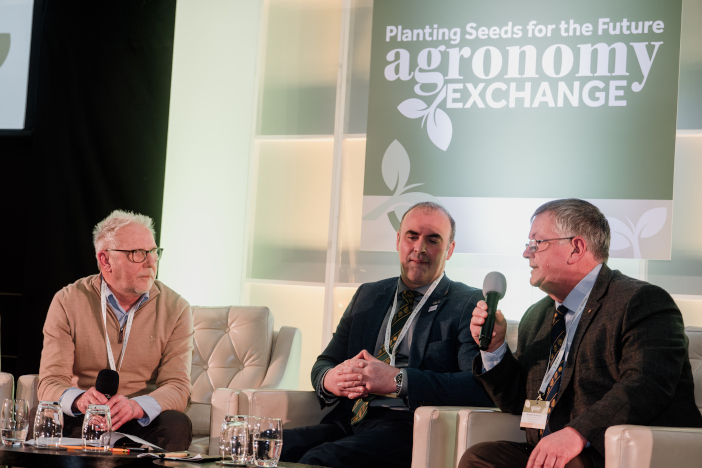
Agronomy Exchange wasn’t just about scientists and agronomists saying what should be done. Space was also given to farmers who were implementing these methods and others within their businesses. David Bell and Richard Anthony, both two-time National Arable and Grassland Award winners, took the stage, with Richard starting by highlighting some of the challenges he faces on his South Wales farm.
“We have very variable soils on the coast, with some of them having up to 70% silt content, making it challenging with the amount of rainfall we receive,” he said.
He said that farmers were looking to innovate but could not do it alone. He had previously established lupins to diversify the rotation. “We had everyone come to the farm and say how marvellous it was, but there was no government support, no nutritional support and no agronomy support, then at the end of it there was no market support.”
David said that as a proud potato grower, he had to innovate to help soils quickly recover from the rotational soil damage caused by harvesting and ploughing. This had been through no-till drilling, where possible, as well as covers and a focus on soil health, as well as looking closely at the margins per enterprise to ensure that every part of the business paid for itself.
Both said they had benefited hugely from on-farm trials, highlighting crops that would work in their conditions, and finding solutions to problems on-farm, such as septoria pressure for Richard. David was concerned, however, about misaligned regulation, which was creating unnecessary borders within the UK.
He highlighted the Precision Breeding Act, which was an England-only piece of legislation and would leave devolved farmers trailing behind, as well as creating issues for breeders and markets if precision-bred grain could not cross into Scotland or Wales.
 The best time is 20 years ago…
Carbon and net zero were bound to be topics at the event, and in a talk led by Liz Bowles, chief executive of the Farm Carbon Toolkit, the question was asked of how growers can benefit from measuring carbon stocks.
Nick Down, senior farm manager – environmental lead at Velcourt, said that the company had been measuring their carbon since 2018 and recognised that nitrogen inputs were making up between 50-55% of all emissions on-farm. He added that growers were delaying the benefits of measuring their carbon stocks, as there were financial benefits to be had now.
Liz agreed, noting that the best time to test was 20 years ago, but failing that, today would have to do.
She acknowledged that there was concern that the most forward-thinking farmers would have soils already at a carbon saturation point, but that soils were likely to have a significant way to go – though there should be support for those who have already done most of the work.
Danielle Robb, research and knowledge exchange assistant at Ceres Rural, added to this, noting that there was a risk of carbon tunnel vision and that it needed to be seen as part of a wider system. Suggesting that even the most carbon-efficient growers likely still had work to do.
The discussion primarily revolved around ensuring that growers are rewarded for their efforts, not only through subsidies but also from the market. However, this came with complications as the market worked with bulk amounts, where an average was necessary. Rewarding individual farmers would require additional work.
Similarly, carbon calculators had to continue evolving to understand the true picture on the farm. Diverse rotations mean that fertiliser use will fluctuate, using less after pulses, but possibly increases the further away in the rotation the grower is. Similarly, adding livestock to arable rotations will help in some ways, but add emissions in others. This all needed to be taken into account.