


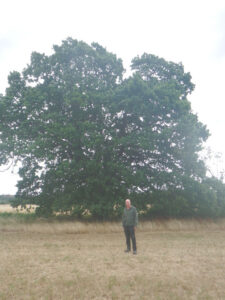
You might ask what an Oak tree has to do with farming, but the tree in question is a sign of resilience.
The tree is up for the Woodland Trust Tree of the Year award, located on Andrew Brown’s 252 ha farm at Caldecott, Rutland.
The story has it that back in 1943 the tree was hit by a Lancaster of 617 Squadron, when practising for the famous Dambuster raid of World War II. The nearby Eye Brook Reservoir was a secret practice site for the raid.
Although no official documentation of the incident exists, an RAF record shows that on 28th April 1945, Lancaster PB983 crashed on a training flight after losing power on both port engines. With all control lost at 100 ft, it crashed, killing two of the crew. This is more plausible as it collates with Andrew’s grandfather’s records, where he listed damage to the tree, the plane coming down two miles away.
Whether the tree has been struck once or twice, it has recovered and is in good health despite the collision and the drought. And it reflects the attitude of Andrew himself. “Years back I saw myself as a farmer. Now I see myself as a businessman first who just also happens to be a farmer,” he says.
 With farm support decreasing, Andrew knew he too had to find another way to improve resilience, so the farm now hosts holiday lets and the Rutland Cricket Centre, both housed in converted farm buildings.
The two holiday lets can sleep 11 each when two sofa beds are employed, and occupancy is high. “We’re pretty full most summers and generally have bookings throughout the year. Interestingly, we appear popular with Hen Parties, who appreciate the rural location and that a hotel bar won’t close at midnight.”
Self-catering accommodation means the majority of the work is restricted to weekend changeovers and general maintenance. To help, Andrew employs a local cleaner to take on the routine work of bed linen and towels.
Given the shell of a former lambing shed was in place, conversion wasn’t an overly complicated business. Andrew used the services of a local builder to do all, including final finishing.
Although the business is weighted to the summer, Andrew has been surprised by the occupancy levels and diversity of visitors. This has included contractors and people living in the local area. “Some just want to get away for a while, a change of scenery, without having a six-hour journey on congested roads.”
Despite the popularity of tourism farm conversions, the two lets are providing a healthy income. “In one year it generated more profit than a typical 250 hectare farm,” he adds.
This is likely to continue, as a survey by finance house Chase forecasts 22.5 million UK adults are likely to have enjoyed a UK staycation this summer, up 40% on 2025. Mintel data suggests the market will rise by 20% by 2030.
However, in Andrew’s view, it is good to have a broad business mix, so another building has been converted to a cricket training facility. A wise move as the facility is widely used in the winter when holiday bookings are lower. Andrew charges the operator a rental fee plus heating and lighting costs, powered by solar.
“It isn’t tall enough for a grain store so was pretty redundant. The good news is the way it is designed, I can convert it back to agricultural use pretty simply if needed.”
The barn was a logical solution for the size of the building. It has three lanes and the latest monitoring technology for first-class coaching. “A typical sports centre doesn’t want all its space being used by just a handful of people when it can accommodate 100 for a pilates class.”
But Andrew is still a farmer, just a very business-minded one. In the past he has “chased the money” and will continue to do so.
The rotation is first and second wheats, most for Weetabix, following two years of the AB15 action.
“It’s a win-win; there’s a lot of biomass, flowers on the clover, and plenty of nitrogen fixation. The downside is the loss of production has got to be made up. If this is imported grain with a higher carbon footprint or the loss of rainforest, it doesn’t make sense.
“If we consumed all the food we produce here, we would run out by August. Relying on others to feed our nation carries risk. But that isn’t my decision; mine is what is the best option here.”
Looking ahead, the same business-minded attitude will dictate the farming landscape in the future. Another poor harvest has made him think hard about his options.
One consideration is whether to drop wheat in favour of a winter cover crop and a low-input cereal. “The hard reality is I can only make the business work with the environmental payments and the additional diversification streams.”
If wheat is to remain in the rotation, Andrew will have to adapt to meet changing customer needs.
Weetabix wants wheat with a total application of 170 kg/N/ha. He was able to do that last season as crops didn’t need a final top-up. But he is hoping the nitrogen fixation of a two-year legume fallow will get him there or close to it.
Plot trials involving sewage sludge and biostimulants have proved promising, and field-scale trials will be undertaken this season. Weetabix is keen to highlight its responsibility, so it is looking for growers to adopt environmental schemes.
Andrew has adopted the AB8 flower margin action, built scrapes to encourage waders into some pasture and converted 3 ha of underperforming land into community woodland. “It was only productive 1 year in 4, so it made sense to do something with it.”
It was established with the help of a grant and local schools and scout groups. 20 years on, it has matured well; the local community granted permissive access.
But the patches of woodland do offer something back to the farm. “Despite the extreme rainfall we receive these days, it has helped alleviate flooding. This is now more once a season than two or three times,” he adds.
It’s also boosting beneficial habitats; Andrew is awaiting a visit from Birmingham University to undertake a biodiversity study.
