

Adrian Tugwell is a busy man. Overseeing more than 50 members of staff, he coordinates operations across 4,000ha of solar farms and cultivation and drilling work spanning 2,800ha of arable ground from his base outside Cirencester.
It’s very different, both in the work offered and the scale, to what the Tugwell family have done historically. Adrian can trace his farming heritage back to the 17th century, where his 16th great-grandfather developed the Beverstone Plough.
Jump forward a few hundred years and Adrian’s father, Peter, returned to the family farm in 1958 after leaving the RAF and established Tugwell Engineering & Contracting.
“He built the business around baling and arable work,” Adrian explains. “When I was old enough, he encouraged me to go and find experience elsewhere, then, in 1994, I joined the business full time.”
Things continued with the same focus until the early 2000s. Combine and forage harvesters had been added to the fleet, and the business was handling a significant area of arable and grassland. “I can trace the business from my grandfather’s horse-drawn trailers up to the large-scale equipment we were using,” Adrian says. “But in the early 2000s farming nosedived and we had to make some difficult decisions about our operations.”
By 2005, Tugwell Contracting was no longer offering combining, foraging or spraying. It instead pivoted to focus on the landscaping work it had always offered alongside its main operations. This included excavation work and fencing, which kept the company moving until 2011, when the first of many opportunities came in.
 Moving into renewables
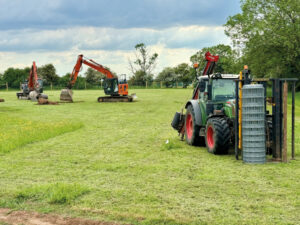
When a new solar farm was built in Cirencester, Adrian was approached to tidy up the site once construction was complete. “They essentially asked Paul [Clapton, arable manager] how they could make the site look scenic again,” he says. “We went in with tractors and cultivators and reseeded the area for them.”
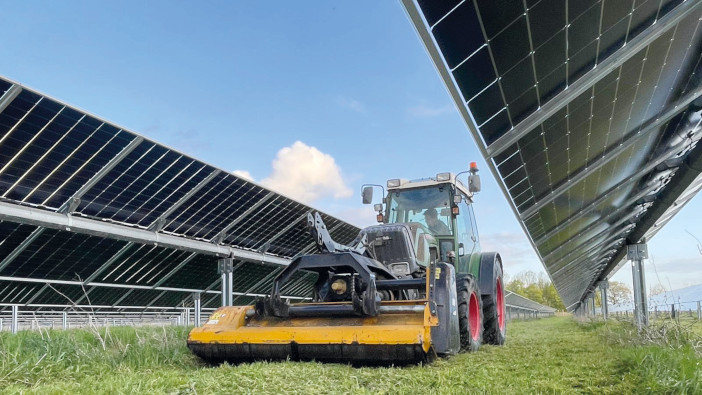
This job quickly expanded into a regular maintenance contract, including cleaning the solar panels and mowing the grass strips in between. Working closely with the company that established the solar farm, the work increased further to include helping to establish new solar farms across the UK and Ireland.
“We now handle the construction of buildings and roads across the sites, cable laying with our trenching equipment and fencing, as well as the general maintenance work,” Adrian explains.
Solar farms remain a controversial topic in agriculture, especially when productive land is used for them, and Adrian finds himself in a unique situation, stating that his first love is farming, while also building a lucrative operation around the construction and maintenance of solar farms.
“I think there is a lot of ground being farmed now that shouldn’t be,” he says. “To increase food production during the war effort, over 1.7m hectares were transferred into farmland and have been farmed chemically for 80 years to maintain yields. This is unsustainable now, especially with the input costs.
“However, I also disagree with the idea that solar farms cannot be productive areas of land. With the focus on biodiversity, solar farms present a unique opportunity for multi-species mixes to be planted and regularly maintained. Then there are the options for sheep grazing. I would argue that solar farms, when constructed on the right field, become high-output, low-input, highly productive areas.”
To ensure this, Josh Hutchinson, commercial and landscaping manager, works closely with each site. This includes helping with the layout to ensure that machinery can work within the site, assessing the mix of species planted and coming up with an overall management plan.
 The right kit
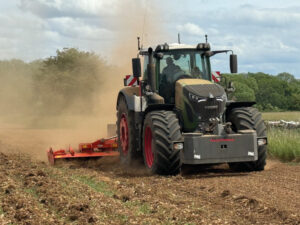
Working across such a large area of both arable land and solar farms, Tugwell Contracting runs an impressive amount of machinery. There are 40 working tractors, including three Fendt 724s, an 824 and a 924 that work primarily on the agricultural side of the business. These run with Kuhn and Lemken combination drills, a Horsch disc drill and a Vaderstad Topdown.
Fendt tractors also feature heavily in the groundworks. Smaller, compact units are used on the solar farms, although Adrian notes that depending on the setup, it’s surprising how much of the equipment can cross over.
“The FendtOne system is a game-changer. It’s easy to use and can be set up to suit each operator. We prioritise regular maintenance and care for the machines, so each operator is assigned their own tractor and is responsible for keeping it clean and tidy.”
The rest of the tractor fleet is made up of New Hollands. Adrian says at one point the farm only used the blue brand, going back to a 1943 Standard Fordson. He even uses modified models for tractor pulling – a hobby he still finds time for, despite the workload.
“To be honest, we moved away from New Holland after the TM175, which had a lot of issues. At the time, the Fendts were just on another level. Now we run a mix of T7s for haulage work, and compact, cabless models for the solar farms,” he says. “The T7s are comfortable and keenly priced, and since we only need the power for the roadwork, they are the ideal tractor.”
Key to the solar farm work is a reliable fleet of mulching units. For this, Adrian looks to the Muthing range from Simon Richard, supplied through Halse. They have more than 50 units on site, 99% of which would be Muthing.
“Like the tractors, we number them and assign each one to an operator. Because we have so many, we also keep a full stock of spares to minimise downtime.”
 He explains that both Simon Richard and Halse have been excellent to work with, and that the Muthing units have proven to be hard-wearing and reliable. For cleaning the solar panels, Adrian spent time researching what was available and settled on the Bavarian-built Sunbrush arm-mounted units. “It’s probably the best-developed system on the market,” he says.
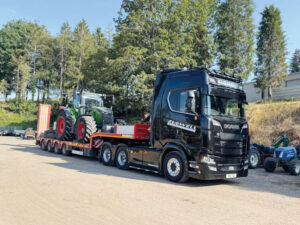
While running through the company’s fleet would take up far more space, there are also six hedgecutters, supplied by Shelbourne Reynolds and Spearhead, 10 specialised sprayers to tackle weed growth around and under the solar panels, nine Scania lorries for hauling equipment up and down the country, and a fleet of Hitachi excavators.
Riding the wave
Asking whether there are areas of opportunity for Tugwell Contracting feels unnecessary. Adrian says in the 15 years since he moved into solar farm maintenance there has not been a year where the business hasn’t grown.
Tractors are kept until the last year of warranty and replaced, but most years at least one new machine is added to the fleet. It’s a similar story for many of the mainline implements. Now the prospect of additional wind farms in the UK is providing the same opportunities that solar did 15 years ago.
And while agricultural operations will continue to play a role in the business, it currently only makes up about 10% of the total turnover. “Farming is my true passion, but I’m realistic about the prospects of growing that side of the business. I never say never when it comes to bringing combining or forage work back, but the financials of farming would have to change significantly for us to justify it.”