


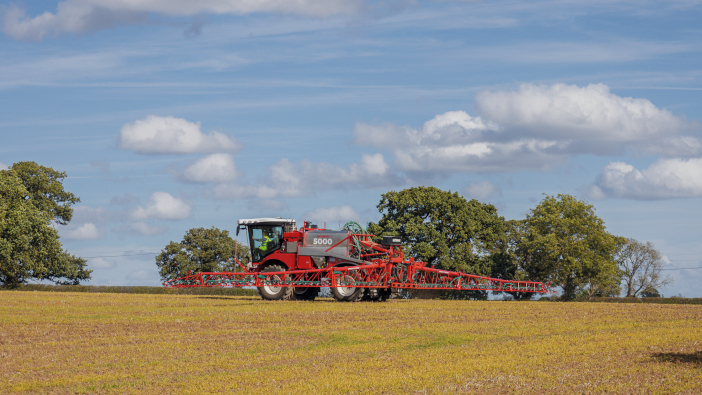
We visited the farm of David Jones, a partner at JH & MM Jones, Stratford-upon-Avon, to get an in-depth look at Bateman’s newly launched RB series of self-propelled sprayers.
To mark 50 years of manufacturing self-propelled sprayers, Devon-based Bateman has overhauled its range. Unveiled earlier this year at the Lamma show, the new line-up includes the RB30 (3,000 litres), RB40 (4,000 litres), RB50 (5,000 litres) and flagship RB60 (6,000 litres), replacing the outgoing portfolio with a clear model naming structure aligned directly with tank capacity and transmission set-ups.
According to Jason Bateman, managing director and chief designer, it represents the company’s most significant portfolio update since it introduced a new cab in 2017.
Bateman has built the entire range around a strict customer wish list. The requests were clear: a new joystick and control interface; increased tank capacity without sacrificing the lightweight agility and near-50/50 weight distribution that has defined the brand for half a century; and the option to specify 25cm nozzle spacings on the boom.
Chassis and structure
Designed and fabricated entirely in-house at Bateman’s headquarters, from the chassis and stainless-steel tanks to the wiring looms and boom assemblies, the new range is said to balance high daily outputs with soil preservation.
The low-profile tank sits deep within the chassis framework, achieving an even lower centre of gravity for slope
stability while preserving the weight balance. Engineering this layout allowed Bateman to achieve a combination of capacity and compactness.
The top-selling RB50 packs 5,000 litres onto essentially the same compact chassis footprint as the 4,000-litre RB40, adding just 25mm to overall tank height.
Meanwhile, responding directly to large-scale growers demanding higher work rates, the flagship RB60 expands
the previous 5,500-litre capability to a full 6,000-litre capacity, using an extended chassis and longer wishbone layout to spread heavy payloads evenly across all four corners.
To handle these increased payloads and wider booms, steering assemblies feature 50mm chrome kingpins set into 50mm-longer bosses with dual top-and-bottom grease points. Heavy-grade steel steering arms, reinforced axles, upgraded hydraulic hose/coupling diameters, adjustable mudguards and standardised bushings further protect long-term resale values and simplify daily field maintenance.
 Plumbing and next-gen VG booms
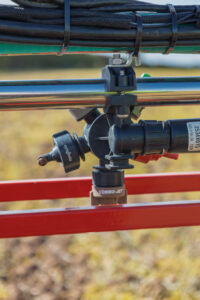
Plumbing across the entire line-up has been optimised for high-speed filling and rapid field turnarounds. Standardised features include a 7.6cm high-speed fill port, clean-water capacity starting at 300 litres (expandable to 500/600/700 litres), automatic fill shutoffs, slow-fill controls, an assisted ram on the induction hopper, stainless-steel drip trays and dedicated pump-out capabilities.
Boom options include the standard 12/24 twin-fold, or the most popular variable geometry (VG) three-stage-fold up to 42m. The redesigned VG boom is structurally stronger yet lighter than predecessor models, incorporating soft hydraulic damping to eliminate frame oscillation and vibration at high forward speeds. To meet modern drift-reduction guidelines and improve chemical target coverage, the boom can now be configured with 25cm nozzle spacing alongside traditional 50cm layouts.
Durability is built directly into the frame, where curved plates absorb field strikes, while 40mm pivot bushes with low-friction seals, hydraulic breakback protection and bolt-on replaceable joints allow damaged sections to be
serviced individually without replacing full assemblies.
In-cab technologies
With operators regularly spending 12-16 hours in the seat during tight application windows, the cab set-up represents the most dramatic upgrade in the range. The all-new armrest console and joystick deliver tactile control designed directly around operator feedback, housing 60 tactile buttons on the surround, including 10 assignable auxiliary switches reserved for custom farm or contractor builds.
Operation is divided into specialised driving modes:
- Road mode: Locks out application hydraulics for transport safety while providing direct access to tool steer,
indicators, forward steering, cruise control and work lights. A quick-access button on the rear of the handle safely toggles two- and four-wheel steering as part of a two-button operation on the road. - Field mode 1 (transmission and drive): Manages cruise settings, auto-steer engagement and tramline sequences, linking with an onboard inclinometer that automatically shifts gear ratios on steep slopes based on incline angles.
- Field mode 2 (section and implement control): Provides instant manual overrides for individual spray sections or mounted implements.
- lField mode 3 (boom geometry): Controls independent left/right-side lifting and full variable- geometry tilt to hug undulating crop canopies.
Electronic failures mid-season are a headache that no farmer wants, so Bateman has integrated parallel mechanical switches alongside electronic controls. If a touchscreen or circuit board suffers an issue, physical manual overrides allow the operator to continue.
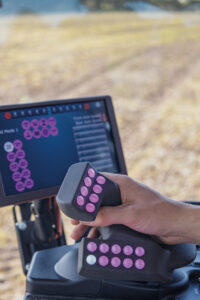 Furthermore, upcoming software updates will also introduce operator user profiles, restoring driver-specific button layouts at the tap of a screen.
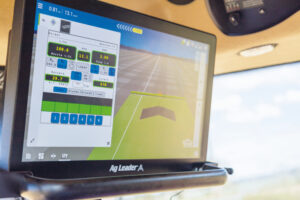
The cab natively integrates with AgLeader for rate control, field mapping, pulse width modulation (PWM), artificial intelligence (AI) weed recognition cameras and automated boom levelling, while offering plug-and-play compatibility with John Deere, Trimble, and Topcon GPS guidance systems.
Transmission options and E-Drive+
Power delivery has been restructured across the model range to balance traction, torque and fuel economy. On standard two-, three- and four-speed models, the transmission can be manually balanced between the front and rear axles to prevent wheel spin under heavy tank loads.
For demanding hill ground or operations seeking maximum fuel economy, Bateman’s E-Drive+ system automatically manages displacement and power delivery to each wheel motor independently. For example, on a wet bank, unlike some traction control systems, Bateman’s Stability Control distributes the power independently
across all four wheels before it loses traction.
On the road, E-Drive+ automatically optimises gear ratios to keep engine speeds low, reducing fuel consumption and cab noise.
Pulse width modulation and AI spot-spraying
Precision application technology is becoming increasingly popular, with well over half of all new Bateman RB sprayers now leaving the factory equipped with PWM systems. By pulsing individual nozzle solenoid valves on and off up to 10 times/second, PWM decouples flow rate from pressure.
The system maintains exact application rates across changing forward speeds by modulating valve duty cycles rather than spiking pressure. On windier headlands, operators can manually drop pressure down to 1.5bar, where the duty cycle instantly expands to compensate, producing coarser, drift-resistant droplets without altering application volume or speed.
During headland turns, the system calculates boom curvature in real time across the width of the boom; outer nozzles speed up while inner nozzles slow down, shutting off completely if an inner section swings backwards over already-treated ground. Operators can also program zonal presets, such as delivering 20% extra volume on
headland borders to combat weed encroachment or 20% reduced volume over tramline margins.
 While operators control application rates in-cab, CapstanAG simplifies daily pre-flight checks. Connecting via
Bluetooth directly to the PinPoint system, an operator can walk the length of the boom with their smartphone,
manually firing individual nozzle solenoids to inspect spray patterns and clear blocked tips without needing a
second person in the cab or large volumes of water.
For ultra-targeted weed control, elevated, boom-mounted Carbon Bee AI cameras scan ground cover ahead in real time, identifying target broad-leaf weeds against bare soil or green crop canopies and triggering individual PWM nozzles only over target weeds.
By listening closely to operator feedback, Bateman’s 50th-anniversary RB line-up bridges high-tech application
precision with practical engineering durability.
