

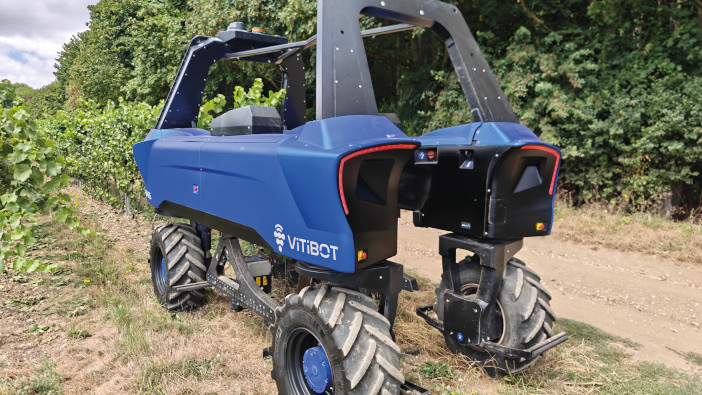
In July 2022, Same Deutz-Fahr (SDF) purchased a majority stake in the French start-up VitiBot. The company, which produces electric-powered robotic units for vineyards, had been developing its Bakus machine for six years at that point. It fits neatly into the SDF portfolio, complementing its narrow tractor range and the Grégoire grape and olive harvesters.
While the SDF deal was still fresh in the memory, VitiBot had already placed its first machine on UK soil. Following demos on French vineyards owned by MDCV, Silverhand Estate in Luddesdown, Kent, took delivery of a Bakus P75L – the 37th unit to be built commercially by VitiBot.
Speaking with Karl Wright, operations director at Silverhand, it’s easy to see why the machine appealed to the company. Its Kent, Essex and Sussex vineyards extend to more than 400ha, with a similar area down as regenerative cereals, livestock and stewardship schemes. “Our founder, Mark Dixon, is very keen on regenerative practices. Over half of our vines are farmed organically, we create our own compost with residues from the winemaking process, graze leaf fall and the vine rows with our flock of Romney sheep, and are involved in various regenerative projects,” he says.
Regenerative and organic practices come with an additional workload. There are 80 vineyard workers with a mix of operatives and tractor drivers working in the vines. The company overall has 160 employees, with the majority at Silverhand. The lack of chemicals means weeding and pest control all need to be handled mechanically, which places pressure on the crew.
The introduction of the VitiBot allows the company to use its staff more efficiently. Instead of being in the tractor seat and requiring another person to walk the rows and perform basic maintenance, the VitiBot can handle inter- and intra-row weeding and mowing, while the operator ties up vines, checks trellises and looks at the overall health of the crop.
Multiple units can be monitored by a single member of staff – as long as they remain between 500 and 900m for the emergency stop function. This means that several tasks could be completed with only one operator in the field.
 Autonomous operations
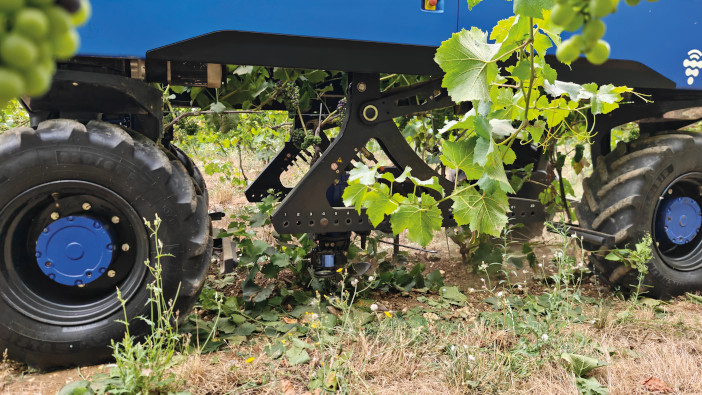
The L variant of the VitiBot is 3.5m long, 1.95m wide and 2.5m tall, with an open centre that can travel over vines up to 2.2m tall and 0.8m wide. This compares to the smaller model (S), primarily designed for Champagne crops, which is 2m tall and can travel over vines up to 1.75m tall and 0.6m wide.
Despite this, the larger model is just 350kg heavier at 2,400kg. This means it can be transported to site using a pickup and trailer. Each model is fitted with low-pressure Michelin MultiBib tyres. “As well as being able to complete multiple tasks with fewer staff members in the field, one of the big benefits was reducing compaction up the rows,” explains Karl.
This is more pronounced on the headlands. The VitiBot requires a 5m end zone for turning – twice its length – but as each wheel is controlled individually, it can turn on its own axis. This keeps turning manoeuvres to a small area.
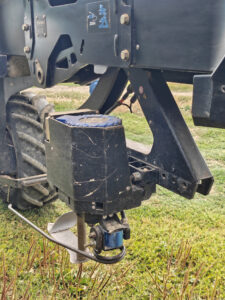
SDF UK product specialist David Jefferson explains that it is a modular unit. Lifting toolbars are placed on the interior of each side, where weeding tools, mowers and pruner bars can be mounted. These simply bolt on, so they can be quickly changed over to suit the task at hand.
“The height of these toolbars can be individually adjusted and set to float so they follow undulations and the incline of the field,” he says.
The fields are mapped out ahead of time, using each corner of the vineyard and the start and end points of the rows. Pathways can also be included in the map, so when carrying out cultivation work, the machine will automatically lift the implement. The VitiBot then uses two RTK receivers, mounted at the front and rear. Using sensors around the machine, it can adjust to the growth of the vines throughout the season, so while it will always follow the row, it can offset either the front or rear slightly.
Pressure sensors under the panels mean it will automatically stop if it gets too close to the vine for some reason. These sensors also make up part of the fail-safe equipment for when it is working around people. A moderate amount of pressure is required to activate the emergency stop, so that vines hitting the side of the machine in passing do not set it off, but a human pressing down with their hand is enough to do it.
It also uses cameras with human detection to slow down and stop if a person walks in front of the machine. Whenever the emergency stop function is activated, the observing worker receives a remote notification (if they are a few rows away, for example) and can check that the obstacle is cleared before restarting.
A full day’s work
Fully charged, the VitiBot can operate for nine to 11 hours, depending on the operation. With a 63amp, three-phase charger, it can be recharged in two hours. This means that during peak season, Silverhand Estate can get 70 hours of work from the machine, with the staff working in shifts.
“The fact that it is fully electric and can continue operating for extended periods of time has a direct effect on not only crop health, but price per bottle that we produce,” explains Karl. “It suits our own aims, which is to preserve the environment and keep the cost of production as low as possible without affecting quality.”
He adds that the VitiBot is already working at capacity, handling weeding and mowing operations across several blocks, covering more than 60ha. While less than what an experienced operator on a tractor can handle, the benefits of being able to work day and night, and the ability for an operator to handle other tasks in the field mean it significantly increases efficiency.
Vineyard operative manager Deyan Deyanov notes that the estate needs another two just to meet the demand and it is actively mapping out plots so the machines can work across all sites. “Because the fields are mapped out without the machine, as and when we add a new unit to the fleet, we can quickly upload the existing maps.”
As the position of the VitiBot is constantly monitored, if a job is not completed one day, a second machine can be brought to the field and pick up exactly where the first finished. For backup, each unit is monitored by the VitiBot Supervision help desk in France, which can wirelessly push updates and diagnose issues remotely.
Silverhand Estate
In 2024, Silverhand Estate was the first UK vineyard to reach carbon-negative status without external offsetting. This was achieved by its organic and regenerative practices, as well as the sequestration from vines, woodland and grasslands.
More than 24 varieties are grown across the estate, with a focus on Chardonnay, Pinot Noir and Meunier and Solaris. A mix of still and sparkling whites and rosé are produced, as well as red wine.
Vines are established conventionally to ensure that they compete against weed and pest pressure, and are converted to organic status ahead of the first harvest. Karl Wright, operations director at Silverhand, says the potential for the Vitibot to apply copper and sulphur could enable the business to speed up this organic conversion.
Picking staff are primarily sourced through the Armed Forces Covenant scheme, for which MDCVUK recently achieved Gold Award status, and the Forces Employment Charity, which has seen Nepali nationals and descendants of the Gurkhas come to the estate. Some of the vines are also machine harvested by a contracting firm, using a trailed Grégoire.
While farming organically and regeneratively, the business also takes part in projects to see how operations can be improved. This includes a 3ha block of Solaris grapes, where the vines have been spaced at 2.4m instead of 1.2m for 3,000 plants/ha as opposed to 6,000. Romney sheep are used to graze this area, and the Geneva Double Curtain trellis setup keeps the fruit-producing vines at 1.2m high.
The use of sheep minimises compaction and fertilises the crop. While the number of vines has halved, Karl says overall yield has only dropped by about 20%.