
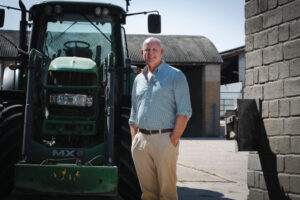
Eddie Rixon is well aware of the challenges facing farming at the moment. The last ten years have resulted in a complete change in the way that Lopemede Farm operates due to a series of compounding events. After the passing of his mother Ellen in 2014, Eddie returned to the business, which was breeding and selling polled Simmentals as well as rearing and selling sheep.
In 2017, the herd contracted TB, just a month after the sheep had been sold on. The farm suddenly found itself with a blank slate and Eddie, who took over management of the business the next year, had a choice to either carry on as before, or make significant changes.
“There were other factors at play,” he says. “We’d just voted to leave Europe and it was clear that farming was not going to get the same level of support again. There simply isn’t the money or motivation in government to provide the same level of financial support to farming.
“And we cannot rely on supermarkets because they are beholden to their shareholders. No retailer will fully commit to UK farming because that is a long-term commitment that could, year-to-year, clash with the needs of their shareholders.”
He compares it to what has happened previously in agriculture. The Rixon family has always tried to avoid the race to the bottom. It initially ran a suckler herd, with cattle slaughtered through its own abattoir and meat being sold through the family’s chain of butcher shops. When supermarkets started aggressively competing with butchers shops, leading to the closure of all but one of the family’s shops, the business shifted, investing in genetics and specialising in breeding Simmental bulls and heifers for sale, focusing specifically on homozygous polled breeding stock.
“My father wanted to create a system that would be immune, in-part, to the price setting of the supermarkets,” Eddie explains.
 Selling direct
Before the TB diagnosis, the business had already started to invest in ways to limit expenditure. In 2015, 60kW of solar panels were installed, with battery storage to provide a level of self-sufficiency. Eddie also had a biomass boiler fitted to provide heat to the whole farm.
He says that being faced with decisions about the future of the business forced him to look at every part and explore new opportunities for income. “We’re in a climate and biodiversity emergency, a mental health crisis. The UK is the most nature disconnected country in Europe, and we know that people who are better connected to nature are more likely to care for nature. Farmers managing 71% of the UK have a central role in helping at every stage, so I was keen to find ways to address this,” he adds.
He set out a 30-year plan, based on nature restoration and nature connection so the farm didn’t just survive for the next generation, it thrived. Instead of moving back into Simmentals, in 2019 he signed an agreement with Warrendale Wagyu because of the fixed price contracts. At any one time, there are between 100 and 200 head of cattle on the farm, brought in as weanlings. More recently, he added a small herd of 24 beef shorthorn cows with a view to increasing beef production.
When looking at the land available, 202ha split between two farms and some rented ground, Eddie pinpointed poorly performing patches and then used grant funding to establish 20ha of woodland. “There were clear benefits to doing this,” he says. “Not only are we paid for establishing and maintaining them, but we have established much needed shade and shelter for our livestock and via the Woodland Carbon Code, we have created woodland carbon units which could in the future be sold or used for in-setting.
“I think this is a huge opportunity for farmers in the UK, and something that will be in increasing demand as companies are forced to account for their own carbon costs. Look at housing for example. The housing demand is not going to decrease, and the construction firms will need to offset their own emissions somehow.”
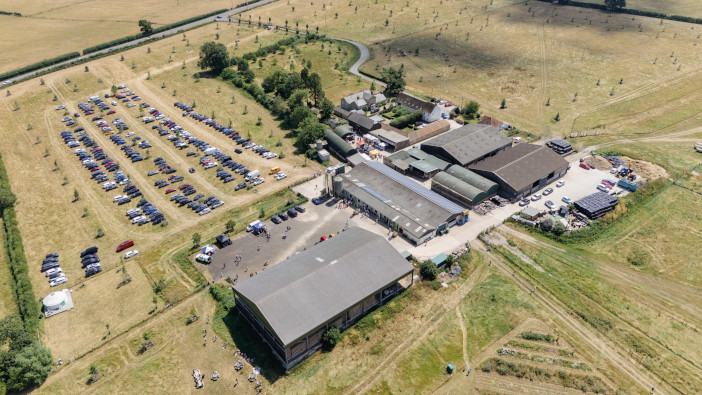
He also managed to secure funding to put in a permissible path, that snakes through some of the newly established woodland and up to the farmyard. Eddie says that this has two advantages. Firstly, it fits the aim of reconnecting with the local community, and secondly, it provides a flow of walkers through to the various businesses now operating on site.
The biggest of these is the Fallow & Fields Kitchen, which has a policy that the kitchen will not serve any ultra-processed food or drinks, and uses locally sourced and on-site produce – including the farm’s own beef. This is supplemented by a one acre market garden, one acre heritage wheat plot, 12ha of heritage fruit trees and honey from the farm’s hives and eggs. By the time this article is published, a farm shop will also have been opened.
“Having these on the farm mean that we can tell a story with our food,” Eddie says. “The cost of living crisis means that a lot of people can’t necessarily afford to pay more for their weekly shop, but the public is trying to maximise their leisure time, so coming to the farm, finding out how the food is made, and then being able to sample it adds a level of value.”
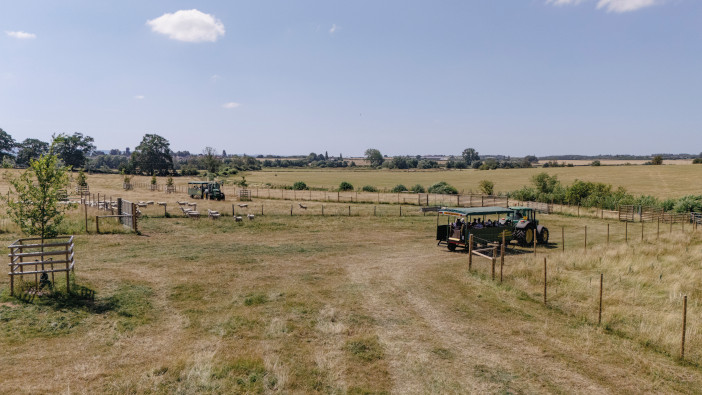
The story of the farm has been told through several events. Open Farm Sundays have proven to be hugely successful, with more than 4,000 people visiting Lopemede in 2025 and 2026. This year, the farm also established a blend of heritage wheats right next to the kitchen and invited people to see the field harvested so that they could follow the process from grain, to flour, to bread.
“We’re having the rest of the grain milled by a local firm and we’ll sell 1.5kg bags in the shop,” he says. “If this proves to be successful, we may look at growing more milling wheat in the future.”
Utilising every part
Land away from Lopemede has been used in a grazing agreement with a local sheep rearing enterprise, with 2,000 sheep grazed in blocks behind the cattle. Where the farm’s own cattle are grazed, additional trees have been planted to create wood pasture and more shade and shelter.
Other units on the farm have been rented out to small artisan businesses. This includes a theatre company that incorporates different areas of the site in its productions. Yoga and Pilates classes are held, a wild sauna and cold plunge are installed behind the cow sheds, and Eddie is looking at glamping and AirBnB opportunities for the future.
“We wanted to create a hub. A place where people could come for one thing, but find other ways to reconnect with food, farming and nature and perhaps escape the hustle and bustle,” he says.
One of the biggest projects is the Future Oaks programme. An educational, curriculum-linked farm visit that aims to teach children where food comes from and the importance of biodiversity and the natural environment. Eddie says that this will link to nearly every other part of the business, and has been funded through various foundations and partnerships, as well as investment from Lifestyle.
Combining private and public funding, as well as increasing profitability, will be key to the future of UK agriculture, Eddie believes, and he says that every farm has access to these opportunities.
“What is perhaps hardest for farmers to do is to shift their mindset; from ego-centric to eco-centric; where we see ourselves as part of nature not separate from it. We all tend to learn how to farm from our fathers, and it’s this unconscious programming that perpetuates ego-centric thinking. We have seen with the climate crisis this summer the urgent need to feel into farming with due regard to addressing the climate and bio-diversity crisis. We have been fortunate to monetise addressing these two crises’ by selling bio-diversity net gain credits, which has provided the finance to diversify on the farm, and provide much needed new income streams.
“Things are rapidly changing and I don’t think we can rely on retailers or Defra to provide the answers. Not everything here will work on every farm, but there are opportunities to sell direct and take control; opportunities to tap into carbon markets, BNG, SFI, Countryside Stewardship, and private investment. Farming accounts for 71% of the UK’s landscape so we are vital to solving all of the major issues that are threatening our species survival.”