


Farm Contractor & Large Scale Farmer
    Twitter LinkedIn
    • FREE Email Newsletters
    • About Us
    • Advertise
    • Subscribe
    • Contact Us
    Twitter LinkedIn
    Podcast
    Farm Contractor & Large Scale Farmer
    • News
      • Arable & Agronomy
      • Dealership News
      • Environmental Land Management Scheme/Policy
      • Event News
      • Health & Safety
      • Machinery
      • People
      • World News
    • Farm Machinery
      • Amenity & Maintenance
      • Cultivations
      • Drilling
      • Grassland Equipment
      • Harvesting
      • Muck & Slurry
      • Sprayers
      • Telehandlers
      • Tractors
      • Tractor of the Year
      • Tyres & Tracks
      • Whatever happened to?
    • Precision Farming
    • Markets & Policy
    • Profiles
      • National Arable and Grassland Awards
      • Company Profiles
      • Reader Profiles
    • Livestock
      • Beef
      • Dairy
      • Sheep
    • Magazines
      1. March 2026
      2. 2026 Tyre Developments supplement
      3. February 2026
      4. January 2026
      5. December 2025
      6. November 2025
      7. 2025 Agritechnica preview
      8. October 2025 issue
      9. September 2025 issue
      10. August 2025 issue
      11. 2025 Drills and Seeds supplement
      12. July 2025 issue
      13. June 2025 issue
      14. Cereals event guide 2025
      15. May 2025 issue
      16. April 2025 issue
      17. March 2025 issue
      18. 2025 Tyre Developments supplement
      19. February 2025 issue
      20. National Arable and Grassland Awards supplement
      21. January 2025 issue
      22. December 2024 issue
      23. November 2024 issue
      24. October 2024 issue
      25. September 2024 issue
      26. August 2024 Issue
      27. 2024 Drills and Seeds supplement
      28. July 2024 Issue
      29. Cereals Supplement
      30. June 2024 Issue
      31. May 2024 Issue
      32. April 2024 Issue
      33. Tyres and Tracks Supplement
      34. March 2024 Issue
      35. National Arable & Grassland Award – Meet the Finalists
      36. February 2024 Issue
      37. January 2024 Issue
      38. December 2023
      39. Agritechnica Preview Supplement
      40. November 2023
      41. October 2023
      Featured

      March 2026 issue available now

      By Matthew TiltMarch 2, 2026
      Recent

      March 2026 issue available now

      March 2, 2026

      2026 Tyre Developments supplement available now

      March 2, 2026

      February 2026 issue available now

      February 1, 2026
    • Events
    • Podcast
    Farm Contractor & Large Scale Farmer
    Arable & Livestock

    Syngenta advises on Amistar application

    Matthew TiltBy Matthew TiltMarch 9, 20224 Mins Read
    Facebook Twitter LinkedIn Email

    During a recent webinar, Syngenta provided growers with new advice on the in-furrow application of Amistar during potato planting. This is will achieve a more complete zone of protection around the mother tuber when using high-speed belt planters according to application specialist Harry Fordham.

    He noted that modern planters are capable of working at a far higher speed compared to traditional cup planters. “That could compromise the consistent incorporation of spray in the soil target zone around the mother tuber with the original sprayer set up on the planter, along with potentially resulting in the risk of drift at the higher speed,” he warned.

    As Amistar plays a key role in the control of both black dot and Rhizoctonia pathogens in the soil, Syngenta has spent three years trialling new nozzle technology, water volume and nozzle orientation.

    Harry Fordham mr
    Harry Fordham

    Mr Fordham pointed out that the original brass AZ in-furrow nozzle – which is no longer available – had a very small orifice that produced fine droplets susceptible to drift. Some of the alternatives trialled include hollow cone technology to give a wide band of application and cover more of the soil at speed, along with a larger orifice that is less prone to blockages and drift.

    Results showed that the Lechler TR80 performed consistently well over successive seasons, with a recommended setup of two nozzles – one at the front and a second at the rear of the planter shoe to spray the soil as it falls back in to cover the tuber.

    Research has shown that 100 litres per hectare produced the best results for both yield and tuber quality, compared to 50 litres, with the TR80 operated with a 015 nozzle in both situations.

    Another combination showed good promise from a year of trials, with two Lechler FT90 nozzles set up to deliver 33% of the spray at the front of the shoe using an 01 sized nozzle and 66% at the rear on the closing soil through an 02 nozzle.

    “The relatively large nozzle orifice would be unlikely to block. More interestingly it is a pre-orifice nozzle design, so offers some level of drift reduction and may be a combination to consider, especially with higher-speed planters,” Mr Fordham said.

    During Norfolk trials, undertaken in a field specifically selected for the high risk of soil bourne black dot, the use of Amistar reduced the incidence of severe infection on the harvested tubers. Results also showed improved disease control for silver scurf and greater marketable yield.
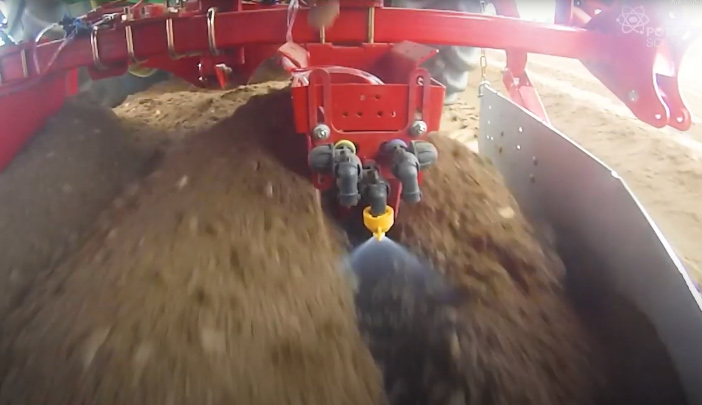
    • The TR80 nozzle set up
    • The FT90 nozzle set up

    Syngenta’s potato technical manager Michael Tait warned that research showed black dot was proving extremely persistent in soils, alongside indications that the pathogen is involved with the early die back complex that is being reported in crops.

    “Microsclerotia of black dot can typically persist in the soil for eight years or more, which means that once established it can usually survive from one potato crop to the next in the rotation,” he said. The pathogen is favoured by warm, wet conditions often associated with changing climate. 

    “We have seen very good results from Maxim seed tuber treatment, to prevent the transfer of seed-borne pathogen onto the daughter tubers. But with this disease now so prevalent in soils, growers and agronomists need to be looking at the combination of both Maxim and Amistar to manage its damaging effects,” he advised.  

    Mr Tait also suggested that a combination of seed and soil controls was effective in countering Rhizoctonia black scurf with Dutch trials showing that Amistar in-furrow and Maxim seed treatment each effectively halved the calculated Rhizoctonia index – a measure assessing both the severity and incidence of infection – from 16 in the untreated to 7.5 or 8 respectively. When the two products were used together, however, the index was further significantly reduced, to just 3.

    Tweet
    Share
    Share
    Pin
    Share. Facebook Twitter LinkedIn Email
    Previous ArticleFirst Milk confirms further milk price increases for April and May
    Next Article Alliance expands Agri Star II range
    Matthew Tilt
    • Twitter
    • LinkedIn

    Machinery editor for Farm Contractor & Large Scale Farmer. Matt has worked as an agricultural machinery journalist for five years, following time spent in his family’s Worcestershire contracting business. When he’s not driving or writing about the latest farm equipment, he can be found in his local cinema, or with his headphones in, reading a good book.

    Read Similar Stories

    Saving seed for greater flexibility

    July 16, 2025

    Opportunities for minor crops amid SFI doubt

    July 7, 2025

    Webinars to launch revised regenagri standards

    June 7, 2024
    Most Read Stories

    Emyr Evans restores classic Massey Ferguson as part of anniversary celebrations

    March 11, 2026

    Triplex aims for bespoke nutrition solutions

    March 11, 2026

    BC Machinery looks to import quality kit

    March 11, 2026
    Farm Contractor & Large Scale Farmer

    The UK's leading agricultural machinery journal

    Twitter LinkedIn
    © 2024 MA Agriculture Ltd, a Mark Allen Group company

    Privacy Policy | Cookies Policy | Terms & Conditions

    • Farmers Weekly
    • AA Farmer
    • Poultry News
    • Pig World

    Type above and press Enter to search. Press Esc to cancel.